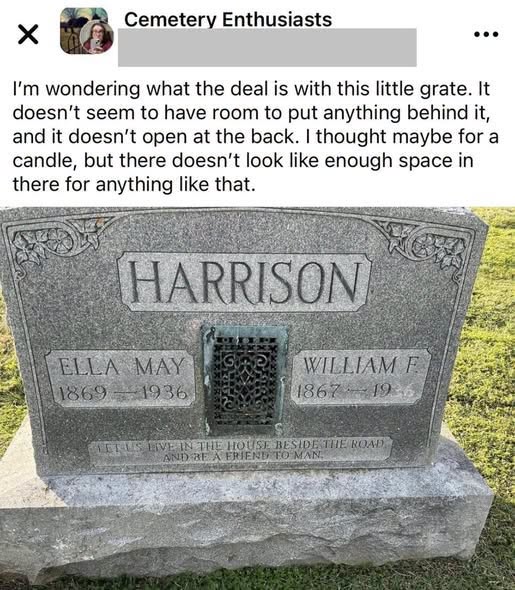
The Story Behind an Unusual Grave Design: A Cast-Iron Detail With a Connection to Home and Memory
Some of the most interesting historical clues are found in places where we might not expect them.
An unusual shape carved into a gravestone, a familiar household symbol incorporated into a memorial, or a small metal detail attached to an old monument can raise questions about the person being remembered and the world they lived in.
At first glance, a grave marker may appear to be nothing more than a stone bearing a name and a date. But memorials often contain additional details that reflect a person’s occupation, family, beliefs, interests, or everyday surroundings.
One particularly interesting example is a grave design incorporating a cast-iron floor grate or heating-related motif.
The object may seem like an ordinary household feature, but its presence in a memorial can invite us to think about the role that the home once played in people’s lives.
Why Would a Household Object Appear on a Grave?
Gravestones are not always limited to names, dates, and traditional decorative patterns.
Throughout history, families have chosen symbols that had personal meaning. A memorial might include flowers, tools, animals, religious symbols, musical instruments, books, or objects associated with a person’s profession or daily life.
A household feature can carry a similar meaning.
For someone whose life was closely connected with the home, family, craftsmanship, heating, construction, or domestic life, a familiar object could become a meaningful part of their memorial.
It can also represent something less literal.
A warm house, a familiar room, or the gathering of family members around a source of heat can symbolize comfort, belonging, and memories of home.
That interpretation, however, should be treated as a possibility rather than a definite explanation unless historical records identify the meaning of the specific monument.
Cast Iron Was an Important Material
To understand why cast-iron details appear in older buildings and objects, it helps to understand the importance of cast iron during earlier periods.
Cast iron could be produced in large quantities and shaped into intricate designs.
It was used for everything from architectural components and cookware to stoves, heating equipment, machinery, railings, and decorative elements.
During the nineteenth and early twentieth centuries, cast iron became particularly visible in domestic and commercial architecture.
A household could contain numerous objects made from the material.
Floor grates were one example.
What Were Old Floor Grates Used For?
In older buildings, metal grates could serve several different purposes.
Some were associated with heating systems, while others provided ventilation or allowed air to circulate between spaces.
In buildings using fireplaces, furnaces, coal-burning systems, or early forms of central heating, carefully designed vents could play an important role in distributing warm air.
A floor grate might therefore be a functional component rather than merely decoration.
The exact purpose depended on the building’s heating and ventilation system.
Some grates were positioned over openings connected to ducts or channels, allowing air to move between different parts of a building.
Others were associated with specific heating arrangements that were common in particular periods.
Why Were Grates Often Decorative?
Functional objects did not necessarily have to look plain.
During the Victorian era and other periods of elaborate architectural design, manufacturers produced cast-iron grates featuring geometric patterns, floral motifs, scrollwork, and other decorative elements.
These objects were designed to be both practical and visually appealing.
A homeowner could therefore have a functional heating or ventilation component that also contributed to the appearance of a room.
This combination of utility and decoration is one reason old homes can contain such distinctive details.
The Connection Between Heat and Home
Before modern heating systems became commonplace, keeping a home warm required considerable effort.
Depending on the period and location, families might rely on fireplaces, wood-burning stoves, coal furnaces, or other heating methods.
Heat was therefore more than a matter of comfort.
It was connected to daily routines.
Someone had to obtain fuel, prepare it, maintain the fire or heating equipment, and manage the temperature of the home.
For many families, the warmest part of the house could become a natural gathering place.
People cooked, talked, read, worked, and spent time together around sources of heat.
That history gives heating-related objects a deeper cultural meaning.
Could a Grave Symbol Represent Home?
It is possible for a memorial symbol to represent a person’s relationship with their home.
But interpreting historical symbolism requires caution.
A particular object may have a specific meaning that is documented in family records, or it may have been selected simply because the family liked its appearance.
Without additional evidence, it is difficult to know exactly what the person or family intended.
This is an important principle when examining old monuments.
A symbol can inspire a reasonable interpretation, but interpretation should not automatically be presented as established fact.
Gravestones Can Reveal Personal Details
Memorials can provide information that does not appear in ordinary historical records.
The wording on a gravestone can identify family relationships.
Dates can help establish a person’s lifespan.
Occupational symbols can provide clues about someone’s work.
Decorative choices can reveal cultural or religious traditions.
Even the material used for the monument can tell researchers something about local stoneworking and manufacturing practices.
When multiple clues are considered together, a grave can become a small historical record.
Memorial Design Has Changed Over Time
Gravestone styles have never been completely uniform.
Different periods favored different shapes, materials, inscriptions, and decorative elements.
In some eras, elaborate monuments were popular. In others, simpler designs became more common.
Families also made choices based on their financial circumstances, local traditions, religious practices, and personal preferences.
That is why unusual memorial designs can be especially interesting.
They may reflect a combination of broader artistic trends and highly personal decisions.
Why Everyday Objects Can Become Meaningful
One of the most interesting aspects of historical objects is that their importance often comes from ordinary life.
A cooking pot, chair, window, stove, floor grate, sewing machine, or workbench may seem unremarkable when viewed in isolation.
But these objects were part of people’s daily routines.
They were touched, repaired, cleaned, used, and passed down through generations.
A memorial that incorporates an everyday object can therefore remind us that a person’s life was not defined only by major public events.
Much of life happens at home.
The Meaning of Warmth in Memorials
Warmth has a natural symbolic association with comfort and family.
A warm room can represent security.
A fireplace can suggest gathering.
A stove can represent cooking and daily routines.
A heating grate can remind us of the physical environment in which a family lived.
For that reason, a heating-related object can potentially carry emotional significance when used in a memorial.
However, the precise meaning remains specific to the monument and the people who commissioned it.
Historical interpretation is strongest when it combines visual evidence with written documentation.
The Importance of Looking at the Whole Monument
It can be tempting to focus on one unusual detail and immediately assign it a meaning.
A better approach is to examine the entire memorial.
Consider:
- What does the inscription say?
- When was the monument created?
- What symbols appear elsewhere?
- Is the object functional or purely decorative?
- Is there a family connection to a particular occupation?
- What materials were commonly used in the region?
- Does the surrounding cemetery contain similar designs?
- Are there historical records explaining the monument?
These questions can help distinguish between a documented symbol and a modern interpretation.
Cast Iron and the History of Manufacturing
The presence of cast iron also connects a memorial to the history of manufacturing.
Producing cast-iron objects required furnaces capable of melting iron and molds capable of producing the desired shape.
Manufacturers could create standardized products while also producing elaborate custom designs.
This allowed cast iron to become common in homes, businesses, public buildings, transportation infrastructure, and industrial facilities.
The same manufacturing tradition that produced practical household components could also create decorative pieces.
That combination helped make cast iron an important part of architectural history.
Old Homes Preserve These Details
Many historical houses contain features that modern homeowners rarely encounter.
Radiators, decorative grilles, transoms, coal chutes, fireplaces, built-in cabinets, old ventilation systems, and specialized floor openings can all provide clues about how earlier buildings functioned.
These details are useful because they show how people solved everyday problems before modern technologies became widespread.
Heating a home, for example, required a very different approach before modern central heating and electronic controls.
Old architectural features allow us to see the physical evidence of those earlier systems.
Why Historical Details Deserve Careful Interpretation
A common mistake when discussing historical objects is assuming that every unusual feature has a dramatic secret behind it.
Often, the explanation is much simpler.
A strange-looking object may have been practical.
A decorative feature may have been fashionable.
A symbol may have been chosen for personal reasons.
And sometimes, the original meaning may simply be unknown.
Recognizing uncertainty does not make a historical object less interesting.
In fact, it can make the investigation more meaningful because it encourages us to look for evidence rather than relying entirely on assumptions.
The Value of Preserving Old Memorials
Historic graves and cemeteries are important cultural resources.
They preserve names, dates, family relationships, artistic traditions, and information about communities.
The physical condition of a monument can also tell us about the materials and techniques used when it was created.
Preserving such sites allows future generations to study them.
Even small decorative details can become valuable sources of information when examined alongside other evidence.
A Simple Object Can Connect Two Worlds
Perhaps the most interesting aspect of an unusual grave design is the connection it creates between two very different parts of life.
A cast-iron heating grate belongs to the world of everyday domestic life.
A gravestone belongs to the world of remembrance.
When a household-related object appears in a memorial, the distinction between those worlds becomes less clear.
The object can remind us that the people being remembered once lived ordinary lives filled with familiar places, routines, objects, and relationships.
Their homes were not simply buildings.
They were places where memories were created.
What the Design May Tell Us
Without historical documentation, it would be inappropriate to claim exactly why a particular family selected an unusual cast-iron detail for a memorial.
But the design can still raise useful questions.
It may reflect an occupation, a family connection, a personal interest, an architectural tradition, or simply a preference for a particular style.
It may also have been inspired by something meaningful about the person’s home.
The most responsible interpretation is therefore one that distinguishes what can be observed from what can be inferred.
History Is Often Hidden in Ordinary Things
Historical research does not always begin with famous documents or spectacular discoveries.
Sometimes it begins with something as simple as a piece of iron.
A floor grate can lead us to the history of home heating.
A heating system can lead us to the history of architecture.
A memorial can lead us to questions about family, symbolism, and remembrance.
And those questions can eventually reveal something about the everyday experiences of people who lived generations before us.
That is one of the reasons historical artifacts are so valuable.
They allow us to approach the past through objects that people actually used, touched, built, and preserved.
A Lasting Reminder of Home
An unusual memorial design can invite us to think about what people choose to remember.
Names and dates tell us when someone lived.
Symbols can sometimes suggest what mattered to them.
And familiar household objects can remind us that much of a person’s story is rooted in everyday life.
Whether a cast-iron detail was chosen because of a specific family connection or simply because it fit the desired design, its presence adds another layer to the monument.
It reminds us that remembrance does not always have to be expressed through grand symbols.
Sometimes, an ordinary object associated with warmth, shelter, work, or home can become a meaningful part of a lasting memorial.
And that may be the most interesting lesson these historical details offer: the objects that seem ordinary today can become some of the most personal clues to the lives of people who came before us.