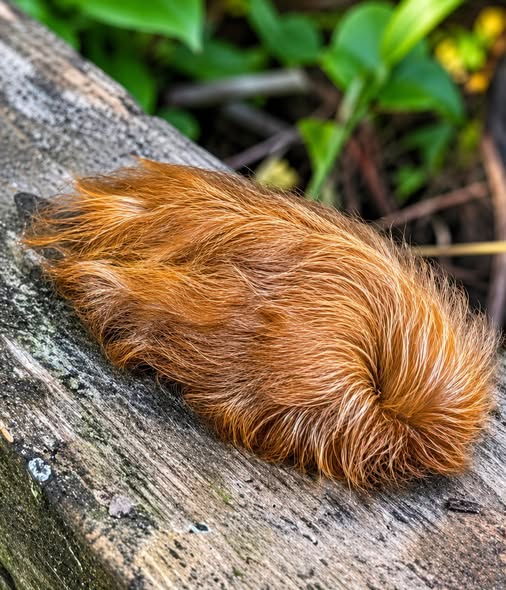
Is That Fuzzy Caterpillar Harmless? What to Know Before Touching One
A fuzzy caterpillar crawling across a leaf can be one of the more interesting sights in a garden.
Some look soft enough to touch, almost like tiny pieces of fur moving slowly across a plant. Their unusual shapes and colors can make them especially appealing to children and curious gardeners.
But appearances can be misleading.
While many hairy or fuzzy caterpillars are harmless to people, some species have hairs or spines that can cause skin irritation. In a few cases, contact can result in a more noticeable reaction.
The challenge is that you cannot reliably determine whether a caterpillar is safe to touch simply by looking at how soft or harmless it appears.
That is why the best approach is to observe unfamiliar caterpillars without handling them.
Why Are Some Caterpillars Fuzzy?
Caterpillars have evolved a remarkable variety of appearances.
Some are smooth and brightly colored. Others are covered with short hairs, longer bristles, tufts, or structures that resemble fur.
These features can serve several purposes.
For some species, hairs help make the caterpillar less appealing to predators. A predator that tries to eat an uncomfortable or irritating caterpillar may learn to avoid similar-looking prey.
Other caterpillars use their appearance as camouflage.
A fuzzy body can help an insect blend into bark, leaves, moss, or other natural surroundings.
The fact that a caterpillar looks soft does not necessarily mean that it is designed to be touched.
Hairy Does Not Always Mean Dangerous
It is important not to assume that every fuzzy caterpillar is harmful.
Many species are simply covered in harmless hairs.
The problem is that there are also species with irritating hairs or specialized structures that can cause discomfort when touched.
This means that general rules based only on appearance are unreliable.
A brown, black, white, or brightly colored caterpillar may be harmless, irritating, or difficult to identify without knowing the species and location.
For that reason, it is better to treat an unfamiliar fuzzy caterpillar as something to observe rather than something to handle.
What Can Happen If You Touch an Irritating Caterpillar?
Some caterpillars have tiny structures that can irritate human skin.
Depending on the species and the person’s sensitivity, contact may cause symptoms such as:
- Itching
- Redness
- A stinging sensation
- Burning or irritation
- Small bumps or a rash
- Localized swelling
The reaction can vary considerably from person to person.
Some people may experience only mild irritation, while others may react more strongly.
The severity also depends on the species involved and the type of contact.
Why Caterpillar Hairs Can Be Irritating
Not all caterpillar hairs function in exactly the same way.
Some are simply body hairs that provide protection or camouflage.
Others may be associated with specialized structures capable of causing irritation.
In certain species, tiny irritating hairs can become detached and remain on the skin after contact.
This can make the reaction feel more intense than expected from such a small insect.
It is one reason why picking up an unfamiliar hairy caterpillar is generally unnecessary.
What Should You Do If You Accidentally Touch One?
If you accidentally come into contact with a caterpillar and develop irritation, avoid rubbing the affected area.
Rubbing can potentially push irritating material deeper into the skin or spread it to other areas.
Instead, gently remove anything visible from the skin and wash the area with soap and water.
If symptoms are significant, persistent, or worsening, seek medical advice.
If the person develops signs of a serious allergic reaction, such as difficulty breathing, swelling of the face or throat, dizziness, or widespread symptoms, seek emergency medical care immediately.
The important point is that most minor contact reactions can be managed appropriately, but unusual or severe symptoms should not be ignored.
What About Caterpillars That Look Like Little Tufts of Fur?
Some fuzzy caterpillars are particularly difficult to identify because their bodies are almost completely hidden beneath hairs.
They can resemble:
- Small pieces of wool
- Tufts of fur
- Tiny brushes
- Cotton-like material
- Leaves covered in fibers
- Small furry animals
This appearance is one reason people may be tempted to pick them up.
But visual resemblance does not tell you whether the insect is safe.
If you are unsure what species you are looking at, taking a photograph from a safe distance is a better option than touching it.
Identification Depends on Location
Caterpillar species vary greatly from one region to another.
A caterpillar commonly seen in one country may be completely unfamiliar somewhere else.
Climate, vegetation, season, and local ecosystems all influence which species are present.
Therefore, a description such as “fuzzy black caterpillar” is usually not enough to make a reliable identification.
For accurate identification, useful information can include:
- Geographic location
- Time of year
- Host plant
- Body color
- Hair pattern
- Presence of spines or tufts
- Body shape
- Size
- Photographs from multiple angles
A local extension service, natural history organization, entomologist, or reliable insect-identification resource may be able to help.
Don’t Rely on Color Alone
Bright colors can sometimes be associated with warning signals in nature, but color is not a reliable safety test.
Some harmless caterpillars are brightly colored.
Some potentially irritating species may be relatively dull.
The same general appearance can occur in unrelated species.
Therefore, it is better to consider the entire appearance and, when necessary, obtain a proper identification.
Even experienced observers can sometimes confuse similar species.
Are All Caterpillar Hairs Dangerous?
No.
This is an important distinction.
The word “hairy” does not automatically mean “harmful.”
Caterpillars have many different types of body coverings, and most are not a threat to humans.
The concern is that a person who cannot identify the species may not know whether the hairs are simply protective structures or something capable of causing irritation.
That uncertainty is easy to avoid.
There is rarely a good reason to handle an unfamiliar caterpillar.
What About Children?
Children are naturally curious about insects.
A colorful or fuzzy caterpillar can be especially tempting to touch because it may look like a tiny toy.
Parents and caregivers can teach children a simple rule:
Look, but don’t touch unfamiliar insects.
This does not mean children need to be afraid of caterpillars.
Instead, they can observe them, photograph them, watch them move, or learn what plants they are feeding on.
Teaching children to respect unfamiliar wildlife is useful beyond caterpillars. The same habit can apply to spiders, beetles, wasps, mushrooms, plants, and other things they encounter outdoors.
What Should Gardeners Do?
Gardeners regularly encounter caterpillars because gardens provide food and shelter for many insects.
Most caterpillars are simply part of the local ecosystem.
Some feed on leaves and may become noticeable when their numbers increase.
Others may eventually develop into moths or butterflies that play important roles in the environment.
If you encounter an unfamiliar fuzzy caterpillar in your garden, there is generally no need to handle it.
If you are concerned about damage to plants, identify the species first.
This can prevent unnecessary treatment and help determine whether the caterpillar is actually causing significant harm.
Caterpillars Are Important to the Ecosystem
It is easy to think of caterpillars only as insects that eat leaves.
But they have an important role in many ecosystems.
Caterpillars provide food for birds, insects, reptiles, and other animals.
They also form an important stage in the life cycle of moths and butterflies.
A garden with caterpillars may therefore be supporting a much larger food web.
This is one reason identification is useful.
A caterpillar that looks unfamiliar is not necessarily a pest that needs to be removed.
From Caterpillar to Moth or Butterfly
The fuzzy insect you find on a plant is only one stage in its life cycle.
Caterpillars are the larval stage of moths and butterflies.
After feeding and growing, they eventually enter a pupal stage