Why Are Some Electrical Outlets Installed Upside Down? The Real Reason Behind the Different Orientation
Have you ever walked into a house, hotel, office, or older building and noticed that one electrical outlet looks different from the others?
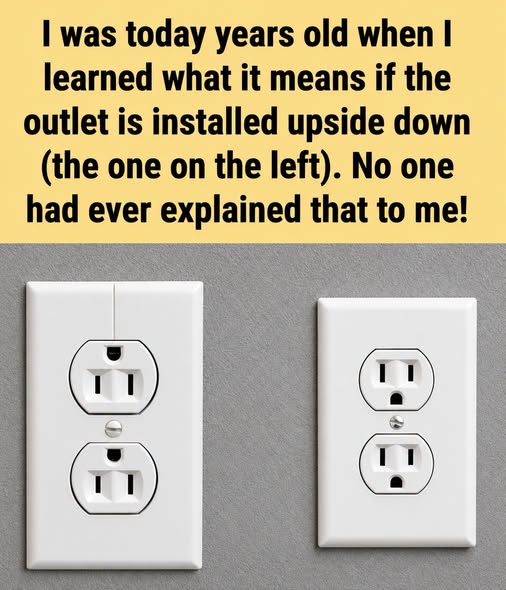
Instead of the familiar grounding opening appearing below the two vertical slots, the ground opening is at the top.
At first glance, it can look like someone simply installed the receptacle incorrectly.
After all, if every other outlet in the room has the ground opening facing downward, why would one be mounted in the opposite direction?
The surprising answer is that an upside-down-looking outlet isn’t necessarily an installation mistake.
In many situations, the orientation of a receptacle is intentional.
There are several reasons an electrician, builder, or property owner might choose to install an electrical outlet with the grounding opening facing upward. In some cases, the orientation can even provide useful information about how the receptacle is being used.
However, there is an important point to understand from the beginning:
There isn’t one universal rule in the United States requiring every standard wall receptacle to face one particular direction.
Electrical installation requirements depend on the applicable electrical code, local regulations, the type of receptacle, and the circumstances of the installation.
So why do people sometimes install them differently?
The answer involves electrical safety, plugs, cords, equipment, and practical installation choices.
What Does “Upside Down” Actually Mean?
A standard North American duplex receptacle generally has two outlets.
Each one has:
- A narrow slot for the hot conductor
- A wider slot for the neutral conductor
- A grounding opening
When the grounding opening is positioned below the other openings, many people consider the receptacle to be in the traditional orientation.
When the grounding opening is positioned above them, the receptacle appears to be upside down.
But electrically, the receptacle doesn’t become “backward” simply because it has been rotated.
The electrical function of the receptacle is not determined by whether the ground opening is physically above or below the other openings.
The important electrical connections are still the same.
That’s why an electrician can install a receptacle in either orientation in situations where the applicable code permits it.
The unusual appearance may therefore have more to do with practical considerations than with an electrical mistake.
Why Do People Assume the Ground Should Always Be Down?
Part of the confusion comes from familiarity.
Most people grew up seeing wall outlets installed with the grounding opening below the two power slots.
Because that arrangement is so common, it becomes easy to assume that it must be the only correct orientation.
But common practice and a mandatory electrical requirement aren’t necessarily the same thing.
A convention can become widespread simply because builders and electricians tend to follow the same pattern.
Once a particular orientation becomes normal, anything different can look incorrect even when it isn’t.
This is similar to many other construction details.
You may find light switches at different heights, doors that open in different directions, or plumbing fixtures arranged differently depending on the building.
The difference doesn’t automatically indicate an error.
One Practical Reason: The Plug and Cord
One of the most commonly discussed reasons for installing a receptacle with the ground opening on top involves the shape of certain plugs.
Consider a heavy appliance cord.
The plug is inserted into the receptacle, and the cord hangs downward.
If the plug is large or heavy, gravity places some force on the connection.
Now imagine a situation in which the plug isn’t fully inserted or is placed under unusual stress.
The position of the receptacle and the shape of the plug can affect how the connection behaves.
In some installations, an electrician may choose an orientation that works better with the equipment being connected.
The goal isn’t necessarily to make the outlet look unusual.
It may simply be about making the installation work better for its intended purpose.
The Grounding Contact Is Important
To understand why orientation sometimes matters, it helps to understand what the grounding contact does.
The grounding connection provides a path intended to help protect people from electric shock under certain fault conditions.
Modern electrical systems use grounding as part of a broader safety design.
If a fault causes an energized part of equipment to come into contact with a conductive metal surface, the grounding system can provide a low-resistance path for fault current.
That can help protective devices operate and disconnect power.
The grounding connection is therefore a critical part of the receptacle.
But its physical position—above or below the other openings—doesn’t fundamentally change the purpose of the grounding conductor.
This is why the phrase “upside down” can be misleading.
The receptacle may look upside down from a visual perspective while remaining electrically functional.
Why Orientation Can Matter With Heavy Plugs
One explanation often given by electricians is related to what happens if a plug becomes partially dislodged.
Imagine a plug with a heavy transformer or power adapter attached to it.
If the receptacle is installed with the ground opening on top, the grounding prong may remain positioned differently relative to the other prongs as the plug moves.
The exact behavior depends on the plug design.
This is one reason receptacle orientation can become more than a cosmetic choice.
However, it’s important not to overstate the benefit.
Simply rotating an ordinary receptacle does not transform it into a safer device.
Proper installation, secure connections, correct grounding, suitable wiring, and appropriate protective devices remain much more important.
Why You May See Different Orientations in the Same Room
If you’ve noticed one outlet facing upward while the others face downward, there could be several explanations.
Perhaps that receptacle was replaced at a later date.
Perhaps a different electrician installed it.
Maybe the outlet serves a particular piece of equipment.
It could also simply reflect the installer’s preferred orientation.
In an older home, different generations of electrical work may exist side by side.
One section of the house could have been wired decades ago, while another section was renovated much more recently.
As a result, the outlets may not all look identical.
That doesn’t necessarily mean something is wrong.
Renovations Can Explain the Difference
Home renovations are another common reason for inconsistent receptacle orientation.
Imagine a kitchen that was originally built in the 1980s.
Years later, the homeowner remodels it.
Several receptacles are replaced or relocated.
The electrician working on the renovation may use a different installation convention from the person who originally wired the room.
The result can be a mixture of orientations.
One outlet may have the ground opening facing upward.
Another may have it facing downward.
A third may be a GFCI receptacle with a completely different appearance.
To someone looking at the finished wall, the differences may seem mysterious.
In reality, they’re often simply evidence of the building’s history.
Does an Upside-Down Outlet Mean It Was Installed Incorrectly?
Not necessarily.
This is probably the most important takeaway.
Orientation alone isn’t enough to determine whether a receptacle was installed correctly.
A receptacle can look unusual while still being properly connected.
Conversely, a receptacle can look completely normal while having an electrical problem.
For example, an improperly wired receptacle could have other issues that aren’t visible from the front.
Electrical safety depends on much more than appearance.
If you’re concerned about an outlet, a qualified electrician can inspect the installation and determine whether it complies with the applicable requirements.
What About the National Electrical Code?
The National Electrical Code, commonly known as the NEC, establishes many requirements for electrical installations in the United States.
However, the NEC is not simply a rulebook saying that every receptacle must be installed with the grounding opening pointing in one particular direction.
The requirements governing receptacles involve numerous issues, including placement, protection, grounding, wiring methods, accessibility, and specialized locations.
Local jurisdictions may adopt particular editions of the NEC and can also have additional requirements.
That’s why it’s important to avoid claims such as “all outlets must face this way” unless the statement is tied to a specific code requirement and jurisdiction.
Electrical rules can be more nuanced than they appear.
Why Some Electricians Prefer the Ground Up
Some electricians deliberately install receptacles with the ground opening facing upward.
Their reasoning may be based on practical experience.
One consideration is the behavior of certain plugs if they become partially pulled from the receptacle.
Another is the placement of cords and equipment.
In commercial or industrial settings, where equipment may be heavier or cords may experience more physical stress, the orientation can sometimes be selected for practical reasons.
There may also be workplace standards or installation preferences that influence the decision.
So if you encounter a row of receptacles with the ground opening at the top, it doesn’t necessarily mean an electrician made a mistake.
It may have been deliberate.
Why Other Electricians Prefer the Ground Down
The opposite orientation is also extremely common.
Many electricians install receptacles with the grounding opening at the bottom because that’s the convention they were taught or have used throughout their careers.
It can also create a consistent appearance across a home.
When every receptacle faces the same direction, homeowners may find the installation more visually pleasing.
Consistency can be useful too.
If every outlet in a building follows the same orientation, it becomes easier to identify whether a particular receptacle has been replaced.
Neither preference should automatically be interpreted as evidence of poor workmanship.
Could an Upside-Down Outlet Be Intentional in a Commercial Building?
Yes.
Commercial buildings often contain specialized electrical installations.
Offices, workshops, laboratories, hospitals, retail spaces, and industrial facilities may have different requirements from ordinary residential rooms.
Some receptacles may serve dedicated equipment.
Others may be connected to special circuits or protective devices.
An unusual orientation can therefore be part of a deliberate installation strategy.
If you’ve ever noticed different-colored receptacles in a commercial building, you may already have seen evidence that not every outlet is intended for exactly the same purpose.
For example, certain receptacle colors can be used as identification in particular facilities.
Orientation may be another visual characteristic chosen during installation.
What About GFCI Outlets?
GFCI stands for Ground-Fault Circuit-Interrupter.
These devices are designed to provide additional protection against certain electrical shock hazards by monitoring current and disconnecting power when an imbalance is detected.
GFCI protection is required in various locations under applicable electrical codes.
You may recognize a GFCI receptacle by its TEST and RESET buttons.
These outlets are often found in areas such as kitchens, bathrooms, garages, outdoor locations, and other places where electrical safety requirements are more demanding.
A GFCI receptacle can be installed in different physical orientations where permitted.
Again, the direction of the receptacle doesn’t change the basic function of the GFCI.
What matters is that the device is correctly installed and functioning properly.
What If the Outlet Feels Loose?
This is much more important than whether the outlet is upside down.
If a receptacle moves noticeably when you insert or remove a plug, it may need attention.
A loose receptacle can indicate that the device isn’t securely fastened to the electrical box.
If the receptacle is loose, don’t repeatedly force plugs into it or attempt to repair electrical wiring if you aren’t qualified.
A licensed or qualified electrician can inspect it and make the appropriate repair.
Electrical problems aren’t something to experiment with.
What If the Outlet Is Warm?
A warm electrical receptacle deserves attention.
An outlet should not become unusually hot during ordinary use.
Heat can be associated with overloaded circuits, loose connections, damaged receptacles, or other electrical problems.
If you notice:
- Burning smells
- Discoloration
- Scorch marks
- Crackling sounds
- Sparks
- Unusual heat
- Repeated tripping of circuit breakers
stop using the receptacle and have it inspected by a qualified professional.
These symptoms are far more significant from a safety standpoint than whether the grounding opening points upward or downward.
What If the Outlet Sparks?
A tiny spark can sometimes occur when certain appliances are plugged in or unplugged, particularly depending on the device and electrical load.
But repeated, large, or unusual sparking isn’t something to ignore.
If a receptacle produces significant sparks, smoke, burning odors, or visible damage, stop using it.
Don’t cover the outlet and continue plugging appliances into it.
Electrical faults can become serious quickly.
A qualified electrician should determine the cause.
Why Outlet Appearance Can Be Misleading
The front of a receptacle tells you surprisingly little about what is happening behind the wall.
Two outlets can look identical while being connected to different circuits.
One might have GFCI protection.
Another might be on a dedicated circuit.
One might be correctly wired.
Another could have a hidden fault.
Likewise, two outlets can face in opposite directions while both are correctly installed.
This is why visual assumptions about electrical systems can be unreliable.
Is Ground-Up Actually Safer?
This question comes up frequently.
The honest answer is that the orientation alone doesn’t make a standard receptacle universally safe or unsafe.
There are situations in which ground-up orientation can offer a practical advantage with certain plug designs, particularly when considering what happens if a plug becomes partially disconnected.
But that doesn’t mean every outlet in every building should immediately be rotated.
Electrical safety depends on the complete installation.
The receptacle must be appropriate for the circuit.
The conductors must be properly connected.
The grounding system must be correctly installed.
Protective devices must be suitable.
The electrical box and cover must be properly installed.
And the installation must comply with applicable requirements.
Changing the physical orientation doesn’t replace those fundamentals.
Why You Shouldn’t Rotate an Outlet Yourself
At first glance, rotating an outlet seems easy.
Remove the cover.
Unscrew the receptacle.
Turn it around.
Put everything back.
But electrical work can involve hazards that aren’t obvious.
Even when a breaker has been switched off, the person performing the work needs to know that the circuit is actually de-energized.
There can also be multiple circuits in the same electrical box.
Improperly reconnecting wires can create serious hazards.
For that reason, homeowners who aren’t trained or qualified to perform electrical work should not treat outlet orientation as a simple DIY project.
If you want an outlet rotated or replaced, consider having a qualified electrician handle it.
What Does the Orientation Tell You?
Sometimes, the direction of an outlet can provide a small clue about the installation.
For example, if all the receptacles in a room have the ground opening down except one, that one may have been installed for a particular reason.
Perhaps it powers specialized equipment.
Perhaps it was replaced during a renovation.
Perhaps the installer simply preferred the opposite orientation.
But orientation alone doesn’t tell you which explanation is correct.
You would need to know the history and purpose of the installation.
Why Hotels Sometimes Have Different Outlets
Hotels can contain a mixture of old and new electrical equipment.
Rooms may have been renovated at different times.
Some receptacles may be connected to specific equipment.
Others may be added during upgrades.
As a result, travelers may notice outlets facing different directions.
The same thing can happen in apartment buildings and office complexes.
Different contractors may have worked on different portions of the building over time.
What appears inconsistent may simply reflect decades of maintenance and renovation.
Older Homes Often Have More Variations
If you live in an older house, don’t be surprised to find electrical components that don’t match.
You might see:
- Different receptacle styles
- Different cover plates
- Grounded and older ungrounded receptacles
- GFCI devices
- Receptacles facing different directions
- Outlets installed at different heights
- Evidence of previous renovations
Some differences are harmless.
Others can indicate outdated or unsafe electrical work.
The key is knowing the difference.
If an older home has questionable wiring, a professional electrical inspection can provide much more useful information than simply examining outlet orientation.
What Does the Ground Opening Actually Do?
The third opening on a standard grounded receptacle is designed for the equipment grounding connection.
The grounding system is intended to provide a path for fault current and help protective devices operate under certain fault conditions.
The grounding contact is therefore not merely an extra feature.
It is part of the electrical safety system.
This is also why removing the grounding prong from a plug just to make it fit an older receptacle is not a good solution.
The grounding connection exists for a reason.
If a plug doesn’t fit a receptacle, use the correct equipment or have the electrical installation evaluated rather than defeating the grounding system.
Why You Shouldn’t Use Adapters Carelessly
Traveling through older buildings can sometimes lead people to use plug adapters.
Adapters can have legitimate uses when properly designed and used in suitable circumstances.
But an adapter shouldn’t be treated as a way to bypass a missing or defective grounding system.
If an appliance has a grounding-type plug, the grounding connection should be maintained appropriately.
When you’re uncertain, consult an electrician.
What About Three-Prong Plugs?
Three-prong plugs are designed to connect to grounded receptacles.
The third prong provides the equipment grounding connection.
Whether the ground opening is above or below the other two openings doesn’t change the fact that the plug is designed to connect to that grounding contact.
This is another reason the term “upside down” can create unnecessary confusion.
The receptacle hasn’t stopped performing its function because it was rotated.
What About Two-Prong Plugs?
Two-prong plugs don’t have an equipment grounding prong.
They can be used with suitable receptacles designed for them.
Again, the physical orientation of the receptacle doesn’t change the basic electrical function.
However, the type of plug and receptacle should always be appropriate for the appliance and electrical system.
Don’t modify plugs or receptacles to force incompatible equipment to work.
The Orientation Debate Is Often About Practicality
Walk into a room with twenty outlets installed ground-down and you’ll probably never think about them.
Walk into a room where ten are ground-up and ten are ground-down, and suddenly the difference becomes obvious.
That’s because orientation is largely a visual convention.
Electricians may have practical reasons for choosing one arrangement over another.
Homeowners may prefer consistency.
Building owners may have established standards.
Maintenance personnel may replace devices without changing the surrounding installation.
There isn’t necessarily one mysterious explanation behind every upside-down outlet.
Sometimes the simplest explanation is that someone installed it that way intentionally.
Should You Change All Your Outlets?
Probably not simply because you’ve discovered that they face a different direction.
If the outlets are properly installed, secure, undamaged, and functioning normally, orientation by itself isn’t generally a reason to start replacing them.
If you’re renovating or already replacing receptacles, you can discuss orientation with the electrician performing the work.
They can tell you whether a particular orientation makes sense for the location and applicable requirements.
When You Should Call an Electrician
The direction of the outlet isn’t usually the biggest concern.
Instead, pay attention to signs that something may actually be wrong.
Contact a qualified electrician if you notice:
- A receptacle that is loose
- Burn marks
- Melting plastic
- A burning smell
- Repeated electrical arcing
- Crackling or buzzing
- Unusual heat
- A plug that repeatedly falls out
- Circuit breakers that trip frequently
- A receptacle that doesn’t appear to work correctly
- Evidence of damaged wiring
These symptoms deserve more attention than whether the grounding opening is on top or bottom.
The Simple Explanation
So why are some wall outlets installed “upside down”?
There isn’t one single answer.
In many cases, the orientation is simply an installation preference.
In other cases, the position may have been chosen because of the equipment being connected, the design of a particular installation, workplace practices, or the electrician’s judgment.
An outlet with the grounding opening facing upward is not automatically defective.
Likewise, an outlet with the grounding opening facing downward isn’t automatically safer simply because it looks familiar.
The electrical safety of a receptacle depends on the complete installation, not just its orientation.
The Bottom Line
The next time you see a wall outlet with the grounding opening on top, you don’t necessarily need to assume someone made a mistake.
It may have been intentionally installed that way.
Electrical receptacles can be oriented differently for practical reasons, installation preferences, equipment considerations, or simply because different electricians worked on different parts of a building.
The important thing is not whether the outlet looks “normal.”
What matters is whether it is properly installed, correctly grounded, securely mounted, suitable for the circuit, and compliant with the electrical requirements that apply in that location.
If the receptacle is loose, damaged, discolored, unusually hot, sparking, or producing a burning odor, that’s a different matter and should be evaluated by a qualified electrician.
But if the only unusual thing about the outlet is that the grounding opening points upward?
It may simply be a different orientation—not an electrical mistake.
And that small detail is a good reminder that many things we assume are “wrong” simply because they look unfamiliar can have perfectly practical explanations.