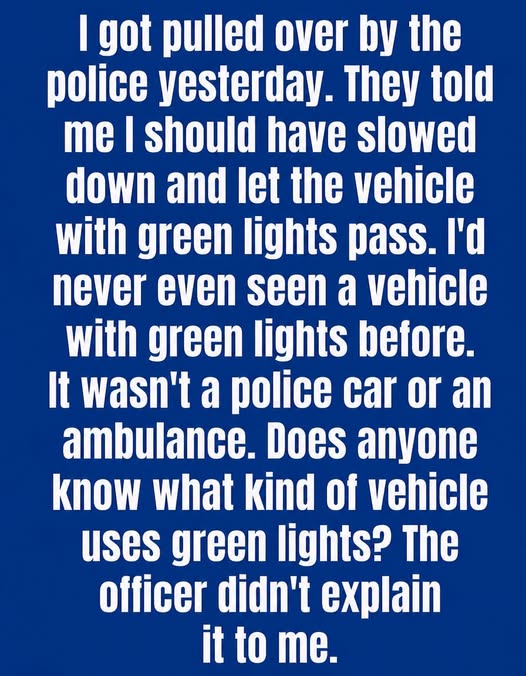
What Do Green Lights on Cars Mean? The Meaning Behind This Unusual Road Signal
Most drivers are familiar with the bright red and blue lights associated with emergency vehicles.
A police car appears in the rearview mirror with flashing lights, and drivers generally know that they need to pay attention. A fire engine or ambulance approaches with its warning system activated, and motorists understand that an emergency may be underway.
But every once in a while, drivers notice something that looks completely different.
A vehicle is displaying a green flashing or rotating light.
For someone who has never encountered one before, the sight can be confusing.
Is it a police vehicle?
Is it an ambulance?
Is the driver responding to an emergency?
Does the green light mean you are legally required to pull over?
The answer isn’t as simple as many social-media posts suggest.
Green warning lights can have several different purposes, and their meaning can vary significantly depending on the state, agency, and type of vehicle involved.
In the United States, green warning lights are commonly associated with fire service or emergency-management operations. They can be used to identify an incident command post, and some jurisdictions also permit certain volunteer firefighters, EMS personnel, or other authorized responders to use green lights on privately owned vehicles.
That means seeing a green light doesn’t automatically tell you exactly who is behind the wheel.
It does, however, tell you something important:
You should pay attention.
Here’s what drivers should know about green lights on vehicles, why they are used, and how to respond safely.
Green Doesn’t Have One Universal Meaning
One of the biggest misconceptions about emergency vehicle lighting is that every color has exactly the same meaning everywhere.
That’s not how vehicle lighting regulations work.
Different states have different laws governing warning lights, including which colors can be displayed, who can use them, where they can be mounted, and whether other drivers are required to yield.
The National Institute of Justice explains that emergency vehicles in the United States use several warning-light colors, including red, blue, amber, white, and green. Green is generally associated with fire service or emergency-management applications and is commonly used to identify an incident command post.
The U.S. Fire Administration similarly notes that green lights are typically associated with fire service or emergency management and can also be permitted for certain volunteer firefighter or EMS vehicles in some states.
So if you see a green light, it’s better to think of it as a special-purpose warning or identification signal rather than assuming it always means one particular type of emergency responder.
One Common Use: Incident Command Posts
One of the most important uses of green lights is at emergency scenes.
Imagine a major traffic collision, structure fire, hazardous-material incident, or other complicated emergency.
Several emergency vehicles may arrive.
Fire engines may be positioned around the scene.
Ambulances may be nearby.
Police vehicles may be controlling traffic.
Additional emergency personnel may arrive from different agencies.
In a large incident, responders need to know where the person coordinating the operation is located.
That’s where the incident command post comes in.
A green light can be used to identify the vehicle or location serving as the Incident Command Post, allowing responders to locate the command function more easily.
The U.S. Fire Administration explains that this use has historical roots in the Incident Command System, where a green flag was used to identify the command post.
So if you see a green light near a large emergency scene, it may not mean that the vehicle itself is racing toward an emergency.
It may be marking the place where the incident is being coordinated.
That’s an important distinction.
Green Lights on Personal Vehicles
Another reason drivers may encounter a green light on an ordinary-looking car or truck is that some jurisdictions permit certain emergency volunteers to use warning lights on their personal vehicles.
Volunteer emergency responders often live in the communities they serve.
They may be firefighters, emergency medical personnel, or members of other response organizations.
When an emergency call comes in, they may need to travel from home, work, or another location to a fire station or emergency scene.
Because they aren’t necessarily driving an official fire truck or ambulance, some jurisdictions have systems that allow authorized responders to display specific warning lights on their privately owned vehicles.
However, the color and legal status of those lights vary considerably.
The U.S. Fire Administration specifically notes that green lights may be used on privately owned vehicles belonging to volunteer firefighters or EMS personnel in some states.
This is one reason a green light can occasionally appear on a vehicle that looks completely ordinary.
The driver may not be operating a traditional emergency vehicle at all.
Why Would a Volunteer Need a Light?
Consider a volunteer firefighter who receives a call while at home.
The local fire department needs additional personnel.
The volunteer gets into their personal vehicle and heads toward the station.
Other motorists have no obvious way of knowing that the driver is responding to an emergency-related assignment.
A permitted warning light can help identify the vehicle.
It can make the vehicle more noticeable, particularly at night or in heavy traffic.
But the exact rules differ by jurisdiction.
Some places treat certain volunteer warning lights as courtesy signals rather than giving them the same legal authority associated with official emergency vehicles.
Other states may provide different rights or restrictions.
Therefore, drivers should never assume that a green light automatically gives the driver permission to ignore traffic laws.
Does a Green Light Mean You Must Pull Over?
This is one of the most important questions.
The answer depends on the law where you are driving.
A green light on a privately owned vehicle does not automatically have the same legal meaning as the red and blue warning lights on an official emergency vehicle.
In some jurisdictions, a green light may serve primarily as a courtesy signal requesting that other motorists provide an opportunity for the responder to pass.
In others, the legal treatment can be different.
That means drivers shouldn’t rely on a universal rule such as “green means pull over” or “green means you don’t have to do anything.”
Instead, drivers should understand their local traffic laws.
Even when another driver is not legally required to yield, creating a safe path for an emergency responder can still be the sensible thing to do when circumstances allow.
The priority should always be safety.
What Should You Do If You See One?
Suppose you’re driving down a two-lane road at night and notice a vehicle behind you displaying a flashing green light.
You don’t know what it means.
What should you do?
Start by staying calm.
Don’t suddenly slam on the brakes.
Don’t make an unsafe lane change.
Don’t pull onto the shoulder unless doing so is appropriate and safe.
Instead, assess the traffic around you.
If the vehicle appears to be responding to an emergency and you can safely provide room, do so.
The safest response depends on the road, traffic conditions, and local law.
If you’re approaching an emergency scene where a green light is being used, slow down and pay close attention to personnel and other vehicles.
You should also follow applicable Move Over requirements.
The National Highway Traffic Safety Administration states that all 50 states have Move Over laws, although the exact requirements vary. Generally, drivers approaching stopped vehicles with flashing lights should change lanes when possible or slow to a reasonable speed when a lane change cannot safely be made.
That principle is important regardless of the color of the light.
Green Lights Don’t Automatically Mean “Police”
A green warning light doesn’t generally mean that a vehicle is a police car.
Police lighting systems vary by jurisdiction, but red and blue are much more strongly associated with law enforcement and traditional emergency response in the United States.
Green has a more specialized role.
The National Institute of Justice notes that green warning lights are typically limited to fire service or emergency-management applications, while blue lights have a broader range of uses among emergency vehicles.
So if you see a green light, don’t assume you’re being pulled over.
If the vehicle is behind you and doesn’t display other indicators associated with law enforcement, there’s no reason to automatically interpret the green light as a police signal.
Green Lights at Fire Scenes
One of the easiest places to encounter a green warning light is near a significant emergency scene.
Fire departments often use several different types of lighting to help organize an incident.
A large fire scene can involve many vehicles, responders, equipment, and traffic-control points.
Visibility becomes extremely important.
At night, emergency lights help responders identify vehicles and positions from a distance.
A green light can be used to identify command functions within that larger operation.
This allows incoming personnel to recognize where they need to report or where command is located.
For an ordinary driver passing the scene, the most important message is simple:
Something unusual is happening ahead. Slow down and pay attention.
Why Are Different Colors Used?
Color helps people recognize different types of vehicles and situations.
Drivers develop expectations based on repeated exposure.
Red and blue are commonly associated with emergency response.
Amber or yellow is frequently associated with caution, maintenance, construction, towing, and other special-purpose vehicles.
Green has more specialized applications.
The U.S. Fire Administration explains that amber lights generally serve as cautionary warning lights, while green lights are commonly associated with fire service and emergency management.
The use of different colors isn’t simply decorative.
Warning lights are designed to attract attention and communicate that a vehicle or scene requires additional awareness.
Green Lights Can Be Confusing
There’s a reason many drivers aren’t sure what a green light means.
Unlike red and blue lights, green isn’t encountered as frequently on roads.
That means most people have less experience interpreting it.
Another complication is that laws can differ between states.
A green light may be permitted for one category of responder in one state while another state uses a different color for a similar purpose.
For example, Washington regulations include provisions for green lamps on certain volunteer firefighter and firefighter private vehicles.
Other states have different rules.
This means information from a driver in one state may not apply to a driver in another.
Why You Shouldn’t Install One Yourself
If you’ve seen a green warning light and thought it might be useful to put one on your own vehicle, don’t assume that it’s legal.
Emergency and warning lights are regulated.
The fact that you can purchase a light online does not mean you are legally allowed to install or operate it on a road.
Some jurisdictions restrict specific colors to particular professions or authorized vehicles.
Unauthorized use can create confusion for other drivers and may result in penalties.
The safest approach is simple:
Don’t install or operate emergency-style warning lights on your vehicle unless you know that you are legally authorized to do so.
Green Lights and Volunteer Firefighters
Volunteer firefighters are an important part of emergency response in many communities.
Unlike full-time emergency personnel who may already be at a station when a call comes in, volunteers can be scattered throughout the community.
They may be working, shopping, sleeping, or driving somewhere when an emergency occurs.
A warning light on an authorized personal vehicle can help identify them when they’re responding.
But the specific rules are local.
For example, Alabama’s official guidance explains that volunteer firefighters using privately owned vehicles are required to obey traffic laws and that the state has specific restrictions concerning emergency lights and privately owned vehicles.
This demonstrates why general statements about green lights can be misleading.
The fact that one state permits a particular warning-light arrangement doesn’t mean another state does.
Green Lights and EMS Personnel
Emergency medical services can also be involved in situations where specialized warning lights are used.
Some jurisdictions permit certain EMS volunteers or personnel to use green lights on their personal vehicles.
The purpose is generally identification and visibility.
But once again, the specific color and legal authority vary.
The U.S. Fire Administration includes volunteer EMS vehicles among the circumstances where green lights may be permitted in some states.
This is why a green light alone isn’t enough to tell you exactly which emergency organization the driver belongs to.
A Green Light Doesn’t Mean the Driver Can Drive Recklessly
Another misconception is that any vehicle displaying a warning light has unlimited permission to break traffic rules.
That’s not generally how emergency-vehicle laws work.
Even when special privileges exist, they are governed by specific conditions and responsibilities.
For example, Alabama’s official guidance states that volunteers operating privately owned vehicles remain required to obey traffic laws.
Texas law, by contrast, contains specific provisions under which a private vehicle operated by a volunteer firefighter can qualify as an authorized emergency vehicle and use required visual signals when responding to certain emergencies.
These differences illustrate why drivers should avoid assuming that every green light carries the same authority.
The law depends on the jurisdiction and circumstances.
What If the Green Light Is Behind You?
This is probably the situation most drivers find confusing.
You’re driving normally.
You glance in your mirror.
A vehicle behind you has a green flashing light.
What now?
First, look at the overall situation.
Is there also a siren?
Is the vehicle approaching quickly?
Does it appear to be an emergency responder?
Are you on a narrow road?
Is there a safe place to allow it to pass?
Your response should be based on safety and applicable traffic laws.
If you can safely give the vehicle room, doing so can help.
But don’t make a sudden maneuver that puts you, your passengers, or another driver at risk.
A courteous response should never become an unsafe one.
What If You See Green Lights at an Intersection?
If green lights are visible around an emergency scene, be particularly cautious.
There could be responders walking near the roadway.
There may be damaged vehicles.
Traffic may be redirected.
Emergency personnel may enter or leave the road unexpectedly.
Don’t focus exclusively on the light itself.
Look at the entire scene.
Reduce your speed.
Increase your following distance.
Watch for hand signals from police officers, firefighters, or traffic-control personnel.
And be prepared for traffic patterns to change.
The Importance of Move Over Laws
Drivers should become familiar with their state’s Move Over requirements.
According to the National Highway Traffic Safety Administration, all 50 states have Move Over laws. The specific laws differ, but they generally require drivers to move over when possible or slow down when approaching stopped vehicles displaying warning lights.
Some states extend these protections beyond traditional police, fire, and ambulance vehicles.
That means the safest habit is not to memorize every possible light color.
Instead, learn the rules where you live and develop a consistent habit:
Slow down, look carefully, and give stopped roadside vehicles as much safe space as possible.
Why Warning Lights Matter at Night
Emergency lighting is particularly important after dark.
A stopped vehicle can be difficult to see until a driver is already close.
Flashing warning lights attract attention from a greater distance.
Research reviewed by the AAA Foundation for Traffic Safety has found that warning-light characteristics can influence how quickly drivers notice special-purpose vehicles.
This is one reason emergency vehicles, roadside-service vehicles, construction equipment, and other specialized vehicles use high-visibility lighting systems.
The purpose is not simply to make the vehicle look official.
The purpose is to make people notice it.
Don’t Stare Only at the Lights
When approaching a vehicle with flashing lights, drivers sometimes become so focused on the light that they overlook everything else.
That’s dangerous.
Look beyond the light.
Check for:
- People standing near the vehicle
- Emergency workers entering the roadway
- Lane closures
- Debris
- Traffic cones
- Disabled vehicles
- Changing traffic patterns
- Other approaching emergency vehicles
A warning light is an instruction to become more alert, not something to stare at while ignoring the road.
What Green Lights Do Not Automatically Tell You
A green light by itself doesn’t necessarily tell you:
- The vehicle is a police car.
- The driver has permission to speed.
- You must always stop immediately.
- You can ignore the vehicle.
- The vehicle is an ambulance.
- The driver has the same legal privileges as a fire engine.
- The same rules apply in every state.
Instead, it indicates that you should pay attention to the vehicle and the surrounding circumstances.
The precise meaning depends on the jurisdiction and the organization using the light.
Why Local Laws Matter So Much
Imagine two drivers discussing green lights.
One says, “You always have to pull over.”
Another says, “No, green lights are only courtesy lights.”
Both could be describing rules that apply in different places.
That’s why online discussions about emergency-light colors can become confusing.
People often assume that their local rules apply everywhere.
They don’t.
Even neighboring states can have different requirements for volunteer responders.
Some jurisdictions may authorize one color for volunteer firefighters.
Another may use a different color for EMS.
Another may impose stricter restrictions on privately owned vehicles.
For that reason, anyone who needs a precise legal answer should check the vehicle-lighting laws of the state or jurisdiction where they are driving.
What Should a Driver Remember?
If you don’t remember anything else from this article, remember these basic points.
Green warning lights have specialized uses.
They are commonly associated with fire service and emergency-management operations, particularly incident command posts.
Some jurisdictions allow certain volunteer responders to use green lights on personal vehicles.
But the rules vary.
A green light doesn’t have one universal legal meaning across the United States.
Don’t assume that a green light automatically gives a driver the same privileges as an official police car, fire engine, or ambulance.
Safety comes first.
If you encounter a vehicle displaying a warning light, slow down, remain alert, and provide space when it is safe and appropriate to do so.
Move Over laws matter.
All 50 states have Move Over laws, although the details differ.
The Bottom Line
Seeing a green light on a vehicle can certainly be surprising, especially if you’ve never encountered one before.
But there’s no need to panic.
Green warning lights are used for several specialized purposes in the United States.
They are commonly associated with fire service and emergency management, including the identification of incident command posts. In some states, certain volunteer firefighters, EMS personnel, or other authorized responders may also use green lights on privately owned vehicles.
The exact meaning and legal requirements depend on the jurisdiction.
That’s the most important point to remember.
So the next time you see a green flashing light on a vehicle, don’t automatically assume it’s a police car or that you’re being pulled over.
Instead, treat it as a reason to become more attentive.
Slow down if necessary.
Watch the surrounding traffic.
Give emergency personnel room when you safely can.
And if you’re near an active emergency scene, expect conditions to change quickly.
A small green light may not tell you the entire story, but it is a useful reminder that something about the situation deserves your attention.