What Is the Small Gap Between Car Cup Holders Actually For?
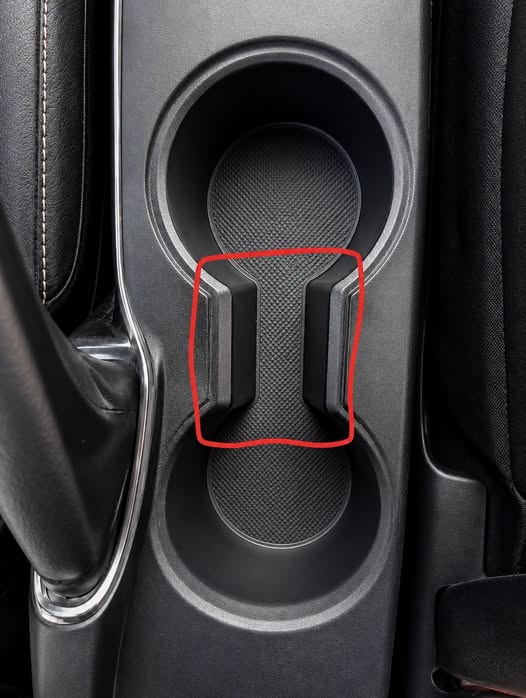
Have you ever looked closely at the center console of a car and noticed the small gap between two cup holders?
For years, many drivers probably never give it a second thought.
It can look like an odd little space left behind by the molding process, a design quirk, or simply an area that wasn’t large enough to become another storage compartment.
But once you notice it, the question becomes surprisingly difficult to ignore:
Why is that gap there?
The answer isn’t always the same for every vehicle, because center-console designs vary considerably between manufacturers and models. However, in many cars, the space between cup holders is intentional and can serve several practical purposes.
It may provide room for objects that don’t fit comfortably inside a traditional cup holder, create clearance between containers, or make it easier to remove cups and bottles without bumping them together.
In some designs, the gap can also be part of a larger flexible storage area.
Here’s a closer look at this easily overlooked piece of automotive design.
It Probably Isn’t an Accident
The first thing to understand is that the gap between cup holders is often part of the overall design.
Modern vehicle interiors are carefully designed around available space.
Engineers and interior designers have to consider everything from the position of the seats and gear selector to storage compartments, electronics, wiring, armrests, and the movement of the driver and passengers.
Even a small section of plastic in the center console may have a specific reason for its shape.
That doesn’t mean every gap has exactly the same purpose.
One vehicle might use it as a small storage recess, while another might simply need the space to provide clearance between two cup holders.
The important point is that it isn’t necessarily wasted space.
Why Not Make the Cup Holders One Large Compartment?
At first, it might seem more efficient to eliminate the gap and create one larger storage area.
But cup holders have to perform a specific job.
They need to keep bottles, cans, and cups reasonably stable while the vehicle is moving.
A pair of separate circular or oval recesses can hold two containers more securely than one large open compartment.
The space between them helps maintain that separation.
If the two cup holders were joined into one large cavity, smaller containers could move around more easily.
That could increase the chance of spills, particularly when the car accelerates, brakes, or travels around a corner.
The Gap Can Provide Clearance
One practical reason for the space is simple clearance.
Not every cup or bottle has the same shape.
Some containers are narrow.
Others are wide.
Some have handles, unusual bases, or other features that make them awkward to place side by side.
A small gap between cup holders can provide additional room around the edges of containers.
It can also prevent two objects from pressing directly against one another.
That may seem like a minor consideration, but small clearances can make an interior easier to use.
It Can Help With Larger Containers
Many people use their vehicle’s cup holders for much more than standard coffee cups.
Reusable water bottles, insulated tumblers, travel mugs, cans, and other containers can have very different dimensions.
A large insulated bottle may fit tightly into one cup holder.
If another large container is placed next to it, the two can interfere with each other.
The space between the holders provides a little breathing room.
It can make it easier to grip the side of one container and lift it without disturbing the other.
It May Be a Small Storage Area
In some vehicles, the space between cup holders is designed as a small storage recess.
It might be large enough for items such as:
- Coins
- Keys
- Small cards
- Sunglasses
- Parking passes
- Small personal items
- Charging cables
The exact use depends on the shape and depth of the console.
Some gaps are little more than a narrow slot, while others are wide enough to hold several small objects.
If the surface has a slightly raised edge or a textured bottom, that can be another clue that the area was intentionally designed for storage.
Some Gaps Are Designed for Handles
Another interesting possibility involves cups and mugs with handles.
A traditional circular cup holder works well for containers without handles.
But a mug handle can interfere with the surrounding console.
Some center-console designs include spaces that allow a handle to extend into an adjacent area without preventing the cup from sitting securely in the holder.
The exact arrangement varies by vehicle.
If you have a mug that doesn’t seem to fit comfortably in a standard cup holder, the surrounding space may have been designed with different container shapes in mind.
Why Cup Holders Are Different From One Car to Another
There is no universal cup-holder design.
Some vehicles have two large holders.
Others have several smaller ones.
Some use sliding covers.
Others include removable inserts.
Luxury vehicles may incorporate cup holders into larger adjustable storage systems, while smaller cars may have very compact designs because interior space is limited.
Pickup trucks, SUVs, family vehicles, sports cars, and compact sedans can all have different approaches.
That’s why it is risky to assume that every gap between cup holders has exactly the same function.
The vehicle’s owner’s manual can sometimes provide the clearest answer.
The Gap Can Make Cleaning Easier
Small spaces around cup holders can also have a practical maintenance benefit.
Cup holders are notorious for collecting crumbs, dust, spilled drinks, and other debris.
A design that separates the holders can make it easier to access the surrounding surfaces with a cloth or small cleaning tool.
Some vehicles use removable cup-holder inserts specifically to make cleaning easier.
If you’ve ever tried to clean dried coffee from a deep cup holder, you already understand why accessibility matters.
It May Accommodate the Shape of the Console
Automotive interior design involves a surprising amount of compromise.
The center console isn’t designed in isolation.
Its shape may need to work around mechanical components, wiring, storage compartments, climate controls, transmission components, seat rails, and other parts of the vehicle.
That means a small gap may sometimes exist partly because of the way the surrounding components are arranged.
The final design can still make use of that space even if the original engineering requirement wasn’t specifically about storage.
In other words, a gap can have more than one reason for existing.
Why Small Design Details Matter
A car interior may appear simple when you sit inside it.
But almost every visible feature has been considered from multiple perspectives.
Designers have to think about ergonomics, manufacturing, durability, safety, appearance, cost, and everyday usability.
A cup holder might need to accommodate different container sizes.
A storage compartment needs to be reachable without distracting the driver.
A console surface has to withstand years of repeated use.
Even small spaces can therefore be the result of several competing requirements.
That’s why seemingly insignificant details can become interesting once you start looking closely.
Could It Be Designed for a Phone?
Sometimes, yes—but not necessarily.
Certain center consoles include slots or recesses that can accommodate a smartphone.
However, you shouldn’t assume that every narrow gap between cup holders is a phone holder.
Phone storage areas a