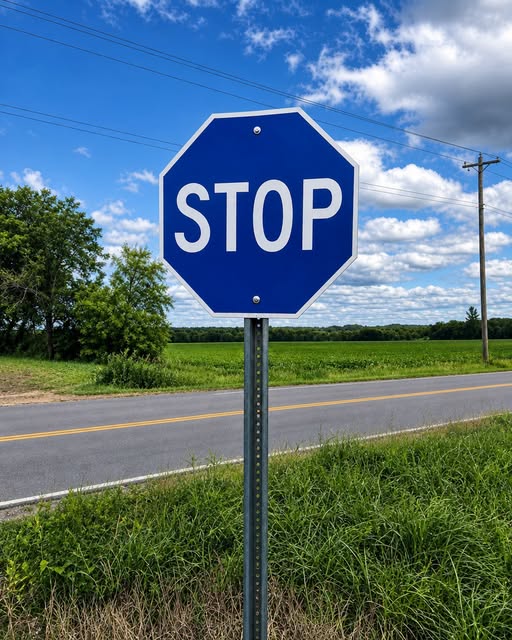
What Does a Blue Stop Sign Mean? Understanding Unusual Stop Sign Colors
When most people picture a stop sign, one image immediately comes to mind: a red, eight-sided sign with the word STOP displayed in clear white letters.
The design is so familiar that drivers usually recognize it almost instantly, even from a distance. That is why seeing a stop sign in a different color can be surprisingly confusing.
A blue stop sign, in particular, can attract attention because blue is not the color most people associate with stopping. If you come across one while traveling, you might naturally wonder whether it has a different meaning, whether it is an old sign, or whether it is simply a decorative variation.
The answer depends heavily on where the sign is located and why it was installed.
Unlike the standardized red stop signs used on public roads in many countries, blue octagonal signs may serve a different purpose or may have been created for a particular local, private, cultural, or decorative setting. The color alone should not be used to assume that the sign carries the same legal meaning as a standard traffic-control sign.
Why Are Stop Signs Usually Red?
The familiar red stop sign is the result of decades of traffic-sign development and standardization.
Red is strongly associated with stopping, warning, and restriction in many transportation systems. It is highly visible and provides a clear visual signal that can be recognized quickly.
The octagonal shape is also important.
A stop sign is not identified only by its color or wording. Its distinctive eight-sided shape helps drivers recognize it even when the sign is partially obscured, viewed from behind, or encountered in poor conditions.
Standardization is especially useful on busy roads because drivers should not have to interpret every sign from scratch.
A familiar combination of shape, color, lettering, and placement allows road users to react more quickly.
So Why Would a Stop Sign Be Blue?
A blue octagonal sign can have several possible explanations, and there is no universal rule that every blue stop sign has one specific meaning.
In some cases, the sign may be associated with a private road or privately managed property rather than a normal public roadway.
Private communities, businesses, resorts, farms, campuses, parking areas, and other properties sometimes use signs that resemble official traffic signs while having their own design choices.
A blue sign may also be used for a decorative or commemorative purpose. Vintage-style signs are popular among collectors, restaurants, garages, homes, and businesses that want to create a particular visual atmosphere.
In other situations, a sign may have been produced for a special local application or may not conform to the standard traffic-control system used on public roads.
That means the surrounding context matters more than the color alone.
A Blue Sign Does Not Automatically Mean “Keep Going”
One of the easiest mistakes would be to see a blue octagonal sign and assume that it means the opposite of a normal stop sign.
That is not a safe assumption.
Drivers should never interpret an unfamiliar traffic sign based solely on its color. If you encounter an unusual sign on a roadway, the safest approach is to consider the actual road environment, other traffic controls, pavement markings, and applicable local rules.
If the sign is clearly functioning as a stop-control device, stopping may still be appropriate even if its appearance differs from the standard design.
The important point is that unusual appearance does not automatically indicate unusual driving instructions.
The Difference Between Official and Decorative Signs
One useful distinction is between signs used as part of an official traffic-control system and signs used primarily for decoration.
An official traffic sign is generally designed according to regulations or standards established by the relevant transportation authority.
These standards can specify details such as:
- Shape
- Color
- Lettering
- Dimensions
- Reflectivity
- Placement
- Mounting height
- Visibility
- Installation requirements
Decorative signs do not necessarily follow those same requirements.
For example, someone might install a blue octagonal “STOP” sign near a private driveway because they like the unusual appearance. A restaurant might use one as part of its exterior decoration. A collector might display an old or reproduction sign on private property.
From a distance, such a sign can look very similar to a genuine traffic sign even though its purpose is completely different.
Could a Blue Stop Sign Be Vintage?
Sometimes an unusual sign may simply be old.
Traffic signs have changed considerably throughout history. Different countries, municipalities, organizations, and private road systems have used different designs over the years.
Collectors of vintage transportation memorabilia often look for old road signs, gas-station signs, highway markers, license plates, and other objects associated with earlier periods of motoring.
However, the presence of a blue color by itself does not prove that a stop sign is antique.
A reproduction can look old without actually being old, and a modern decorative sign can be manufactured with a deliberately vintage appearance.
If you’re interested in identifying a particular sign, details such as its material, lettering style, mounting hardware, manufacturer markings, dimensions, and location can provide much more useful information than color alone.
Why Unusual Signs Get So Much Attention
Road signs are designed to be noticed, but they are normally so familiar that people rarely stop to think about them.
When something breaks that familiar pattern, however, our attention naturally increases.
A blue stop sign is a good example.
The mind expects the standard red octagon. When the same basic shape appears in blue, the difference immediately stands out.
This is one reason unusual road signs frequently become subjects of photographs and online discussions. People recognize the familiar shape but notice that something about it does not match their expectations.
The result is an interesting visual puzzle: Is this a real traffic sign, a local variation, an old sign, or simply decoration?
Context Can Help Identify the Sign
If you encounter an unusual stop sign, look at its surroundings before drawing conclusions.
Consider whether the sign is located:
- On a public street
- Inside a private neighborhood
- At a business or resort
- On a farm or rural property
- At a school or campus
- In a parking area
- Near a historical site
- On private land
- As part of a collection or decoration
Its location can provide important clues.
A sign installed along an ordinary public road should be treated differently from a sign mounted beside a restaurant entrance or displayed in someone’s yard.
Other nearby signs can also help. Official traffic-control areas often have additional standardized signs, pavement markings, lane arrangements, and road features that provide context.
What Should Drivers Do When They See an Unfamiliar Sign?
The safest response to an unfamiliar traffic sign is to avoid guessing.
Slow down and observe the entire roadway. Look for additional signs, road markings, signals, and the behavior of other traffic.
If the sign appears to be controlling an intersection or requiring vehicles to stop, treat the situation cautiously rather than assuming the unusual color makes the sign irrelevant.
When traveling in another country or region, remember that traffic signs can differ from those you are accustomed to seeing at home.
Learning the basic traffic signs of a place before driving there can make unfamiliar situations easier to understand.
Why Standardization Matters
The story of the stop sign also demonstrates why standardization is so important in transportation.
Imagine if every city used completely different colors and shapes for basic traffic instructions. Drivers would have to spend more time interpreting signs, particularly when traveling through unfamiliar areas.
Standard designs reduce that mental workload.
A recognizable sign can communicate an instruction without requiring a driver to read a long explanation.
This is especially important when decisions need to be made quickly.
For that reason, official traffic signs tend to follow carefully established design systems rather than allowing every location to choose its own colors.
Blue Is Common on Many Other Types of Signs
Blue itself is not an unusual color for road signs.
In many traffic-sign systems, blue is commonly associated with information, services, directions, parking, or other specific categories.
That is why seeing blue on a road sign does not automatically indicate danger or stopping.
The meaning depends on the complete sign system being used.
A blue sign with a particular symbol may communicate something entirely different from a blue octagonal sign carrying the word “STOP.”
This is another reason why it is important to consider shape, wording, symbols, location, and local regulations together rather than relying on color alone.
The Appeal of Unusual Road Signs
There is also a cultural reason why unusual signs are interesting.
Road signs are part of the visual landscape of everyday life. They appear on highways, residential streets, rural roads, parking lots, and city intersections, but most people rarely consider them as objects of design.
Vintage or unusual signs can therefore have a nostalgic appeal.
Old lettering, weathered surfaces, unusual colors, metal construction, and faded paint can remind people of earlier periods of transportation.
Collectors and enthusiasts sometimes display road-sign reproductions as part