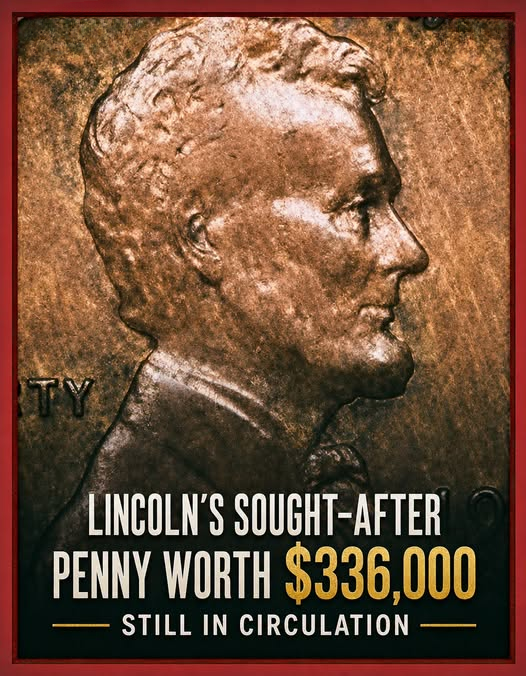
Most people give little thought to an ordinary penny. Coins accumulate in jars, disappear beneath furniture, and remain forgotten in car cup holders for years.
Yet one small date can occasionally attract the attention of serious collectors.
The 1943 bronze Lincoln cent is one of the most famous error coins in American numismatics. Authentic examples are extraordinarily rare, and individual specimens have sold for hundreds of thousands of dollars.
In July 2022, an authenticated 1943 bronze cent graded AU50 by Professional Coin Grading Service sold through Heritage Auctions for $336,000. The result is documented by both PCGS and Heritage Auctions.
That does not mean every penny bearing the date 1943 is valuable. The overwhelming majority are ordinary zinc-coated steel cents. Many copper-colored examples offered online are plated coins, altered dates, replicas, or counterfeits.
Understanding why the genuine error exists—and how professionals distinguish it from common imitations—is essential before imagining that a fortune is sitting in a change jar.
Why Most 1943 Cents Were Made of Steel
The unusual story began during World War II.
Copper was an important material for the war effort, so the United States changed the composition of the one-cent coin in 1943. Instead of the familiar bronze alloy, cents produced that year were generally struck on zinc-coated steel planchets.
The result was a silver-gray coin that looked very different from the traditional Lincoln cent. The United States Mint confirms that pennies were made from zinc-coated steel in 1943 because copper was needed for wartime purposes. U.S. Mint history of the penny
A planchet is the prepared metal disc on which a coin’s design is struck. For 1943 cents, the correct planchets were made of coated steel.
However, a very small number of bronze planchets left over from the previous year apparently remained in equipment or storage containers used during production. Those discs accidentally entered the presses and received the 1943 cent design.
This created a transitional wrong-planchet error: a coin carrying the correct design and date but struck on the wrong metal.
The authenticated bronze examples are famous because they were never intended to exist.
Why the $336,000 Coin Was Special
The cent that realized $336,000 was not simply an old penny with a brown appearance. It was an authenticated 1943 Philadelphia bronze cent with a documented history and a professional grade of AU50.
“AU” means “About Uncirculated.” A coin at this level may show light evidence of circulation while retaining considerable original detail.
Heritage described the coin as being struck on a bronze planchet composed of approximately 95 percent copper and 5 percent tin and zinc. Its stated weight was 3.11 grams.
Its selling price reflected several factors:
- The rarity of the error
- Professional authentication
- The coin’s state of preservation
- Collector demand
- Its documented ownership history
- Competition among bidders at that particular auction
Auction prices are historical results, not promises about future value. Another authenticated example could sell for more or less depending on its mint of origin, grade, surface quality, provenance, market conditions, and bidder interest.
Other genuine bronze cents have achieved different six-figure prices. In 2026, for example, a 1943-S bronze cent graded AU55 sold for $456,000, illustrating that the specific mint, condition, and individual specimen matter greatly. PCGS report on the 2026 auction
A person should therefore avoid saying, “A 1943 penny is worth $336,000.” A more accurate statement is that one particular authenticated 1943 bronze cent sold for that amount.
Philadelphia, Denver, and San Francisco Examples
In 1943, Lincoln cents were produced at three United States Mint facilities.
A coin without a mintmark was produced in Philadelphia. A small “D” beneath the date indicates Denver, while an “S” represents San Francisco.
Genuine bronze errors have been identified from all three facilities, but their known populations differ. The Denver issue is especially famous because only one authentic 1943-D bronze cent is widely recognized.
This does not mean a newly discovered example is impossible, but any such claim would face intense professional scrutiny. An unusual-looking coin is not accepted as genuine merely because it has the correct date, color, and mintmark.
Authentication specialists examine its weight, metal, design details, surfaces, method of manufacture, and any signs of alteration. They may also compare it with known dies and established genuine examples.
The First Test: Use a Magnet Carefully
A basic magnet test can help eliminate many ordinary 1943 steel cents that were later coated with copper.
Steel is magnetic. Bronze is not.
If a copper-colored 1943 cent is strongly attracted to a magnet, it is almost certainly a common steel cent with a copper-colored coating rather than the valuable bronze error.
Use a small magnet gently. There is no reason to scrape the coin or allow a powerful magnet to strike its surface.
A coin that does not stick to a magnet has passed only an initial screening. It has not been authenticated.
Counterfeits can be made from nonmagnetic metal, and altered coins may also fail to react to a magnet. The test is useful for ruling out certain plated steel cents, but it cannot prove that a coin is genuine.
Check the Weight
Weight provides another useful clue.
The documented bronze planchet weight is approximately 3.11 grams, while a standard 1943 zinc-coated steel cent weighs approximately 2.7 grams. Differences caused by wear, corrosion, damage, or inaccurate equipment must be considered.
A scale should be properly calibrated and capable of measuring to at least one-hundredth of a gram. Kitchen scales that display only whole grams may not be precise enough.
Once again, the correct weight does not establish authenticity. Modern counterfeits may be manufactured at approximately the expected weight.
Think of weight as another screening step rather than a final answer.
Watch for Altered Dates
One common deception involves changing the date on another Lincoln cent to resemble 1943.
A 1948 cent can be altered by reshaping part of the “8” so that it appears to be a “3.” Other dates may also be manipulated or combined with added mintmarks.
Professional graders examine the date’s shape, spacing, and relationship to nearby design elements. They also look for tool marks, disturbed metal, unnatural edges, or inconsistencies with genuine dies.
Online photographs are rarely sufficient for a final determination. Lighting, magnification, image compression, and surface discoloration can make a normal digit appear unusual.
If a coin looks promising, avoid attempting to reshape, scratch, or “improve” any part of it. Such actions can damage a real coin and eliminate important evidence needed for examination.
Copper-Plated Steel Cents
Many supposed discoveries are ordinary 1943 steel cents that have been coated with copper.
Some may have been created as souvenirs, science experiments, or novelty items. Others may have been altered specifically to deceive buyers.
A plated coin may look convincing in a photograph. Its surface can have the reddish-brown appearance associated with older copper coins. The magnet test often reveals the truth because the steel core remains magnetic.
Under magnification, plating may appear uneven around the lettering, rim, or damaged areas. Places where the coating has worn away may expose the gray steel underneath.
Do not remove the coating yourself. If the coin has any realistic possibility of being important, preserve it as found and let a professional evaluate it.
Never Clean a Potentially Valuable Coin
One of the most damaging mistakes a new collector can make is cleaning an old coin.
Polishing may make a penny appear brighter, but it can leave scratches, alter the surface, remove original material, and reduce collector value. Chemical cleaners can cause discoloration or other permanent changes.
Do not use vinegar, baking soda, metal polish, brushes, abrasive cloths, or household cleaning products.
Avoid rubbing the coin between your fingers. Hold it gently by the edges over a soft, clean surface.
Place it in a non-PVC coin holder or another archival-quality container designed for long-term storage. PVC-containing plastics can interact with coin surfaces over time.
If you are unsure which holder is appropriate, consult a reputable coin dealer or professional numismatic organization.
Professional Authentication Is Essential
A magnet test, weight measurement, and visual comparison may help determine whether a coin deserves further attention. They cannot establish a six-figure value.
An extraordinary claim requires expert authentication.
Established third-party grading services such as PCGS and Numismatic Guaranty Company evaluate coins for authenticity and condition. Submission procedures and fees vary, especially for coins that may have exceptionally high values.
A reputable local coin dealer or numismatic organization may help with an initial examination. Look for someone with established professional affiliations, transparent business practices, and experience with United States error coins.
Do not immediately surrender a potentially important coin to an unknown online buyer. Keep records, photograph both sides, and document where it came from if that information is available.
Before sending it anywhere, confirm the company’s official address and submission process directly from its website. Consider insured shipping and appropriate security precautions.
Be Cautious With Online Offers
Online marketplaces contain many listings for “rare 1943 copper pennies” with unrealistic asking prices.
An asking price proves nothing. A seller can list an ordinary object for almost any amount, but that does not mean a buyer has paid it.
Completed sales from established auction companies provide more useful evidence, especially when the coins were authenticated by a recognized grading service.
Be skeptical of sellers who:
- Guarantee enormous profits
- Refuse to provide clear photographs
- Claim professional authentication without a certificate number
- Use an auction result from a different coin to justify their price
- Pressure buyers to act immediately
- Avoid questions about weight or magnetism
- Offer several supposedly genuine examples at once
- Rely only on color as evidence
The genuine 1943 bronze cent is famous precisely because it is exceptionally rare. Finding multiple uncertified examples from one casual source would demand extraordinary verification.
Could One Still Be Found?
Stories exist of authentic examples being discovered in circulation many decades ago. That history is part of what makes the coin so fascinating.
It is theoretically possible that an undocumented example remains in an old collection, inherited container, or forgotten group of coins. However, finding one in ordinary modern pocket change would be extraordinarily unlikely.
The phrase “it could be in your pocket” makes an effective headline, but it does not communicate the true odds.
Most 1943 cents encountered today are standard steel issues. A copper-colored specimen is far more likely to be plated, altered, or counterfeit than an undiscovered Mint error.
Still, examining old coins can be enjoyable even when no fortune is found. A normal 1943 steel cent is a tangible artifact from the World War II era. Its historical story gives it interest beyond its monetary value.
The Real Value of Looking Closely
The 1943 bronze Lincoln cent demonstrates how manufacturing history, accidental errors, and collector demand can transform an ordinary denomination into an exceptional rarity.
One authenticated example did sell for $336,000 in 2022. Other specimens have produced different auction results, including higher prices. Those sales belong to specific, professionally evaluated coins—not every penny with a similar color or date.
If you discover a copper-colored 1943 cent:
- Handle it only by the edges.
- Do not clean or polish it.
- Test it gently with a magnet.
- Weigh it using a properly calibrated precision scale.
- Store it in an appropriate holder.
- Ask an experienced professional for an initial opinion.
- Submit promising candidates to a recognized authentication service.
The odds may be extremely small, but the process of investigating a coin can introduce someone to history, manufacturing, art, and numismatics.
A penny may have a face value of only one cent. Its story, however, can be worth examining carefully.