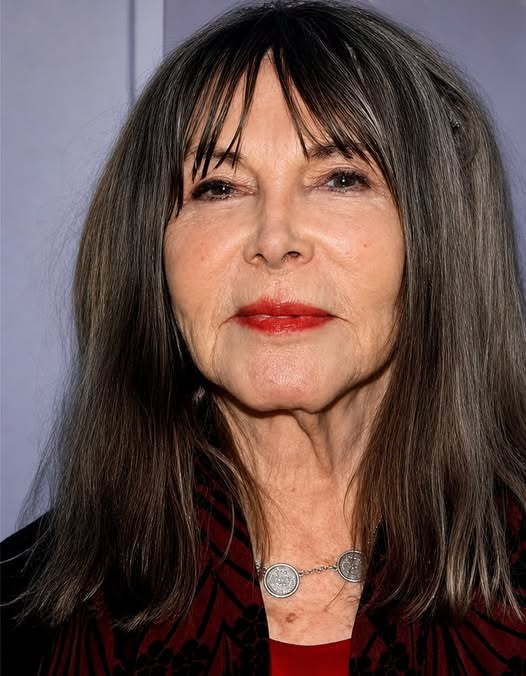
The Resilience of Lee Grant: An Extraordinary Career Beyond the Hollywood Blacklist
In the early 1950s, Lee Grant appeared to be standing at the beginning of a remarkable Hollywood career.
Her performance as a distressed young shoplifter in the 1951 film Detective Story displayed an emotional intensity that immediately attracted critical attention. It was her first major film role, yet it earned her an Academy Award nomination for Best Supporting Actress.
The performance also received international recognition. At the 1952 Cannes Film Festival, Grant was named Best Actress for her work in the film. Festival de Cannes archive
For a young performer entering the motion-picture industry, such recognition should have opened the door to years of important roles. Instead, Grant’s career was interrupted by one of the most politically charged periods in American entertainment history.
Her name became associated with the Hollywood blacklist, severely limiting her ability to work in film and television for more than a decade.
Grant’s eventual return would have been noteworthy by itself. However, she did much more than resume acting. She earned some of the industry’s most respected honors, moved behind the camera, and became an accomplished director whose documentaries examined poverty, discrimination, labor disputes, and people frequently overlooked by mainstream media.
Her career is not merely a story about surviving professional rejection. It is about developing a new artistic voice after an industry attempted to silence the first one.
A Powerful Beginning
Born Lyova Haskell Rosenthal in New York City, Grant became involved in performance at an early age. She studied dance and acting before establishing herself on the New York stage.
Her breakthrough arrived with Sidney Kingsley’s Detective Story. Grant played a shoplifter whose brief appearance brought vulnerability and human complexity to a role that could easily have been treated as a minor character.
She later repeated the performance in director William Wyler’s film adaptation. The movie featured Kirk Douglas in the leading role, but Grant’s work stood out even within an experienced ensemble.
The Academy Award nomination and Cannes honor suggested that she had the talent to become one of the leading dramatic performers of her generation.
Then politics entered her career.
The Hollywood Blacklist
During the late 1940s and 1950s, the American entertainment industry became a major focus of investigations into suspected communist influence. The House Un-American Activities Committee questioned actors, directors, screenwriters, and other professionals about their political associations.
People who refused to cooperate or identify others could lose access to employment. Studios were often unwilling to hire anyone whose name appeared in publications or informal lists connecting them to alleged political activity.
The system did not require an ordinary criminal conviction. Suspicion, association, or a refusal to participate in questioning could be enough to damage a career.
Grant came under scrutiny after delivering a eulogy for actor J. Edward Bromberg, who had been questioned during the period. Her marriage to screenwriter Arnold Manoff also contributed to the political pressure surrounding her.
Grant declined to provide the kind of testimony investigators wanted. As a result, her opportunities in film and television became severely restricted.
Many accounts describe her blacklist period as lasting approximately twelve years. Turner Classic Movies similarly identifies twelve years during which her Hollywood career was blocked. TCM retrospective on Lee Grant
The exact experience of blacklisted artists varied. Grant was not entirely prevented from performing. She continued working in theater and occasionally found screen opportunities, but the promising film career suggested by Detective Story was abruptly disrupted.
This distinction matters. Saying that she simply disappeared would overlook the stage work and persistence that sustained her. Yet suggesting that the blacklist caused only a minor delay would understate its consequences.
A performer’s career depends on momentum, access, and visibility. Grant lost important years during which other actors were building relationships with studios, directors, and audiences.
The blacklist could prevent employment, but it could not erase her ability.
Returning to Television and Film
As the political climate changed, Grant gradually regained access to prominent screen roles.
One of her major successes came through the television drama Peyton Place. Her performance as Stella Chernak earned her a Primetime Emmy Award and reintroduced her to a wide audience.
Film opportunities followed. Grant appeared in In the Heat of the Night, Valley of the Dolls, and Buona Sera, Mrs. Campbell. Her performances demonstrated a range extending from serious drama to sophisticated comedy.
In 1970, she received another Academy Award nomination for her work in Hal Ashby’s The Landlord. The recognition arrived almost two decades after her nomination for Detective Story.
She then appeared in Neil Simon’s Plaza Suite, the television film The Neon Ceiling, and numerous other productions.
Grant had not returned as a nostalgic figure from an earlier era. She had reestablished herself as a relevant and versatile contemporary performer.
An Oscar for Shampoo
Grant’s most famous acting honor came from her performance in the 1975 film Shampoo.
Directed by Hal Ashby and starring Warren Beatty, Julie Christie, and Goldie Hawn, the film examined relationships, ambition, and social change against the background of late-1960s Los Angeles.
Grant played Felicia Karpf, a wealthy woman involved with Beatty’s character. Her performance balanced sharp comedy with emotional dissatisfaction, giving the character a complexity that extended beyond the role’s surface.
At the 48th Academy Awards, Grant won the Oscar for Best Supporting Actress. Academy highlights from the 1976 ceremony
The victory carried unusual significance.
Twenty-four years had passed since her first Academy Award nomination. During much of that period, she had been prevented from competing fairly within the industry.
The award could not restore the opportunities she had lost. No trophy could return twelve years or reconstruct every role that might have been hers.
Nevertheless, the Oscar represented public recognition that her talent had endured.
Grant received another supporting-actress nomination the following year for Voyage of the Damned. By then, she had achieved a level of professional success that the blacklist had once threatened to make impossible.
Yet she was preparing to take her career in another direction.
Moving Behind the Camera
For many actresses in the 1970s, opportunities became less predictable as they grew older. The industry frequently offered women fewer substantial roles while continuing to build films around aging male stars.
Grant responded by developing skills that gave her greater creative control.
She became one of the early participants in the American Film Institute’s Directing Workshop for Women, a pioneering program created to address the lack of opportunities for female directors. AFI identifies Grant among the program’s earliest participants, alongside artists including Maya Angelou, Anne Bancroft, Ellen Burstyn, Jessie Maple, and Cicely Tyson. American Film Institute history of the program
During the workshop, Grant directed The Stronger, a short adaptation of August Strindberg’s play.
The project allowed her to apply decades of acting experience to visual storytelling. She understood how performers developed characters, how emotional tension could build within a scene, and how a director’s guidance could support or limit an actor.
Grant did not treat directing as a temporary experiment. It became the second major chapter of her career.
Tell Me a Riddle and Women’s Stories
Grant’s first narrative feature as a director was Tell Me a Riddle, released in 1980.
Adapted from Tillie Olsen’s writing, the film centered on an older Jewish couple confronting illness, memory, family conflict, and the meaning of a long marriage.
At the time, Hollywood rarely placed an older woman’s inner life at the center of a feature film. Grant approached the material with patience and seriousness, demonstrating her interest in people whose stories were often considered commercially unimportant.
That concern continued throughout her directing career.
Rather than limiting herself to conventional entertainment, she made documentaries and television projects dealing with social and economic issues.
Her subjects included women challenging workplace inequality, individuals living on the margins of accepted gender categories, people affected by domestic abuse, women in prison, displaced families, and Americans confronting poverty.
These projects were not unrelated to her experience with the blacklist. Grant knew what it meant for institutions to decide whose voice could be heard and whose story could be excluded.
Directing allowed her to turn that knowledge outward.
Documenting Labor and Inequality
In The Willmar 8, Grant documented eight women working at a bank in Willmar, Minnesota, who protested workplace discrimination and unequal treatment.
The film gave the women space to explain their experiences in their own words. It was not simply a story about one labor disagreement. It examined dignity, economic power, and the risks ordinary employees take when they challenge established systems.
Grant also directed When Women Kill, which explored the lives and circumstances of women convicted of serious crimes. Rather than reducing them to sensational headlines, the documentary investigated the social and personal conditions surrounding their cases.
In What Sex Am I?, she focused on transgender and gender-nonconforming people at a time when mainstream media representation was far more limited than it is today.
These works reflected a consistent directorial approach: listen closely, look beyond easy labels, and allow people to describe their own realities.
Down and Out in America
One of Grant’s most important documentaries was Down and Out in America.
Released in 1986, the film examined unemployment, homelessness, farm foreclosures, and the economic pressures affecting American families and communities.
The documentary arrived during a period when public discussions of prosperity often ignored people being displaced by economic change. Grant placed those experiences at the center of the screen.
Down and Out in America shared the Academy Award for Best Documentary Feature at the 1987 ceremony. The Academy’s official record lists producers Joseph Feury and Milton Justice as the recipients, while Grant directed the film. Official record of the 59th Academy Awards
This wording is important for accuracy: Grant’s film won the Oscar, although the award in that category was formally presented to its credited producers.
The achievement nevertheless confirmed her stature as a filmmaker. The actress once denied screen roles because of political suspicion had directed an Academy Award-winning examination of Americans whose difficulties were frequently kept outside the national success story.
Recognition as a Television Director
Grant also built an extensive career directing television films.
Her credits included A Matter of Sex, Nobody’s Child, No Place Like Home, Seasons of the Heart, and The Loretta Claiborne Story, among many others.
For Nobody’s Child, a drama starring Marlo Thomas, Grant received the Directors Guild of America Award for Outstanding Directorial Achievement in Movies for Television. According to the DGA, she was the first woman to win in that category. Directors Guild visual history of Lee Grant
Her directing work demonstrated that she was not dependent on a single format. She moved between documentaries, theatrical films, television dramas, and episodic programs.
Throughout those projects, she remained interested in characters whose lives were constrained by institutions, social expectations, or economic conditions.
A Legacy Larger Than Survival
It is tempting to describe Lee Grant’s career as a simple triumph over adversity: a talented actress was blacklisted, waited patiently, returned, and eventually received the recognition she deserved.
The reality is more complicated.
The blacklist caused genuine and irreversible harm. It removed professional opportunities during crucial years and subjected artists to fear, uncertainty, and public suspicion.
Grant’s later success did not make that injustice acceptable.
What makes her story inspiring is not the idea that hardship automatically creates strength. It is that she continued developing her abilities despite a system designed to limit her.
She acted onstage when screen opportunities disappeared. She returned to film and television when the doors reopened. After winning major acting awards, she entered a field in which women faced additional barriers and established herself as a director.
Then she used that position to document people whose voices might otherwise have been ignored.
Her career ultimately became larger than the industry’s attempt to restrict it.
Beyond the Blacklist
Lee Grant’s story belongs to several histories at once.
It is part of the history of the Hollywood blacklist and the damage caused when political fear replaces fairness. It is part of the history of American acting, from Detective Story and Peyton Place to The Landlord and Shampoo.
It is also part of the history of women directors who expanded their careers during a period when opportunities behind the camera were extremely limited.
Most importantly, her work demonstrates that resilience is not simply returning to where one started.
Sometimes resilience means creating a different path.
Grant did not merely recover the acting career interrupted in the 1950s. She became a filmmaker capable of choosing subjects, shaping narratives, and bringing neglected experiences to the screen.
Hollywood once attempted to define her through suspicion and silence.
Her performances, documentaries, and directing achievements provided a lasting response—one built not from slogans, but from decades of disciplined and compassionate work.