My eight-year-old son, Tyler, had been visiting Lewis’s Barbershop since he was four years old.
Mr. Lewis knew exactly how Tyler liked his hair: shorter around the sides, slightly longer on top, and never so neat that it could not be messed up beneath a baseball cap.
Their relationship extended far beyond haircuts.
Mr. Lewis knew which baseball team Tyler supported and kept grape-flavored lollipops behind the counter specifically for him. Whenever the shop was quiet, he allowed Tyler to choose the music. Tyler always selected the same playlist of old songs because he knew they reminded Mr. Lewis of his younger years.
Going to the barbershop had become one of Tyler’s favorite Saturday routines.
Because the shop was only three blocks from our home, I had recently started allowing him to walk there alone during daylight. The route was simple, and Tyler knew that he had to call me as soon as he arrived.
It was a small step toward independence, and he was incredibly proud of it.
That Saturday morning, I watched him leave with twelve dollars in his pocket and strict instructions to come directly home afterward.
He called when he reached the shop.
“I’m here, Mom,” he said cheerfully. “Mr. Lewis says hello.”
“Have fun, and remember to look both ways when you cross.”
“I know.”
About forty-five minutes later, the front door opened.
Tyler stepped inside without saying a word.
I was sitting at the kitchen table with a cup of coffee. When I looked up, I almost dropped it.
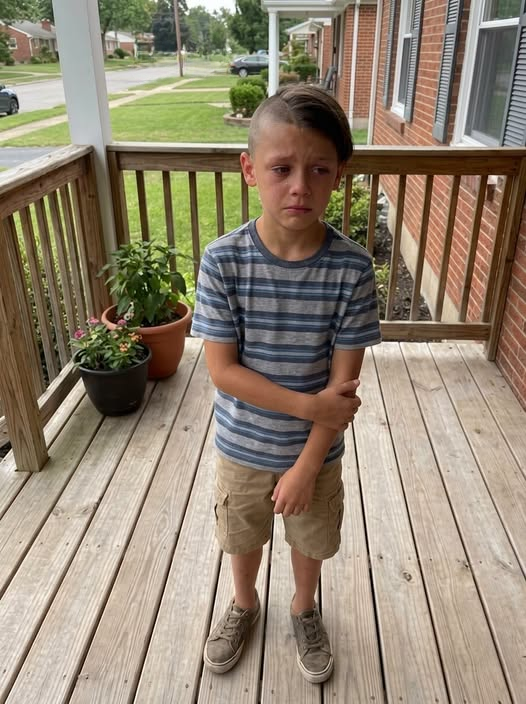
The right side of Tyler’s hair had been carefully trimmed. The left side remained long and completely untouched. A white line of talcum powder was still visible near his neck, and a few loose pieces of hair clung to his shirt.
“Tyler,” I said, standing quickly, “what happened?”
He stared at the floor.
“Mr. Lewis stopped.”
“Did the clippers break?”
Tyler shook his head.
“Did you ask him to stop?”
Another shake.
“Did someone come into the shop?”
He pressed his lips together.
My son usually could not keep a secret for more than five minutes. Even when he tried, his face revealed everything. But that morning, he looked frightened and deeply worried.
“Tyler, I need you to tell me what happened.”
He whispered, “Mr. Lewis said I should come home.”
That answer only made me more uneasy.
I picked up my phone and called the barbershop.
Mr. Lewis answered on the second ring, but he did not sound like himself. His voice was unsteady, and I could hear him trying to control his breathing.
“I’m sorry about Tyler’s hair,” he said. “I couldn’t finish it after what happened.”
“What happened? Is Tyler all right?”
“Yes. Tyler is fine.”
“Then why are you crying?”
There was a long pause.
“Please bring him back to the shop,” he said. “There’s something you need to see.”
The Closed Barbershop
I grabbed my purse and hurried outside with Tyler.
The three-block walk felt much longer than usual.
I asked him whether anyone had frightened him or behaved inappropriately. He shook his head.
I asked whether Mr. Lewis had become angry.
“No.”
“Did you break something?”
“No, Mom.”
“Then please tell me what happened.”
Tyler looked up at me with tears forming in his eyes.
“I promised Mr. Lewis I would let him explain.”
His answer frightened me more than silence.
When we reached the shop, the sign on the door had been turned to CLOSED, even though it was not yet noon.
Mr. Lewis unlocked the door and quietly motioned for us to enter.
The shop looked as it always did. Three barber chairs faced a long mirror. Clippers and combs were arranged neatly on the counter. A radio played softly near the cash register.
Then I noticed something unfamiliar.
A paramedic’s equipment bag was sitting near the first chair.
Beside it was an opened packet of glucose gel, a small blood glucose meter, and a printed sheet of emergency instructions.
My legs suddenly felt weak.
“What happened here?” I asked.
Mr. Lewis sat down and covered his face with both hands.
“Your son may have prevented something very serious.”
I turned toward Tyler.
He was staring at the floor again.
Mr. Lewis took a slow breath and began explaining.
The Moment Everything Changed
Tyler had been sitting in the barber chair while Mr. Lewis trimmed the right side of his hair.
At first, everything seemed normal. They discussed baseball, school, and whether Tyler would choose another grape lollipop before leaving.
Then Mr. Lewis began behaving strangely.
His hands started shaking. He dropped his comb twice and seemed unable to remember what he had been saying. When Tyler asked whether he was all right, Mr. Lewis insisted that he was simply tired.
A few seconds later, he became confused and sat heavily in the empty chair beside Tyler.
Mr. Lewis had diabetes. He kept emergency supplies in a locked cabinet at the back of the shop, but he had never explained this to Tyler.
Fortunately, a bright red card was attached to his key ring. It contained brief emergency instructions and identified where his glucose supplies were stored.
Tyler climbed down from the chair and asked what he should do.
Mr. Lewis was too confused to give a clear answer.
That was when Tyler remembered a health-and-safety lesson his class had completed only a week earlier. Their teacher had explained that if an adult suddenly became confused or unable to respond normally, a child should not attempt to manage the situation alone. The child should call emergency services, give the location, and follow the dispatcher’s instructions.
Tyler picked up the shop telephone and called for help.
He gave the dispatcher the barbershop’s address from the business card beside the register. He explained that Mr. Lewis was awake but confused and shaking.
The dispatcher told Tyler not to give him anything unless instructed and to avoid placing anything in his mouth if he became unresponsive. Tyler followed every instruction carefully.
He then used the keys to unlock the front door so the paramedics could enter. When asked about medications or medical conditions, he gave them the red emergency card.
A neighboring business owner arrived moments before the ambulance. The paramedics evaluated Mr. Lewis, provided appropriate care, and monitored him until his condition stabilized.
They strongly encouraged him to receive further medical evaluation, and his sister drove him to a nearby clinic. Mr. Lewis had returned only briefly to secure the shop and call me.
That explained why Tyler’s haircut had stopped halfway through.
It did not explain why my son had refused to tell me.
Mr. Lewis looked toward him.
“He didn’t want you to worry before you knew I was all right,” he said. “And he didn’t want anyone making a big fuss over him.”
Tyler’s face turned red.
“I just did what my teacher said.”
Mr. Lewis began crying again.
“You stayed calm when I couldn’t,” he said. “You found the address, called for help, opened the door, and gave the paramedics my medical card. You were braver than many adults would have been.”
A Mother’s Relief
I knelt in front of Tyler and placed both hands on his shoulders.
“Why didn’t you tell me when you came home?”
He finally looked at me.
“I thought you might think it was my fault because I asked Mr. Lewis to play another song. Then he started acting strange.”
My heart tightened.
“Sweetheart, you did not cause any of this.”
“But he was cutting my hair when it happened.”
“That still doesn’t make it your fault.”
Children often connect events in ways adults do not expect. Because Mr. Lewis’s medical episode happened during Tyler’s appointment, Tyler had convinced himself that something he said or did might have triggered it.
Mr. Lewis moved closer.
“You didn’t make me sick,” he told Tyler. “You helped me when I needed it.”
Tyler’s shoulders finally relaxed.
I pulled him into my arms.
For the first time since he had returned home, he began to cry.
The fear he had been holding inside poured out all at once.
“I thought he was going to stop breathing,” he whispered.
“I know,” I said. “But you called the people who knew how to help. You did exactly the right thing.”
Finishing the Haircut
Mr. Lewis offered to finish Tyler’s haircut that afternoon, but I refused.
“You need to rest and follow your doctor’s instructions,” I said.
He smiled weakly.
“Your son cannot walk around looking like that.”
“He can wear a hat for a few days.”
Tyler immediately objected.
“I have school pictures on Monday!”
Despite everything, we all laughed.
Mr. Lewis called another barber named Angela, who worked at a shop across town. After hearing the story, she offered to finish Tyler’s haircut free of charge.
Before we left, Mr. Lewis reached behind the counter and pulled out the entire container of grape lollipops.
“These belong to you now,” he said.
Tyler selected one and pushed the container back.
“I only need one. Save the others for next time.”
Mr. Lewis’s eyes filled with tears again.
“There will definitely be a next time,” he promised.
A Lesson for the Entire Community
News of Tyler’s actions spread after the neighboring business owner told several customers what had happened.
His teacher invited a local emergency dispatcher to speak with the class about responding to urgent situations. The lesson focused on finding a trusted adult, knowing one’s address, contacting emergency services when necessary, and following instructions carefully.
The school did not present Tyler as someone who had treated Mr. Lewis. That responsibility belonged to trained medical professionals.
Instead, Tyler was praised for recognizing that something was wrong and asking for help.
That distinction mattered to me.
Children should never feel responsible for diagnosing an illness or providing medical treatment beyond their abilities. Their most important job is to move to safety, contact a trusted adult or emergency service, and follow professional guidance.
Mr. Lewis also made changes at the barbershop.
He placed updated emergency information in an accessible location and explained his condition to his employees. He arranged regular meal breaks instead of continuing to work through the entire day, and he scheduled a follow-up appointment with his healthcare provider.
Most importantly, he stopped assuming that he could ignore warning signs and continue working.
Returning to the Chair
Two weeks later, Tyler returned to Lewis’s Barbershop.
This time, I walked with him.
Mr. Lewis looked healthier and more rested. He had placed a framed photograph on the counter showing Tyler in the barber chair with half of his hair cut.
Beneath the photograph was a small sign:
Staying calm means knowing when to ask for help.
Tyler climbed into his usual chair.
“Same haircut?” Mr. Lewis asked.
Tyler thought for a moment.
“Yes—but please finish both sides this time.”
Everyone in the shop laughed.
As Mr. Lewis adjusted the cape around Tyler’s shoulders, he looked at me through the mirror.
“I’ll never forget what your son did.”
Neither would I.
When Tyler first entered our home with half a haircut, I imagined every frightening explanation possible. The truth was serious, but it also revealed something about my son that I had not fully recognized.
He had been scared, yet he listened.
He had been uncertain, yet he asked for professional help.
He had only been eight years old, but when an adult needed assistance, he remembered what he had learned and used it responsibly.
The unfinished haircut eventually grew out.
The lesson remained.
Courage does not always look dramatic. Sometimes it is a frightened child standing beside a barber chair, holding a telephone with both hands and calmly telling a dispatcher where help is needed.
This is a fictional story created for entertainment and reflection. In a real emergency, contact the appropriate emergency service and follow the dispatcher’s instructions.