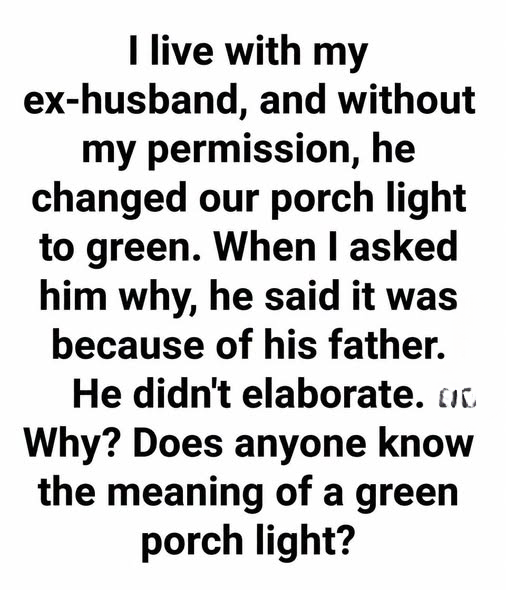
Living with an ex-husband is a strange emotional exercise.
For two years after our divorce, Darion and I continued sharing the small house we had once purchased as newlyweds.
It was not a romantic arrangement.
Housing costs in our area had increased rapidly, and neither of us could afford to move while continuing to pay our existing obligations. Selling the property immediately would have created a substantial financial loss.
So we developed rules.
Darion used the bedroom upstairs, while I moved into the former guest room. We purchased separate groceries, divided household expenses, and followed a schedule for laundry and kitchen use.
We did not ask about each other’s social lives.
From the outside, we appeared to be two polite roommates.
Inside the house, however, every room carried memories of the marriage that had ended.
The dining table was where Darion proposed. The kitchen wall still showed faint pencil marks from the home-improvement project we attempted together, and the porch light had once communicated something only the two of us understood.
A Marriage That Ended Quietly
Our marriage did not collapse because of one dramatic betrayal.
There was no affair, secret bank account, or explosive argument.
We simply stopped communicating.
During the early years, Darion and I talked about everything. We discussed our hopes, disappointments, work problems, and absurd observations from ordinary days.
Gradually, our conversations became logistical.
“Did you pay the electric bill?”
“Can you pick up groceries?”
“What time will you be home?”
We were both under pressure.
Darion had started a construction business and worked long hours trying to keep it operating. I was caring for my father, whose health had declined, while maintaining my own job.
Neither of us wanted to burden the other.
Unfortunately, in trying to protect each other from stress, we became emotionally isolated.
Darion stopped telling me when he was frightened about the business. I stopped discussing the exhaustion and grief I experienced while caring for Dad.
Small misunderstandings became resentment.
I interpreted Darion’s silence as indifference.
He interpreted my independence as proof that I no longer needed him.
By the time my father died, our relationship felt like another loss I did not have the strength to address.
We attended counseling twice, but neither of us spoke honestly. We were more interested in proving that the other person had withdrawn first.
Eventually, we agreed to divorce.
Life After the Divorce
The legal end of our marriage was peaceful.
We divided our finances, established ownership arrangements for the house, and agreed to sell when the market allowed us to do so without creating unnecessary hardship.
Until then, we remained under the same roof.
At first, the arrangement was uncomfortable.
We avoided entering the kitchen at the same time. If one of us watched television in the living room, the other remained behind a closed door.
Over time, our routines became easier.
Darion repaired things around the house without announcing it. I occasionally prepared enough soup for two people and left an extra bowl in the refrigerator without mentioning his name.
We were kind but distant.
I assumed that was the healthiest relationship we could manage.
Then, one evening, I came home and saw a green light glowing above the porch.
The Meaning of the Green Light
The green bulb had been our private signal during the first years of marriage.
Darion and I both struggled to begin difficult conversations. After an argument, we sometimes spent hours waiting for the other person to speak first.
One evening, while walking through a hardware store, I found a green porch bulb.
I jokingly told Darion that green meant permission to move forward.
We created a rule.
If either of us turned on the green porch light, it meant:
“I’m ready to talk. I may still be hurt or afraid, but I do not want silence to win.”
The signal worked because it removed the pressure of finding perfect opening words.
Sometimes Darion turned it on after an argument. Other times, I did.
We would sit on the porch and talk until we reached some understanding.
As the marriage became more difficult, we stopped using it.
The bulb remained in a kitchen drawer for years.
Now it was shining above me.
The Letter on the Porch
I stood beside the driveway, staring at the light.
My first reaction was anger.
We were divorced. Darion had no right to use an old symbol and expect me to reopen the past.
Then I noticed an envelope taped to the front door.
My name was written across it.
Inside was a short note.
“Meredith,
“I found the bulb while cleaning the kitchen drawer.
“I almost threw it away.
“Then I realized we spent two years living ten feet apart without having one honest conversation about how we reached this point.
“I am not asking you to reconcile.
“I am asking whether you would sit with me on the porch once, not as my wife, but as someone who shared twelve years of life with me.
“If the answer is no, turn off the light. I will understand.”
Darion was sitting on the porch steps.
He held two cups of tea.
I considered walking inside without speaking.
Instead, I sat in the chair opposite him.
The Conversation We Avoided for Years
For several minutes, neither of us spoke.
Then Darion apologized.
Not for one specific argument or the paperwork that ended our marriage.
He apologized for disappearing emotionally when I needed him.
“My business was failing,” he said. “I thought admitting that would make you feel even less secure.”
“Why didn’t you trust me enough to tell me?”
“I confused protecting you with excluding you.”
His answer reflected exactly what I had done to him.
During Dad’s final months, I refused help. When Darion offered to attend appointments or remain with my father so I could rest, I insisted I could handle everything.
I believed strength meant never needing anyone.
Darion experienced my refusal as rejection.
“I thought you didn’t want me involved,” he admitted.
“I wanted you to insist.”
“How was I supposed to know that?”
“You weren’t.”
For the first time, I acknowledged that I expected him to understand needs I never expressed.
We remained on the porch for three hours.
The conversation did not become a dramatic declaration of love. We did not decide to remarry beneath the green light.
We simply told the truth.
What Changed the Following Morning
The next day, the atmosphere inside the house felt different.
Darion made coffee for both of us. I thanked him rather than treating the gesture as dangerous.
We continued speaking.
Some conversations were uncomfortable. We discussed how work, grief, pride, and fear created distance between us.
We also acknowledged that divorce had not resolved every emotional issue. It merely formalized the distance we had already created.
Darion suggested returning to counseling.
I hesitated.
Counseling had failed before because we used it as a courtroom. Each of us collected evidence against the other and waited for the therapist to declare someone responsible.
This time, we agreed that counseling would not be a secret path back to marriage.
Its purpose would be understanding, closure, or, if appropriate, the careful exploration of a new relationship.
Starting With Boundaries
Our counselor encouraged us not to treat renewed communication as proof that reconciliation was inevitable.
Nostalgia can create powerful emotions, especially when two people continue living in a home filled with shared memories.
We established boundaries.
We maintained separate rooms and finances. We did not resume physical intimacy. We also avoided announcing anything to friends and relatives before we understood it ourselves.
Each week, we scheduled one conversation without phones or television.
Sometimes we discussed the marriage.
Other times, we spoke about current life.
I learned that Darion had taken business courses and stabilized his company. He learned that I had been attending a grief-support group and considering a career change.
We began getting to know one another again—not the versions we remembered, but the people we had become.
The First Real Date
Six months after the green light appeared, Darion asked whether I wanted to have dinner with him.
“Is this a date?” I asked.
“Only if you want it to be.”
I said yes.
We met at a restaurant rather than leaving from the house together. That small distinction mattered. We were not slipping automatically into familiar roles.
We were making a deliberate choice.
The evening felt awkward at first.
Then Darion told a terrible joke, and I laughed the way I had years earlier.
For the first time, I allowed myself to consider that our relationship might not be finished.
Why We Did Not Immediately Remarry
Friends sometimes tell stories of divorced couples who reunited, remarried quickly, and lived happily ever after.
That was not our path.
Love had never been our only problem. Communication, emotional avoidance, unrealistic expectations, and poor boundaries damaged our marriage.
Those patterns required consistent work.
For another year, Darion and I dated while continuing counseling. Eventually, the housing market improved, and we sold the house.
Rather than purchasing another property together, we moved into separate apartments.
Some people thought that meant the reconciliation had failed.
It did not.
Living separately allowed us to determine whether we chose each other freely or remained together because rent and familiarity made separation difficult.
We continued dating.
A year later, Darion proposed again.
This time, I did not answer immediately.
We discussed finances, work schedules, grief, conflict, and what each of us expected from marriage. We prepared agreements and plans rather than assuming love would solve every practical problem.
Then I said yes.
Our Second Wedding
Our second wedding was small.
There were no elaborate decorations and no attempt to recreate the ceremony from years earlier.
Near the entrance to the garden, Darion installed one green light.
During the vows, he said:
“I cannot promise that I will always know what you need. I can promise that I will ask instead of assuming.”
My promise was similar.
“I cannot promise that I will never withdraw. I can promise that I will tell you when I am afraid rather than expecting you to interpret my silence.”
Those promises were less romantic than the ones we made during our first wedding.
They were also more honest.
What the Green Porch Light Taught Us
The green light did not magically restore our marriage.
It created an opening.
What brought us back together was everything that followed: accountability, counseling, boundaries, separate growth, and the willingness to build a new relationship rather than revive the old one unchanged.
Reconciliation is not always the healthiest choice.
Some relationships end because of violence, coercion, repeated betrayal, or circumstances that make renewed contact unsafe. A symbolic gesture should never pressure someone to return to a harmful situation.
In our case, the marriage ended because two overwhelmed people stopped allowing themselves to be known.
We still cared for each other, but care without communication had not been enough.
The green light reminded us of a language we once created together.
It did not mean, “Forget what happened.”
It meant, “I am willing to speak honestly.”
A Signal We Still Use
Darion and I have now been remarried for several years.
We still disagree.
Occasionally, work becomes stressful, or one of us begins retreating into old habits.
A small green lamp sits near our living-room window.
When one of us turns it on, the meaning remains the same:
“I am ready to talk.”
Sometimes we resolve the problem in 10 minutes. Other times, we need space, reflection, or another counseling session.
The light does not guarantee an easy conversation.
It simply ensures that neither of us can pretend the conversation is unnecessary.
For two years, Darion and I lived under the same roof while maintaining a safe emotional distance.
We believed silence was protecting us from further pain.
In reality, it prevented healing.
One evening, a forgotten green bulb brought us back to the porch.
The most important moment was not when Darion turned it on.
It was when I chose not to turn it off.