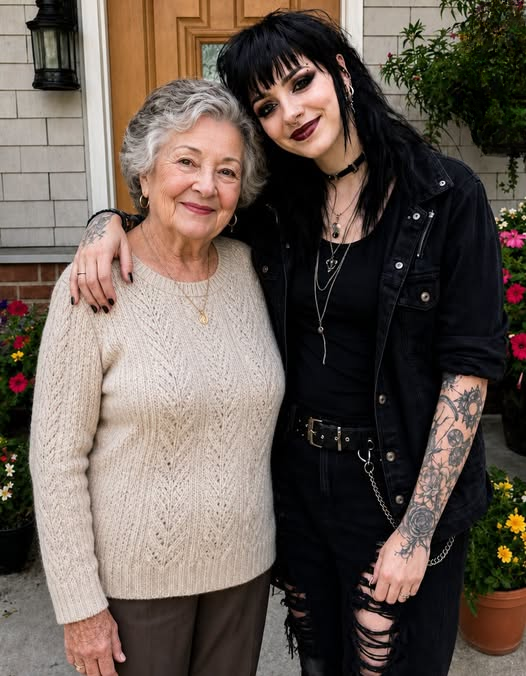
A Tattooed Young Woman Visited My Mother Every Saturday—After the Funeral, She Gave Me a Key and Revealed Their Secret
My mother, Doris, was one of the quietest people I knew.
At 73, she still lived in the modest house where I had grown up. She found happiness in simple routines: caring for her garden, attending a weekly book club, and drinking tea beside the kitchen window.
She dressed conservatively, avoided attention, and rarely spoke to strangers for longer than necessary.
That was why I was so surprised when I discovered a young woman named Raven sitting at Mom’s kitchen table.
Raven could not have been older than 25. She wore black clothing, heavy eyeliner, and several pieces of facial jewelry. Colorful tattoos covered both arms.
At first glance, she and my mother appeared to have nothing in common.
Yet they sat across from each other sharing tea and laughing like old friends.
“This is Raven,” Mom said. “She’s a friend.”
Raven smiled politely.
“It’s nice to meet you.”
I wanted to ask how they knew each other, but Mom immediately changed the subject.
“Would you mind going to the store?” she asked. “I forgot to buy milk.”
When I returned, Raven was gone.
The Saturday Visits
The following Saturday, Raven was there again.
Then she returned the week after that.
Before long, her visits became a regular part of my mother’s routine.
Raven arrived shortly after lunch and stayed for several hours. Sometimes she carried flowers. Other times, she brought books, pastries, or small plants for the garden.
Mom seemed happier after every visit.
Still, something about the friendship puzzled me.
Whenever I attempted to join them, Mom found a reason to send me elsewhere. She asked me to collect a prescription, purchase groceries, or check something in the garden.
By the time I returned, Raven had usually left.
I began to wonder whether Raven wanted something from her.
Perhaps she was asking Mom for money. Maybe she had recognized an older woman living alone and was taking advantage of her kindness.
I felt guilty for thinking that way, especially because Raven had never behaved disrespectfully.
My concern was based largely on how she looked.
I had always considered myself open-minded, yet I caught myself treating dark clothes, tattoos, and piercings as signs of danger.
One afternoon, I asked Mom directly.
“Who is Raven?”
“I told you. She’s my friend.”
“How did you meet?”
Mom looked toward the window.
“It’s complicated.”
“Is she asking you for money?”
My mother’s expression hardened.
“No. Raven has never asked me for anything.”
“I’m only trying to protect you.”
“I know,” she replied gently. “But sometimes protection becomes judgment before we realize it.”
That ended the conversation.
The Final Months
Raven continued visiting.
Mom seemed to wait for Saturdays with increasing excitement. She baked cakes, arranged flowers on the table, and occasionally bought small gifts.
I eventually stopped questioning the friendship.
Whatever they discussed appeared to bring my mother comfort.
Then, several months later, Mom suffered a severe stroke.
She was taken to the hospital, but her condition did not improve. She passed away shortly afterward.
The loss broke something inside me.
Although I had my own home and responsibilities, Mom had always been the center of my family. Her house was the place I returned to when life felt uncertain.
Without her, every room seemed unnaturally quiet.
Raven at the Funeral
At the funeral, I noticed Raven standing near the back.
She wore a simple black dress, and several of her piercings had been removed. Tears ran down her face throughout the service.
She did not approach the family or attempt to draw attention.
After most guests had left, Raven walked toward me.
For several seconds, she said nothing.
Then she placed an old-fashioned brass key in my hand.
“What is this?” I asked.
She folded my fingers around it.
“Your mother told me I was only supposed to give it to you after she was gone.”
I stared at her.
“A key to what?”
“The cedar chest in the attic.”
I knew the chest.
It had stood beneath the attic window for as long as I could remember. Whenever I asked about it as a child, Mom said it contained old family belongings.
The lock had no key, and I assumed it had been lost decades earlier.
“Why did my mother give the key to you?”
Raven looked terrified.
“Because the truth inside is about both of us.”
Opening the Cedar Chest
Raven followed me to Mom’s house.
We climbed the narrow attic stairs and found the chest beneath a faded sheet.
My hands shook as I inserted the key.
The lock opened easily.
Inside were letters tied with ribbon, a baby blanket, several photographs, and a thick envelope containing official documents.
The first photograph showed my mother as a teenager. She stood outside a hospital holding a newborn baby.
I had never seen the picture.
On the back, she had written:
“My son, Samuel. June 1967.”
I looked at Raven.
“Mom didn’t have a son.”
Raven lowered her eyes.
“Yes, she did.”
The Brother I Never Knew
When Mom was 17, she became pregnant.
Her parents were deeply concerned about social judgment and believed she could not raise a child alone. They arranged for the baby to be adopted.
Mom named him Samuel, but the adoptive family changed his name to Michael.
She was allowed to hold him only briefly.
Afterward, she was told never to speak about the pregnancy again.
Years later, Mom married my father and had me. She never told him about Samuel.
The secret remained buried for more than five decades.
Samuel grew up with loving adoptive parents and eventually had a daughter.
Raven.
She was my niece.
I sat on the attic floor, unable to speak.
“How did you find her?” I finally asked.
Raven explained that her father died several years earlier. Before his death, he admitted that he had always wondered about his biological family but feared that searching would hurt the parents who raised him.
After both adoptive parents passed away, Raven began researching on his behalf.
A DNA test connected her with one of Mom’s relatives. From there, she found Doris.
Their first meeting took place in a café.
“Your mother recognized Dad immediately when I showed her his photograph,” Raven said. “She started crying before I told her his name.”
Why Mom Kept Raven a Secret
Raven wanted Mom to tell me immediately.
Mom refused.
She feared I would feel betrayed.
“She kept saying she had lied for too many years,” Raven explained. “She thought you would stop loving her.”
“That’s ridiculous.”
“She didn’t think so.”
Mom also carried guilt that she had never searched for Samuel. She did not know that records and family pressure had made such a search extremely difficult. She believed she had abandoned him.
Raven repeatedly explained that her father had a happy childhood and never blamed his biological mother.
“He wanted to know where he came from,” Raven said. “But he didn’t spend his life feeling unwanted.”
The Saturday meetings allowed Mom to learn about the son she had lost.
Raven brought photographs, school reports, birthday cards, and recordings of her father’s voice. She told Mom about his career, marriage, humor, and favorite music.
In return, Mom shared family history and stories about her own childhood.
They were attempting to recover a relationship across generations.
My Mother’s Recorded Message
At the bottom of the cedar chest was a tablet wrapped in fabric.
Raven entered the password and opened a video.
My mother appeared on the screen, sitting at her kitchen table.
“My dear Claire,” she began, “if you are watching this, then I did not find the courage to tell you while I was alive.”
I covered my mouth.
Mom explained the pregnancy, adoption, and shame her parents imposed upon her.
“I convinced myself that silence protected everyone,” she said. “In truth, it protected me from facing my fear.”
She spoke about meeting Raven.
“When she first came to my door, I saw Samuel in her eyes. She has his smile and the same habit of tapping her fingers when she is nervous.”
Beside me, Raven immediately stopped tapping her fingers.
Mom continued.
“I should have introduced her as your niece. Instead, I called her a friend because I was afraid of losing your respect.
“Please do not blame Raven for keeping the secret. I asked her to wait.
“She gave me something I thought I would never have: the chance to know the person my son became.
“Claire, you have a family connection you never knew existed. Whether you choose to build a relationship with Raven is up to both of you.
“But please do not let my fear decide for you.”
The Letters Samuel Never Sent
The chest contained letters written by Samuel throughout different periods of his life.
Most were addressed simply to “My Birth Mother.”
He never knew where to send them.
One letter came from the year he became a father.
“I have a daughter now,” he wrote. “Holding her makes me wonder whether you were allowed to hold me. I hope you were. I hope someone told you I was safe.”
Another was written shortly before his death.
“I want you to know I had a good life. My parents loved me, and I loved them. Looking for you would never have erased that.
“If you are alive, I hope you were able to build a life without carrying shame.
“You gave me life. My parents helped me live it. There is room in my story for all of you.”
Mom had read every letter during Raven’s visits.
Her fingerprints appeared in the creases.
What the Key Really Opened
The key did more than unlock a wooden chest.
It opened a part of my family history that had been hidden before I was born.
At first, I felt angry with Mom.
She had allowed me to believe I was an only child. She met with Raven for months while repeatedly sending me out of the room.
I deserved the truth.
But as I read the letters, anger became more complicated.
My mother had been a frightened teenager living in a time when unmarried pregnancy carried intense stigma. Adults made decisions for her and instructed her to erase an entire chapter of her life.
Silence became a survival habit.
Even decades later, she could not easily escape it.
Understanding did not make the secrecy harmless.
It allowed me to see my mother as a complete human being rather than only as the person who raised me.
My First Conversation With My Niece
Raven and I remained in the attic for hours.
I asked about Samuel.
She told me he was a high-school art teacher who loved motorcycles, terrible science-fiction movies, and strong coffee.
“He would have liked you,” Raven said.
“How could you know?”
“Because you ask questions exactly the way he did.”
We laughed through our tears.
Then I apologized.
“For what?”
“For judging you when I saw you with Mom.”
Raven looked at her tattooed arms.
“You thought I was trying to take advantage of her.”
“I did.”
“Your mother thought that was funny.”
I groaned.
“She probably did.”
Raven explained that many of her tattoos were connected to people she loved. One represented her father. Another showed the flower Mom grew beside the kitchen window.
The appearance I treated as evidence that she and Mom had nothing in common actually carried their shared family history.
The Family We Chose to Build
Raven and I did not become close immediately.
Family relationships cannot be created by one key or a DNA connection alone.
We started with coffee.
Then we met for dinner and visited the art classroom where Samuel had taught. Raven introduced me to her mother and showed me albums filled with photographs.
Several months later, we held a small memorial beneath Mom’s favorite tree.
We placed copies of Samuel’s letters beside photographs of him and Doris.
For the first time, mother and son were represented together.
Looking Beyond Appearances
When I first saw Raven sitting in Mom’s kitchen, I focused on black clothing, piercings, and tattoos.
Mom saw her granddaughter.
I believed the two women were opposites. In reality, they shared humor, stubbornness, a love of books, and an extraordinary capacity for loyalty.
Raven had not visited every Saturday because she wanted money.
She came to return a lost son to the mother who had spent a lifetime grieving him in silence.
After the funeral, I expected the key to reveal financial documents or a hidden possession.
Instead, it gave me a brother whose life I could learn about and a niece I had nearly dismissed because of her appearance.
Mom’s secret hurt.
But her final message offered us a choice.
We could allow fear and judgment to continue separating the family—or we could begin again with the truth.
Raven still visits on Saturdays.
We sit at Mom’s kitchen table, drink tea, and read through Samuel’s letters.
Sometimes the house feels quiet.
But it no longer feels empty.