The Incredible Mother Scorpion: Discover How These Remarkable Creatures Protect Their Young
Nature is full of extraordinary examples of parental care. Across the animal kingdom, parents use different methods to protect their offspring, provide nourishment, and help their young survive during the earliest stages of life.
Some animals build carefully prepared nests, while others carry their babies wherever they travel. Certain species remain close to their offspring until they become independent, demonstrating that parental care takes many different forms.
One particularly fascinating example can be found among scorpions.
Although scorpions are often associated with their powerful pincers, venomous stings, and mysterious appearance, their reproductive behavior reveals a different side of these ancient animals.
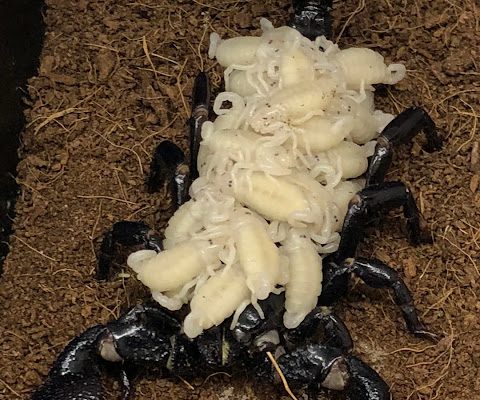
Female scorpions give birth to live young rather than laying eggs in the way many other invertebrates do. After birth, the tiny offspring climb onto their mother’s back, where they remain during an important early stage of development.
This remarkable behavior is one of the most recognizable examples of maternal care among arachnids.
The sight of a mother scorpion carrying numerous tiny offspring may seem unusual, but it serves an important biological purpose. The young are especially vulnerable immediately after birth, and staying on their mother’s body helps them remain together during their earliest days.
Let’s explore how this fascinating process works, why it matters, and what it teaches us about the incredible diversity of parental care in nature.
1. Scorpions Have a Remarkable Way of Giving Birth
One of the most interesting facts about scorpions is that they are generally viviparous, meaning they give birth to live young.
This makes their reproductive process different from that of many other invertebrates.
Depending on the species, the development of young scorpions can involve different reproductive strategies. In many species, embryos develop inside the female’s reproductive system before the young are born.
When the time comes, the female gives birth to small, pale offspring.
These newborn scorpions look noticeably different from fully developed adults.
Their bodies are soft and delicate, and their appearance may be almost translucent or whitish immediately after birth.
They are not yet ready to live independently.
Instead, they begin one of the most distinctive stages of their early development.
2. Why Baby Scorpions Climb Onto Their Mother’s Back
Soon after birth, young scorpions climb onto their mother’s back.
This behavior is especially fascinating because the mother does not need to build a nest or carry her offspring inside a pouch.
Instead, the tiny scorpions gather directly on her body.
They position themselves across her upper surface and remain there while their bodies develop.
For observers, the sight can be surprising.
A single female may carry numerous offspring at once, creating the appearance of a living cluster of miniature scorpions.
The behavior is commonly known as maternal transport.
It helps keep the young together during a vulnerable period when they are not yet fully prepared to move around independently.
Their mother’s body provides a temporary place of protection while they continue developing.
3. The First Days Are Especially Important
Newborn scorpions are physically different from adults.
Their outer coverings are initially soft, and they need time to develop the stronger external structure associated with mature scorpions.
Like other arthropods, scorpions grow by shedding their exoskeleton.
This process is called molting.
A newly born scorpion generally undergoes its first molt while still riding on its mother’s back.
After the molt, its external covering becomes firmer, and the young scorpion becomes better equipped to move independently.
This stage is important because the offspring gradually transition from depending on maternal transport to exploring their surroundings.
The timing of this process varies between species and environmental conditions.
Temperature, humidity, and other factors can influence development.
4. A Mother Scorpion Provides More Than Transportation
Carrying offspring on her back is one of the most recognizable aspects