The afternoon began like countless others.
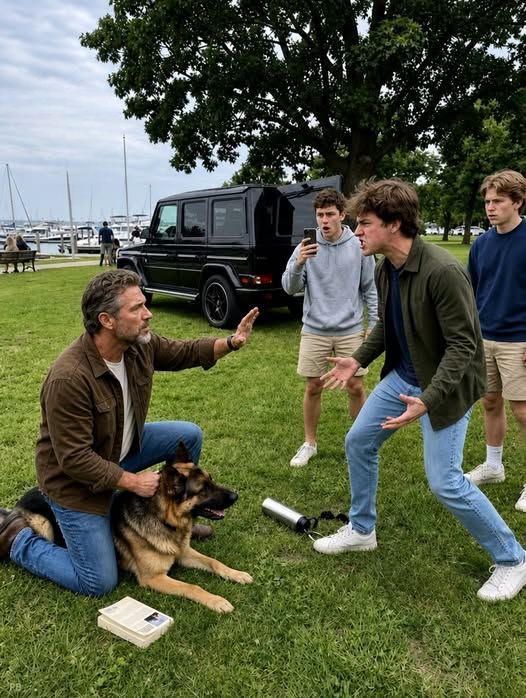
Kaiser and I were walking along the familiar path that circled Westport Park. The weather was mild, families were gathered near the playground, and several people were enjoying lunch beneath the trees.
Kaiser moved slowly beside me. At twelve years old, he no longer had the speed he once possessed, but he still carried himself with the quiet discipline that had defined his working years.
Before becoming my companion at home, Kaiser had served as a military working dog. He had been trained to detect dangerous materials and alert his team to potential threats. He remained calm in crowded environments and never reacted aggressively without a legitimate reason.
After his retirement, I was fortunate enough to adopt him.
To most people, he was an aging German shepherd with a gray muzzle. To me, he was a trusted partner and a member of my family.
We had nearly completed our walk when three young men stepped onto the path ahead of us.
I recognized one of them immediately.
Trent Harrington was nineteen years old and belonged to one of the wealthiest families in the region. His father, Arthur Harrington, owned several businesses and was a major financial contributor to local projects and political campaigns.
Trent was known around town for reckless behavior, but complaints involving him seemed to disappear before they reached court.
One of his friends, Logan, was holding a phone and broadcasting a livestream to his followers. Another young man stood behind them, laughing at something Trent had said.
As we approached, Trent moved into the center of the path.
“That dog looks ancient,” he said.
I shortened Kaiser’s leash and attempted to walk around him.
“We’re not interested in entertaining you,” I replied.
Trent stepped sideways and blocked us again.
“What happened to him?” Logan asked from behind the camera.
“He’s retired,” I said. “Please let us pass.”
Trent removed his sunglasses and looked at Kaiser.
“Retired from what?”
“Military service.”
That answer caught Logan’s attention. The phone moved closer, framing Kaiser and me in the video.
Instead of showing respect, Trent laughed.
“Let’s find out whether he still remembers how to fight.”
He moved his foot toward Kaiser.
Kaiser stepped backward and released one warning bark. His leash remained short, and he made no attempt to move toward Trent.
I placed myself between them.
“That is enough,” I said. “Stay away from my dog.”
Trent lifted the metal water bottle he had been carrying. Before I could move Kaiser completely out of reach, Trent swung the bottle and struck him near the ear.
Kaiser cried out and fell beside my boots.
For one terrible moment, the park became silent.
Then several people began shouting.
I caught Trent’s wrist before he could swing again and moved the bottle away from him. I held his arm only long enough to prevent a second strike, then released him and stepped back.
“You will not touch him again,” I said.
My voice remained controlled, although every instinct urged me to react more forcefully.
Twenty-two years in the United States Navy had taught me that anger could make a dangerous situation worse. My priority was Kaiser—not punishing the person who had hurt him.
I immediately knelt beside my dog.
“Easy, partner,” I whispered. “I’m here.”
Kaiser was conscious, but a small injury was visible near his ear. He tried to rise, and I gently encouraged him to remain still.
Several witnesses moved closer. A woman called the police while another person offered me a clean cloth.
Logan continued holding the phone.
“The livestream is still running,” he said nervously.
Trent looked directly at the camera. For the first time, he appeared to understand that hundreds—or possibly thousands—of people had seen what happened.
Instead of apologizing, he straightened his shirt and pointed toward Kaiser.
“That dog tried to attack me,” he announced.
“No, he didn’t,” Logan replied.
Trent stared at his friend.
“Turn that off.”
Logan hesitated.
“Now!” Trent shouted.
The livestream ended, but the recording had already been viewed, shared, and saved by numerous people.
Trent leaned toward me.
“You have no idea who you’re challenging,” he said. “My father practically controls this town.”
I did not respond. I was too concerned about Kaiser to waste time arguing.
Trent and his companions left before the local police arrived. When the officers finally reached the park, I gave them my name, the contact information of several witnesses, and a description of the vehicle.
One officer photographed the area near Kaiser’s ear. Another wrote down Logan’s name and noted that a video existed.
I then carefully helped Kaiser into my truck and drove him to an emergency veterinary clinic.
An Unexpected Arrest
The veterinarian examined Kaiser and treated his injury. Fortunately, there was no skull fracture or severe internal damage. He needed several stitches and would have to remain under observation, but the doctor expected him to recover.
I felt an enormous sense of relief.
The clinic provided a written report documenting the location and likely cause of the injury. I photographed every page and sent copies to my attorney, a veterans’ organization, and a former Navy colleague who now worked in state law enforcement.
I also downloaded multiple copies of Logan’s livestream. People had already uploaded recordings to several platforms, making it nearly impossible for anyone to erase completely.
Later that evening, I returned home with Kaiser.
He was resting near the fireplace when police vehicles pulled into my driveway.
Chief Lawson stepped onto the porch with two officers.
“You are under arrest for assaulting Trent Harrington,” he said.
“Trent injured Kaiser,” I replied. “Several witnesses saw it, and there is video.”
Lawson’s expression did not change.
“Mr. Harrington claims his son acted in self-defense.”
“The recording shows otherwise.”
“You can explain that at the station.”
I realized that arguing on the porch would accomplish nothing. I asked whether Kaiser could remain with my neighbor, who had already offered to watch him. Once that was arranged, I allowed the officers to place me in handcuffs.
Before leaving, I looked toward Kaiser.
“Stay, partner.”
He slowly lifted his head.
At the police station, I was placed in an interview room and left alone for almost two hours.
No one asked to see the veterinary records. No detective requested the witness list. It was becoming clear that the purpose of my detention was not to conduct a fair investigation.
Eventually, the door opened.
Arthur Harrington entered wearing a carefully tailored suit. Chief Lawson followed him but remained near the doorway.
Arthur sat across from me as though we were discussing a business arrangement.
“My son says your dog attacked him,” he said.
“Your son is lying.”
Arthur gave a faint smile.
“That may be your opinion.”
“It is recorded evidence.”
“Recordings can be misunderstood. People see what they expect to see.”
I remained silent.
He leaned forward.
“By tomorrow, Trent will be described as the victim of an unstable veteran who could not control a dangerous animal. You will face criminal charges, and the town will demand that the dog be removed.”
His confidence explained why Trent had behaved as though consequences were impossible.
Arthur believed influence could rewrite anything.
What he did not know was that copies of the video, witness statements, and veterinary report had already been sent beyond Westport. A state investigator had confirmed receiving the material shortly before my arrest.
Arthur stood.
“You should have thought carefully about whom you were challenging.”
Footsteps sounded in the hallway.
Chief Lawson looked toward the door, and his expression changed.
A firm voice came from outside.
“Captain Hayes?”
Arthur’s face lost its confidence.
The person entering the room was Commander Rebecca Cole, an investigator with the state police’s public-integrity unit. Beside her stood an assistant district attorney from another county and a representative from the state’s animal-welfare enforcement division.
They were not there to negotiate.
Evidence That Could Not Be Ignored
Commander Cole placed a tablet on the table.
“Before we discuss anything else,” she said, “Captain Hayes is no longer being questioned without his attorney present.”
She turned to Chief Lawson.
“We have reviewed the livestream, statements from nine witnesses, security footage from a nearby café, and the veterinary report. None of that evidence supports the allegation that Kaiser attacked Mr. Harrington.”
Lawson attempted to interrupt.
Cole continued.
“We also have concerns about why Captain Hayes was arrested before witnesses were interviewed or the available video was formally reviewed.”
Arthur stepped forward.
“This is a local matter.”
“Not anymore,” Cole replied.
My attorney arrived several minutes later. After a short conversation, I was released without charges.
Meanwhile, an independent investigation began into Trent’s conduct and the police department’s handling of the complaint.
Logan voluntarily provided the original livestream file. It included the minutes before the incident, clearly showing Trent discussing his plan to provoke Kaiser. The recording also captured Trent trying to kick the dog and Kaiser stepping backward.
Most importantly, it showed that Kaiser never lunged at or attempted to bite anyone.
Logan admitted that Trent had pressured him to delete the video and repeat the self-defense story. He refused.
“I should have stopped filming and helped,” he later told investigators. “But I’m not going to lie about what happened.”
The other friend also provided a statement confirming the sequence of events.
Within days, the charges against me were formally dismissed. Trent was charged in connection with harming the dog and providing false information to investigators. The final outcome was determined through the legal process rather than public anger.
Chief Lawson was placed on administrative leave while state officials examined his communication with the Harrington family. Investigators eventually discovered that Arthur had contacted him before officers arrived at my cabin.
Arthur could no longer claim that he had merely been protecting his son. His effort to influence the investigation had become part of the inquiry.
Kaiser’s Recovery
Public attention was intense, but I avoided most interviews.
I did not want Kaiser’s service reduced to a dramatic headline. I wanted him to recover in peace.
For several days, he slept more than usual and followed me closely whenever I moved around the cabin. The veterinarian explained that physical healing might be quicker than rebuilding his sense of security around unfamiliar people.
We returned to the park gradually.
During our first visit, Kaiser stopped near the location of the incident. I gave him time to observe his surroundings without pulling the leash or forcing him forward.
Then a little girl approached with her mother.
“May I say hello?” she asked.
I looked at Kaiser. His posture was relaxed, so I gave permission and showed her how to offer the back of her hand.
Kaiser sniffed gently and allowed her to touch his shoulder.
His tail moved once.
It was a small moment, but it felt like a victory.
What the Livestream Truly Revealed
The livestream did more than document one person’s cruelty. It showed how quickly a false story could be constructed when wealth and influence were involved.
It also showed why evidence must be preserved and investigated properly.
Without the recording, the case might have become my word against Trent’s. Because Logan kept filming and viewers saved copies, investigators could examine what occurred instead of relying on status or reputation.
Several months later, Kaiser and I attended a community event supporting retired service animals. Donations helped establish a local fund for veterinary treatment and adoption assistance.
Logan attended as well. He apologized to me and asked whether he could volunteer.
I told him that recording the truth mattered, but standing against harmful behavior before someone was injured mattered even more.
He nodded.
“I understand that now.”
Kaiser eventually returned to his normal routine. The hair near his ear grew back, leaving only a small scar that was difficult to see beneath his coat.
As for me, I learned something I should have understood long before that afternoon: powerful people may believe they can control a story, but confidence is not the same as truth.
Trent expected fear to protect him.
Arthur expected influence to erase the evidence.
Chief Lawson expected his badge to prevent questions.
They all forgot one thing.
The truth had already been witnessed, recorded, and placed beyond their control.
And throughout it all, Kaiser responded exactly as he had been trained to respond—with discipline, patience, and trust.
He had protected people throughout his years of service.
This time, it was our responsibility to protect him.
This is a fictional story created for entertainment and reflection.