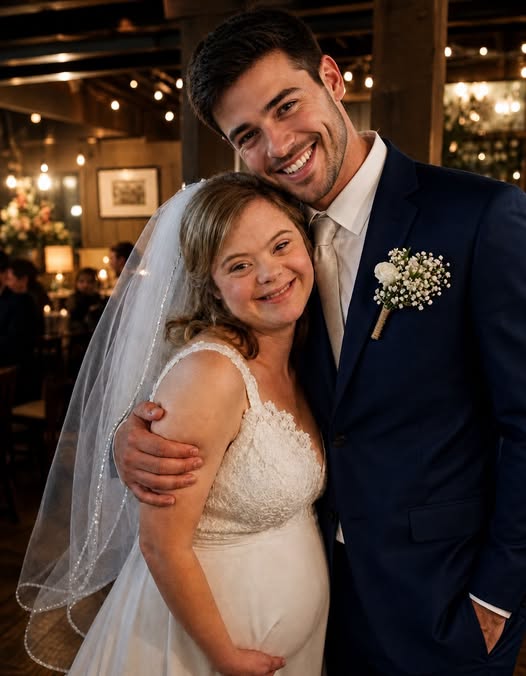
My Best Friend Married My Sister, and Years Later He Revealed a Secret That Changed How I Saw Their Relationship
My sister Rosie is one year younger than me.
From the moment she was born, our family understood that her life might look a little different from mine.
Rosie has Down syndrome, and while our parents always encouraged her to become as independent as possible, growing up wasn’t always easy.
Children can be remarkably cruel when they don’t understand differences.
At school, Rosie sometimes encountered classmates who didn’t know how to interact with her. Some ignored her. Others made insensitive comments. There were moments when she came home upset because someone had laughed at the way she spoke or treated her as though she couldn’t participate in something simply because she had a disability.
Whenever that happened, I tried to remind her of something important.
“You’ll always have me,” I’d tell her.
And there was another person I knew she could count on.
My best friend, Ben.
Ben Was Always Part of Our Family
Ben and I had been friends for years.
Our friendship began when we were children, long before either of us understood how complicated adulthood could become.
He spent so much time at our house that my parents eventually stopped treating him like a guest.
He knew where we kept the snacks.
He knew which television remote worked properly.
He knew which floorboard creaked when someone stepped on it at night.
And, most importantly, he knew Rosie.
Unlike some people who met her and immediately focused on what she couldn’t do, Ben seemed to notice what she could do.
He talked to her normally.
He joked with her.
He listened when she spoke.
And when she wanted to join whatever my friends and I were doing, he never acted as though her presence was an inconvenience.
One memory from elementary school stayed with me for years.
We were playing a game during recess, and teams were being chosen.
Rosie was standing nearby, watching.
Some of the children hesitated when it was time to choose her.
Before anyone could say anything, Ben raised his hand.
“She’s on our team.”
That was it.
No speech.
No dramatic gesture.
Just a simple decision that told Rosie she belonged.
She smiled for the rest of the afternoon.
The Joke That Became Something More
When we were around nine or ten years old, Ben once joked that he would take Rosie to prom when we were older.
“I’m calling it now,” he announced.
Rosie laughed.
I rolled my eyes.
“You don’t even know what prom is.”
“I don’t care,” Ben replied. “I already promised.”
It was the kind of silly promise children make without thinking about the future.
None of us imagined that years later, that childhood joke would become something we remembered for an entirely different reason.
Because Ben eventually did become part of Rosie’s future.
But not in the way any of us expected.
Everyone Thought Ben and I Would End Up Together
Ben and I were incredibly close.
We grew up together.
We knew each other’s families.
We shared secrets, argued over stupid things, supported each other through difficult periods, and remained friends when other relationships came and went.
Naturally, people assumed there was something romantic between us.
Family members teased us.
Friends made comments.
At different points, people even asked when we were finally going to admit that we liked each other.
But the truth was simpler.
Ben and I were best friends.
There was affection, loyalty, and trust between us, but it wasn’t romantic.
Then Ben surprised everyone.
He proposed to Rosie.
The Proposal Nobody Expected
When Ben told me he wanted to marry Rosie, I initially didn’t know what to say.
Not because I thought Rosie wasn’t capable of love.
And not because I thought she couldn’t have a meaningful relationship.
My hesitation came from the fact that Ben had been my best friend for so many years.
The idea of him becoming part of my immediate family felt enormous.
Then I saw Rosie’s face.
She was happier than I’d ever seen her.
She couldn’t stop smiling.
She kept looking at the ring on her finger as though she couldn’t quite believe it was real.
That was when my doubts disappeared.
I hugged her.
Then I hugged Ben.
And eventually, I started crying.
Rosie laughed.
“You’re crying more than me!”
“I know,” I said.
She laughed even harder.
Their Marriage Was About More Than a Wedding
Their relationship wasn’t perfect.
No relationship is.
They disagreed about ordinary things.
They had different preferences.
They occasionally frustrated each other.
But they also learned how to communicate, compromise, and support one another.
Most importantly, Ben never treated Rosie as someone who needed to be rescued.
He treated her as his wife.
Rosie made decisions.
She had opinions.
She had goals.
She had things she wanted from life.
And Ben respected those things.
Our family gradually became accustomed to seeing them together.
The strange thing was that what had initially seemed surprising eventually became completely normal.
Ben wasn’t “my best friend’s husband” anymore.
He was simply my brother-in-law.
Rosie wasn’t the little girl everyone had once worried about protecting.
She was an adult building a life of her own.
And I couldn’t have been prouder of her.
Then Rosie Told Us She Was Pregnant
A few years into their marriage, Rosie and Ben gave our family some incredible news.
Rosie was pregnant.
Everyone was thrilled.
Then we learned there were actually two babies.
Twins.
The excitement in our family was almost impossible to describe.
My parents immediately started making plans.
I started looking at tiny baby clothes.
Ben became obsessed with researching everything from car seats to strollers.
Rosie talked constantly about becoming a mother.
She was nervous, of course.
Anyone facing such a major life change would be.
But she was also excited.
She had already begun imagining what her children would be like.
She talked about the names they might choose.
She wondered which baby would be born first.
She joked about how much work two babies would be.
And every time she talked about them, her face lit up.
For a while, everything seemed wonderful.
Then the pregnancy became more complicated.
The Hospital Call
At thirty-four weeks, Rosie suddenly needed urgent medical attention.
The phone call came unexpectedly.
One moment, everything seemed normal.
The next, our family was rushing to the hospital.
Doctors and nurses moved quickly.
There were tests.
There were consultations.
There were conversations we barely understood because our minds were overwhelmed by fear.
The twins were still premature.
And Rosie was facing a serious medical situation.
Nobody could tell us exactly how everything would unfold.
All we could do was wait.
Ben stayed near me in the hospital corridor.
He barely spoke.
He looked exhausted.
I had never seen him so frightened.
This was the same person who had always been calm when everyone else was panicking.
Now he looked like someone trying desperately to hold himself together.
The Longest Wait of Our Lives
The hours seemed endless.
Family members sat together without speaking.
Someone would occasionally stand up and walk down the hallway before returning a few minutes later.
Every time a doctor appeared, everyone’s attention immediately turned toward them.
We wanted answers.
But medicine doesn’t always provide certainty immediately.
The doctors were doing everything they could.
We could only wait.
Eventually, Rosie was taken for emergency treatment.
Ben watched her disappear through the doors.
Then he sat beside me.
For several minutes, neither of us spoke.
I could hear the faint sounds of hospital equipment from somewhere down the hallway.
Ben looked down at his hands.
They were trembling.
I reached over and touched his shoulder.
“We’re going to get through this,” I said.
I wasn’t sure whether I was telling him or myself.
He nodded.
Then something changed in his expression.
He looked at me.
“There’s something I need to tell you.”
A Promise Rosie Had Made Him Keep
I turned toward him.
“What?”
Ben took a deep breath.
“Before they took Rosie away, she said something to me.”
My heart immediately started racing.
“What did she say?”
He looked toward the doors where Rosie had disappeared.
“She made me promise that if something happened and she couldn’t explain it herself, I would tell you something.”
I stared at him.
“What kind of something?”
Ben didn’t answer immediately.
Instead, he reached into his jacket.
He pulled out a folded piece of paper.
I looked at it.
“What is that?”
“Something Rosie gave me.”
My hands were suddenly cold.
“Why didn’t she give it to me herself?”
“She wanted me to wait.”
“Wait for what?”
Ben looked at me.
“Until you were ready to understand something about her.”
The Letter
He handed me the paper.
I unfolded it carefully.
The handwriting was unmistakably Rosie’s.
My eyes immediately filled with tears.
The first sentence was simple.
But it completely changed what I thought I knew.
I read it again.
Then again.
I couldn’t speak.
Ben watched me.
“What does it say?” he asked.
I looked up at him.
“You already know?”
He nodded.
“She told me.”
I looked back at the page.
The letter wasn’t about money.
It wasn’t about an inheritance.
It wasn’t about some secret scheme.
It was about something much more personal.
Something Rosie had apparently carried quietly for years.
Rosie Had Been Thinking About My Life Too
The letter explained that Rosie had always known how protective I could be.
She knew I worried about her.
She knew I sometimes wondered whether she would be able to build an independent life.
She knew I occasionally treated her more like someone I needed to protect than someone who could make her own choices.
And she wanted me to understand something.
She didn’t want to spend her entire life being defined by what other people thought she could or couldn’t do.
She wanted to make her own decisions.
She wanted relationships built on respect.
She wanted to become a mother.
And she wanted me to trust her.
The words hit me harder than I expected.
I had always believed that supporting Rosie meant protecting her from disappointment.
But perhaps sometimes support meant allowing her to take risks, make choices, and live her own life.
Then I Read the Part About Ben
The next section was about Ben.
Rosie wrote that she had never married him because she needed someone to take care of her.
That was not what she wanted.
She married him because he listened to her.
Because he respected her.
Because he made her laugh.
Because he never treated her as though she were incapable of having dreams.
And because he loved her.
The letter explained something else that made me stop reading.
Rosie knew there were people who would question their relationship.
She knew some people would assume Ben had married her because he felt sorry for her.
Others might assume he had some hidden motivation.
She hated those assumptions.
Because they ignored the simplest explanation.
They loved each other.
I Had Been Looking at Their Relationship Through the Wrong Lens
I suddenly realized that I had been guilty of something I had never intended.
I had spent years worrying about whether Rosie was being treated fairly.
That was understandable.
But somewhere along the way, I had started seeing every decision involving her through the lens of protection.
Ben saw something different.
He saw Rosie as a person.
Not a diagnosis.
Not a list of limitations.
Not someone whose life needed to be controlled by everyone around her.
A person.
My sister.
His wife.
And now, a mother waiting to meet her children.
I looked at Ben.
“Why didn’t you ever tell me this?”
He wiped his eyes.
“Because it wasn’t my story to tell.”
That answer stayed with me.
He had kept Rosie’s confidence.
Even when I might have wanted answers, he respected her privacy.
Then the Hospital Doors Opened
Before I could say anything else, a doctor approached us.
We immediately stood.
The expression on his face was serious, but calmer than before.
He told us that the medical team had stabilized Rosie.
The twins had been delivered safely and were receiving specialized care because they were premature.
But they were alive.
Rosie was alive.
For several seconds, none of us moved.
Then Ben covered his face with both hands.
I started crying.
Not the frightened kind of crying from earlier.
This time, the tears came from relief.
Our family had been given the news we desperately needed.
There would still be challenges ahead.
Rosie needed monitoring.
The babies needed medical attention.
Nobody was pretending everything was suddenly perfect.
But we had hope.
Meeting the Babies
The twins spent time receiving care in the hospital.
Eventually, family members were allowed to see them under the hospital’s rules.
They were tiny.
Much smaller than I had imagined.
But they were fighters.
Ben stood beside the neonatal unit, staring at them through the glass.
I had never seen him look so proud.
Rosie was still recovering, but when she was finally able to see her babies, her expression was unforgettable.
She cried.
Ben cried.
My parents cried.
And yes, I cried too.
It was one of those moments when nobody cared who was watching.
Rosie Was Still Rosie
As the weeks passed, Rosie continued recovering.
There were appointments.
There were sleepless nights.
There were moments of anxiety.
There were also countless beautiful moments.
She learned the twins’ routines.
She figured out what made them laugh.
She developed her own way of soothing them.
And she became increasingly confident as a mother.
Our family helped where appropriate, but we also learned to step back.
That was perhaps one of the most important lessons.
Helping someone doesn’t mean taking control of their life.
Sometimes helping means asking:
“What do you need?”
Instead of assuming:
“I know what’s best for you.”
Ben Eventually Explained Everything
Months later, Ben and I sat together and talked about the letter.
I asked him how long he had known what Rosie had written.
He said he had known for some time.
“She wanted you to understand that I didn’t marry her because of anyone else,” he said.
“I know,” I replied.
He shook his head.
“I don’t think you did before.”
I smiled sadly.
He was right.
I had always trusted Ben.
But I hadn’t fully understood what his relationship with Rosie meant.
I had been looking at it through my own fears.
He had been living it.
The Question I Had Been Asking Was Wrong
For years, I had unknowingly asked myself:
“Why would Ben marry Rosie?”
But the better question was:
“Why wouldn’t he?”
Rosie was funny.
She was affectionate.
She was stubborn when she wanted to be.
She had dreams.
She had flaws.
She had a personality that had nothing to do with her diagnosis.
She could make people laugh.
She could be incredibly thoughtful.
She could also drive us all crazy.
In other words, she was human.
The idea that someone could genuinely fall in love with her shouldn’t have been surprising.
What was surprising was how long it took me to recognize that I had been allowing other people’s assumptions to influence the way I viewed her life.
The Meaning of Ben’s Promise
I remembered the childhood joke.
“I’ll take Rosie to prom.”
At the time, we all laughed.
Years later, I realized there was something meaningful about that memory.
Ben had always treated Rosie as someone who belonged.
He didn’t see her as an outsider.
He didn’t wait until adulthood to decide that she deserved inclusion.
That attitude had been present since childhood.
But their marriage wasn’t the fulfillment of a childhood joke.
It was something much more important.
It was two adults choosing each other.
What Rosie Wanted Me to Understand
The letter had one central message.
Rosie wanted me to stop measuring her life by other people’s expectations.
She knew she had Down syndrome.
She knew that certain things might be more difficult for her.
She also knew that difficulty wasn’t the same thing as impossibility.
She wanted opportunities.
She wanted responsibility.
She wanted relationships.
She wanted to make mistakes.
She wanted to learn.
She wanted to be trusted.
And most importantly, she wanted to be seen as Rosie.
Not as a diagnosis.
That distinction changed me.
Families Can Be Protective Without Realizing It
When someone we love has additional challenges, protection can become instinctive.
We want to prevent disappointment.
We want to make life easier.
We want to keep them safe.
Those instincts come from love.
But there is a line between support and control.
Adults with disabilities deserve opportunities to express preferences, participate in decisions, build relationships, and pursue meaningful goals according to their individual abilities and circumstances.
The right kind of support should help a person exercise their own choices rather than automatically making those choices for them.
Rosie taught me that without ever giving a lecture.
She simply lived her life.
Their Story Changed My Definition of Strength
Before this experience, I had thought strength meant protecting someone when life became difficult.
Now I think strength can also mean trusting someone enough to let them live.
Rosie had spent years proving that she could grow.
Ben had spent years encouraging her.
And I had spent years worrying.
The hospital experience forced me to see the difference.
Sometimes the people we love don’t need us to build walls around them.
They need us to stand beside them while they walk through those walls themselves.
The Family Became Closer
The twins changed our entire family.
There were countless exhausting days.
There were bottles, diapers, appointments, and sleepless nights.
There were moments when everyone felt overwhelmed.
But there was also laughter.
There were photographs.
There were first smiles.
There were little milestones that felt enormous.
Rosie loved showing us every new thing the babies did.
Ben became the kind of father who took too many photographs.
My parents became enthusiastic grandparents.
And I became the aunt who was constantly bringing gifts that the babies didn’t need.
Life became busy.
Messy.
Loud.
And wonderful.
What I Learned About Love
The experience taught me that love isn’t always dramatic.
Sometimes it looks like listening.
Sometimes it looks like respecting someone’s decision even when you would choose differently.
Sometimes it means standing beside someone in a hospital corridor without knowing what to say.
Sometimes it means keeping a promise.
And sometimes it means allowing another person to become more independent even though part of you is afraid.
Ben’s relationship with Rosie wasn’t a mystery that needed solving.
It was simply a relationship.
They had good days.
They had difficult days.
They supported each other.
They disagreed.
They laughed.
They built a family.
And they chose to remain together.
I Never Forgot That Letter
I still remember the moment I opened Rosie’s letter.
I remember the hospital hallway.
I remember Ben’s trembling hands.
I remember the fear of not knowing whether my sister and her babies would be okay.
And I remember the realization that came afterward.
The biggest surprise wasn’t some hidden scandal.
It wasn’t money.
It wasn’t an inheritance.
It wasn’t a secret plan.
The real revelation was much more personal.
I realized that I had underestimated someone I loved.
Rosie didn’t need me to decide what her life should look like.
She needed me to believe that she could help shape it herself.
Years Later
The twins eventually grew into energetic little children.
They became part of every family gathering.
Rosie became more confident as a mother.
Ben remained the same supportive partner he had always been.
And our family changed too.
We became more careful about the assumptions we made about other people’s abilities.
We learned that disability doesn’t erase individuality.
We learned that relationships shouldn’t automatically be dismissed because they look different from what society expects.
And we learned that support should involve respect.
Most importantly, I learned something about my sister.
Rosie had never been waiting for someone to give her permission to live.
She had been living all along.
I was simply learning to see it.
Final Thoughts
There are moments in life when an unexpected event forces us to reconsider something we thought we already understood.
For me, that moment came in a hospital hallway while my sister was receiving emergency medical care.
I thought Ben was about to reveal some terrible secret.
Instead, he helped me understand something I had overlooked for years.
He hadn’t married Rosie because he felt sorry for her.
He hadn’t married her because he needed something from our family.
He hadn’t married her as part of some hidden plan.
He married her because he loved her.
And Rosie chose him for the same reason.
Their relationship wasn’t defined by her disability.
It was defined by who they were as people.
The letter Rosie left behind reminded me that sometimes the people we try hardest to protect are the same people who can teach us the most about independence, courage, and trust.
I will always be protective of my sister.
That’s what siblings do.
But now I understand that protecting someone doesn’t mean deciding their future for them.
Sometimes the greatest form of love is giving someone room to choose their own path—and being there to support them along the way.
Rosie didn’t need anyone to prove that she deserved happiness.
She simply deserved the same opportunity to pursue it as anyone else.
And Ben understood that long before I did.