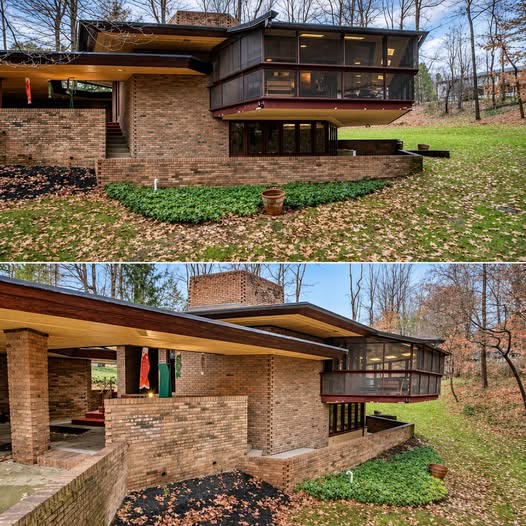
Inside This Mid-Century Modern Akron Home Where Wright-Inspired Design Meets Everyday Comfort
Some houses are memorable because they are enormous.
Others stand out because of their address, their history, or the price attached to them.
And then there are homes that capture attention for a completely different reason: their design.
This distinctive residence in Akron, Ohio, belongs in that category.
With its mid-century modern character, strong architectural geometry, natural materials, expansive windows, and carefully considered relationship between indoor and outdoor spaces, the home offers a look at a style that continues to attract homeowners decades after it first became popular.
Its design also reflects an architectural tradition strongly associated with Frank Lloyd Wright.
That distinction is important.
A home can be Wright-inspired without having been designed by Wright himself. Across Ohio, Wright’s ideas influenced generations of architects and homeowners, particularly through principles such as horizontal lines, natural materials, open living areas, built-in elements, and a close relationship between a house and its landscape. Ohio is home to several genuine Wright-designed residences, including Usonian houses that demonstrate those principles.
This Akron property takes that broader design language and turns it into something distinctly livable.
Rather than relying on elaborate decoration, its appeal comes from proportion, materials, light, and the way its rooms connect.
And that is exactly what makes mid-century modern homes so interesting.
A Different Approach to Home Design
Mid-century modern architecture developed during a period when architects were rethinking what an American home could be.
The traditional idea of a house divided into numerous separate rooms was increasingly challenged by designs that emphasized openness, functionality, natural light, and connections to the outdoors.
The result was a style that could look simple from a distance but become remarkably sophisticated when experienced from inside.
The architecture often depended on a relatively small number of elements:
- Clean horizontal and vertical lines
- Large areas of glass
- Natural wood
- Brick or stone
- Open interior layouts
- Built-in storage and furnishings
- Strong relationships between rooms
- Carefully framed outdoor views
- Functional spaces without excessive ornament
Wright’s work played an important role in developing the American conversation around organic architecture, although mid-century modernism was much broader than Wright alone.
His Usonian houses, in particular, were generally designed as practical residences with an emphasis on nature and the relationship between the building and its surroundings.
That philosophy can still be seen in many homes inspired by his work.
Why Wright’s Influence Remains So Popular
Frank Lloyd Wright’s architecture continues to influence residential design because many of his ideas remain relevant.
He wasn’t simply interested in creating unusual-looking buildings.
He was interested in how people experienced those buildings.
A room could be designed around a fireplace.
A window could be positioned to frame a tree or landscape.
A low roofline could visually connect a building to the ground.
Materials could be selected not merely for appearance but because they helped the structure feel connected to its surroundings.
Those ideas helped establish a design vocabulary that would continue influencing architects long after Wright’s major period of work.
Ohio provides some particularly interesting examples.
The Westcott House in Springfield was completed in 1908 and is recognized as the earliest Wright-designed house in Ohio. Later Usonian residences demonstrated how Wright adapted his architectural philosophy to smaller and more practical homes.
The state also contains houses designed by Wright that use strong geometry, natural materials, broad glazing, and integrated interior elements.
So when a mid-century home in Akron is described as Wright-inspired, the comparison isn’t difficult to understand.
The Beauty of Simplicity
One of the most appealing characteristics of this architectural tradition is its restraint.
The home doesn’t need elaborate decoration to make an impression.
Instead, the architecture itself provides the visual interest.
A carefully placed wall.
A long roofline.
A broad window.
A section of natural wood.
A stone surface.
A change in ceiling height.
These seemingly simple elements can dramatically change how a room feels.
That’s part of the reason mid-century modern interiors often photograph so well.
There is less visual clutter.
The eye can move naturally from one architectural feature to another.
Furniture becomes part of the composition rather than competing with it.
Natural light becomes another design element.
And outdoor views can function almost like artwork.
Windows That Become Part of the Architecture
Windows are particularly important in homes influenced by organic modernism.
Instead of treating windows merely as openings for ventilation or daylight, architects often used them to establish a visual connection between the interior and exterior.
A large window can make a room feel larger.
A row of windows can emphasize a home’s horizontal structure.
A carefully framed view can bring trees, gardens, or changing seasons into the living space.
This approach remains highly desirable today.
Modern homeowners frequently want homes that feel bright and connected to their surroundings, but that doesn’t necessarily mean creating a completely glass-walled building.
The key is intentional placement.
A well-positioned window can accomplish more than dozens of randomly placed ones.
It can direct attention.
It can establish privacy.
It can bring morning light into a bedroom or afternoon light into a living area.
And it can make the surrounding landscape feel like part of the home.
Natural Materials Add Warmth
Another defining characteristic of Wright-influenced and mid-century modern architecture is the use of natural materials.
Wood, brick, and stone can prevent a modern interior from feeling cold.
This is especially important because modern architecture is sometimes associated with concrete, steel, glass, and minimal decoration.
But mid-century modern design often balances those harder architectural elements with warmer textures.
Wood can introduce visual warmth.
Stone can provide weight and permanence.
Brick can add texture.
Glass can bring in light.
Together, these materials create contrast.
The result can feel modern without feeling sterile.
That balance is one reason the style continues to appeal to homeowners today.
A Home Designed Around Its Spaces
Another quality worth noticing is the relationship between rooms.
In older houses, each room may have been designed for a very specific purpose.
A formal living room was separated from the dining room.
The kitchen was often isolated from the rest of the house.
Hallways connected one enclosed space to another.
Mid-century modern design frequently approached the problem differently.
Living spaces could flow into one another.
The kitchen could become part of the social area.
Dining and living spaces could share natural light.
Large openings could create visual connections without eliminating every boundary.
This creates a sense of movement.
Instead of walking through a series of small boxes, residents experience a sequence of connected spaces.
That concept is surprisingly contemporary.
In fact, many renovations today involve opening walls and creating more connected living areas—essentially rediscovering an idea that mid-century architects had already been exploring decades ago.
The Importance of Proportion
Good architecture isn’t always about having more space.
It’s about using available space effectively.
A modest room can feel impressive if its proportions are right.
A ceiling can create drama without being excessively tall.
A long wall can emphasize the direction of a room.
A carefully positioned fireplace can become the visual anchor.
A wide window can make a relatively compact space feel connected to a much larger landscape.
These details are easy to overlook when viewing a house quickly.
But together they can determine whether a home feels ordinary or memorable.
Why Mid-Century Modern Homes Age So Well
One of the most interesting things about mid-century modern design is its ability to remain visually relevant.
Styles come and go.
Some decorative trends can make a home look immediately tied to a particular decade.
But strong architectural fundamentals tend to age differently.
Clean lines don’t necessarily become outdated.
Natural materials rarely go out of fashion.
Good proportions remain good proportions.
And natural light is always valuable.
That’s why carefully maintained mid-century homes can attract attention from contemporary buyers.
Rather than completely redesigning such a property, many owners choose to preserve its original character while updating areas that no longer meet modern needs.
That approach can be particularly effective.
Preserving Character While Updating a Home
Renovating an older modernist house presents a challenge.
A homeowner may want contemporary conveniences without destroying the elements that made the house special.
Replacing every original surface with generic modern materials might make the property newer, but it can also erase its identity.
A better approach is often selective renovation.
Modern systems can be upgraded.
Kitchens and bathrooms can be refreshed.
Lighting can be improved.
Insulation and energy efficiency can be addressed.
But distinctive architectural details can remain.
The goal isn’t necessarily to freeze a house in the past.
It is to allow the house’s original design to continue functioning in the present.
This philosophy can be seen in other mid-century projects around Akron as well. One recent Akron renovation, for example, intentionally preserved the home’s original mid-century character while reorganizing surrounding spaces and adding modern functionality.
Akron Has a Surprisingly Rich Architectural Story
When people think about architecturally significant American cities, Akron may not be the first place that comes to mind.
But northeastern Ohio has a meaningful connection to modern architecture.
The broader region contains examples of modernist and Wright-associated residential design.
Ohio’s architectural records include several mid-century homes in the Cleveland-Akron-Youngstown region, including documented Wright-designed residences.
That history helps explain why Wright-inspired homes can feel particularly appropriate in the Akron area.
The region’s architecture reflects several periods of American growth and experimentation.
Industrial prosperity created demand for new homes.
Postwar America brought new ideas about family life and residential design.
Architects experimented with materials and layouts.
And homeowners became increasingly interested in houses that felt modern rather than traditionally formal.
The result was an architectural landscape that still rewards exploration today.
The Difference Between “Wright” and “Wright-Inspired”
This distinction deserves attention because architectural descriptions can sometimes blur the line.
A house designed by Frank Lloyd Wright is a specific historical fact.
A house influenced by Wright’s philosophy is something different.
There are numerous examples of architects and communities adopting elements associated with Wright’s work without being directly designed by him.
Ohio’s Rush Creek Village, for example, is a collection of mid-20th-century modern homes inspired by Wright’s architecture. The community was developed from the 1950s through the 1970s and includes dozens of residences that reflect that broader influence.
That is why terms such as “Wright-inspired,” “Wrightian,” or “influenced by Wright” can be useful when describing a home’s visual language.
They recognize the influence without incorrectly assigning authorship.
For architecture enthusiasts, that distinction makes the story more interesting—not less.
A Style Built Around Everyday Life
Perhaps the most enduring quality of this Akron residence is that the architecture isn’t simply decorative.
Its appeal comes from the way design can affect ordinary life.
Imagine having morning coffee beside a large window.
Reading in a room filled with natural light.
Watching the seasons change through carefully positioned glass.
Gathering with friends in a connected living space.
Walking directly from an interior room onto a patio or garden.
These aren’t spectacular events.
They’re ordinary moments.
But thoughtful architecture can make ordinary moments feel better.
That’s one of the central ideas behind good residential design.
A house isn’t a museum.
It is a place where people wake up, cook meals, work, relax, entertain friends, and spend time with family.
The best designs support those activities without demanding constant attention.
Why Buyers Are Looking Again at Older Modern Homes
There has been renewed interest in mid-century properties because they offer something that can be difficult to reproduce in new construction.
A newly built home can certainly imitate the appearance of mid-century modern architecture.
But an original house may have proportions, materials, craftsmanship, landscaping, and details that are difficult to duplicate.
There is also an intangible quality.
Older homes carry history.
A mark in a wood surface.
An original built-in cabinet.
A particular style of door handle.
A fireplace designed specifically for the room.
A mature tree outside a window.
These details give a house a sense of identity.
For buyers who appreciate architecture, that character can be more valuable than simply having the newest finishes.
The Landscape Matters Too
Wright’s architectural philosophy placed significant emphasis on the relationship between buildings and their sites.
That broader idea has become increasingly relevant as homeowners seek more connection with nature.
A house doesn’t need to sit in a dramatic landscape to benefit from thoughtful site planning.
Even an ordinary suburban lot can be designed to provide:
- Privacy
- Natural shade
- Outdoor living areas
- Seasonal views
- Garden spaces
- Tree-lined perspectives
- Transitions between indoor and outdoor areas
The architecture becomes more successful when these elements work together.
A house should not feel as though it was simply dropped onto a piece of land.
Ideally, it should feel as though it belongs there.
The Timeless Appeal of Mid-Century Design
There is a reason photographs of mid-century homes continue to attract attention online.
They often look simultaneously familiar and unusual.
The furniture may look vintage.
The architecture may be several decades old.
Yet the overall composition can still feel contemporary.
That’s the paradox of timeless design.
It doesn’t necessarily look modern because it follows today’s trends.
It looks modern because its underlying principles remain relevant.
Clean geometry.
Functional spaces.
Natural materials.
Abundant light.
Connection with nature.
Minimal unnecessary decoration.
These ideas don’t belong to one decade.
They can work in almost any era.
More Than Just a Beautiful House
At first glance, this Akron residence may simply appear to be an attractive mid-century modern home.
But looking more closely reveals something more significant.
It represents a period when American architects were reconsidering the relationship between people, houses, materials, and nature.
It reflects the influence of a design philosophy that helped reshape residential architecture.
And it demonstrates why certain homes remain compelling long after the era in which they were created has passed.
The most successful architecture doesn’t have to shout.
Sometimes its impact comes from subtle details.
The way sunlight moves across a wooden wall.
The way a roofline follows the shape of the landscape.
The way a fireplace anchors a room.
The way one space opens naturally into another.
The way a window turns a tree outside into part of the interior experience.
Those details can make a house feel special without making it extravagant.
Final Thoughts
This Akron home is a reminder that architectural character doesn’t necessarily come from size or luxury.
It can come from thoughtful design.
Mid-century modern architecture remains popular because it combines visual simplicity with practical ideas about how people actually live. And when those principles are combined with the natural materials, geometry, and landscape-conscious thinking associated with Frank Lloyd Wright’s influence, the result can be especially memorable.
Whether or not a particular home was designed by Wright himself, the influence of his architectural philosophy can still be seen across Ohio and throughout American residential design.
That legacy is perhaps most meaningful when it becomes part of everyday life.
A beautiful home isn’t simply something to look at.
It is something to experience.
And decades after mid-century modernism first transformed American residential architecture, homes built around those principles can still feel remarkably fresh.