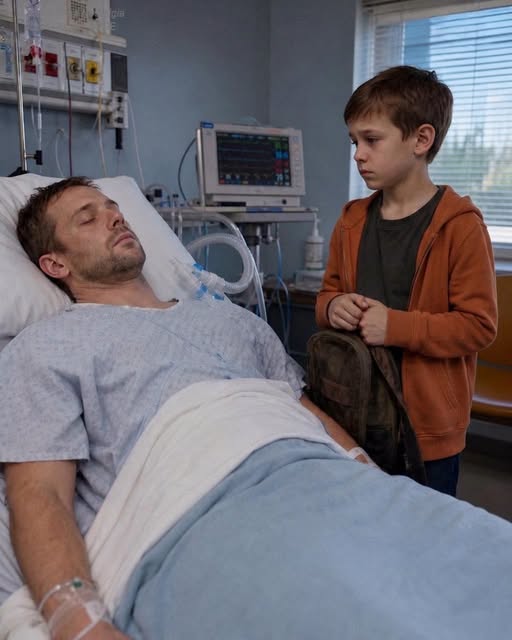
After 14 Days in a Coma, Doctors Told Me to Say Goodbye to My Husband — Then Our 8-Year-Old Son Revealed Something Hidden in His Backpack
For fourteen agonizing days, I sat beside my husband’s hospital bed, listening to the steady rhythm of the machines that helped keep him alive. Every time the ventilator released its familiar breath, I found myself hoping it was a sign that Mark was still fighting his way back to us.
He had always been a fighter.
But after a terrible car accident, the man who once filled our home with laughter lay motionless beneath the white hospital sheets, his eyes closed and his hand resting in mine.
I spoke to him every morning.
I told him about the weather, the neighbors, and the little things happening at home. I reminded him that our eight-year-old son, Leo, was waiting for him. I even told him about the football game he had promised to watch with our boy.
“Please come back to us, Mark,” I whispered. “We still have so much to do together.”
There was no answer.
For two weeks, I lived between hope and fear, never knowing whether the next conversation with a doctor would bring encouragement or another heartbreaking update.
Then, on the fourteenth day, a neurologist asked me to speak with him privately.
His expression told me that the news would not be easy.
“The latest examinations haven’t shown the improvement we were hoping for,” he explained gently. “We need to discuss your husband’s condition, what the results mean, and the options available to your family.”
I gripped the edge of my chair.
“Are you saying he won’t wake up?”
The doctor paused before answering.
“His condition is extremely serious. We need to review the findings carefully and explain what they tell us about his chances of recovery.”
I stared at him, desperately searching his face for something reassuring.
“There must be something else you can try.”
He explained that the medical team had already pursued the appropriate treatments and that the next decisions would require careful discussion with the family. He did not rush me. He answered my questions, explained the uncertainty surrounding Mark’s condition, and gave me time to absorb what he was saying.
But every word felt impossibly heavy.
I returned to my husband’s room with trembling hands.
Leo was sitting in the corner, holding his small, worn backpack against his chest.
He had barely spoken during the past few days. Usually, he was an energetic child who asked a hundred questions before breakfast and filled every quiet moment with stories about school.
Now he seemed to have retreated into himself.
He rarely let go of that backpack.
At first, I assumed it contained his favorite toy, a notebook, or one of the small objects he carried everywhere. I had asked him about it several times, but he always answered that he needed to keep it safe.
I hadn’t pushed him.
I had been too overwhelmed with worry about Mark to understand how frightened our son must have been.
I knelt beside him and gently brushed his hair away from his forehead.
“Sweetheart, the doctors want us to talk about some difficult decisions,” I said.
He looked up at me.
“Is Daddy coming home?”
My throat tightened.
“I don’t know, darling. The doctors are doing everything they can to help him, and we’re going to listen carefully to what they tell us.”
Leo’s eyes filled with tears, but he quickly lowered his head.
“I brought something for him,” he whispered.
I glanced at the backpack.
“What did you bring?”
He hugged it even more tightly.
“Something important.”
Before I could ask another question, the neurologist entered the room with a nurse. They had come to continue the conversation about Mark’s condition and the decisions that might lie ahead.
I stood beside the bed, trying to hold myself together.
The doctor spoke softly, explaining that our family needed to understand the medical facts and the possible outcomes before making any decisions about continued treatment.
I listened, but my thoughts kept returning to the same question.
How was I supposed to explain any of this to an eight-year-old?
How could I tell my son that the person who taught him to ride a bicycle, helped him build model airplanes, and carried him on his shoulders might never come home again?
I looked at Leo.
He was staring at his father.
Then, unexpectedly, he stood up.
“No,” he said quietly.
The doctor paused.
Leo took a few steps toward the bed.
“No, Daddy isn’t finished.”
I hurried toward him.
“Leo, sweetheart…”
He shook his head.
“I know something.”
Everyone in the room fell silent.
The nurse lowered the folder she was holding. The doctor turned toward our son, giving him his full attention.
“What is it, Leo?” he asked gently.
The boy placed his backpack on the chair beside the bed.
“I’ve been waiting for the right time.”
My heart began to pound.
“Waiting for what, honey?”
He looked at me, then at his father.
“To let Daddy hear it.”
He opened the backpack.
Inside were several folded sheets of paper, a small toy car, a photograph of our family, and a black electronic device with a pair of headphones wrapped around it.
I recognized the device as an old digital audio player.
Mark had used one years earlier when he went jogging. After he stopped using it, Leo had discovered it in a drawer and become fascinated by the buttons and tiny screen.
I stared at it in confusion.
“Where did you get that?”
“Daddy gave it to me,” Leo answered.
“When?”
“Before the accident.”
I remembered that morning clearly.
Mark had been getting ready to leave the house. He had kissed me goodbye, ruffled Leo’s hair, and promised that he would return in time for dinner.
Nothing about that ordinary morning had suggested it would become the last time our family would see him awake for weeks.
Leo lifted the audio player carefully.
“He told me that if he ever had to stay somewhere for a long time, I should remember the things he taught me.”
My eyes filled with tears.
“Sweetheart, what do you mean?”
Leo pressed a button.
At first, there was only a faint click.
Then a familiar voice filled the hospital room.
“Hey, buddy. If you’re listening to this, I want you to remember something important.”
I stopped breathing for a moment.
It was Mark.
His voice was warm, unmistakable, and full of the gentle humor I had missed so desperately.
Leo moved closer to the bed and placed the headphones beside his father’s pillow, allowing the recording to play through the device’s small speaker.
The message continued.
“First, I want you to take care of Mom. She’s stronger than she thinks, but sometimes she forgets that she doesn’t have to be strong every minute of every day.”
A sob escaped my throat.
The nurse looked down, giving me a moment.
Mark’s recorded voice continued.
“Second, never be afraid to ask questions. If something doesn’t make sense, ask someone who can help you understand it. And third, no matter what happens, remember that you are loved more than you could ever imagine.”
Leo stood completely still.
He had heard those words before. I could tell by the way he followed every sentence, as though he had memorized the message.
Then another part of the recording began.
“And, buddy, if you ever feel scared, remember our little promise. You don’t have to solve every problem by yourself. You just have to take the next right step.”
I covered my mouth.
That was something Mark said to Leo whenever our son became frustrated with a difficult puzzle or struggled to learn something new.
He would sit beside him and remind him that even the biggest challenges became easier when approached one step at a time.
For a few seconds, the only sound in the room was Mark’s voice.
Then the recording ended.
Leo looked toward the doctor.
“Can you play it again?”
The neurologist nodded.
“Of course.”
Leo pressed the button, and the message began once more.
I watched my son’s face as he listened. His shoulders gradually relaxed, and for the first time in days, he seemed able to breathe without fighting back tears.
When the recording finished, he turned to me.
“Daddy made it for me because he wanted me to remember his voice.”
I pulled him into my arms.
“Oh, sweetheart.”
He leaned against me, finally allowing himself to cry.
“I thought maybe if he heard it, he’d know we were here.”
The words broke my heart.
I held him tightly, wishing I could take away every ounce of fear he had carried during those fourteen days.
The doctor waited patiently until we were ready to speak.
“Leo,” he said, lowering himself slightly so he could meet the boy’s eyes, “that was a very special message. Your father clearly loves you very much.”
Leo nodded.
“Can Daddy hear it?”
The doctor answered carefully.
“We can’t know exactly what your father can hear or understand right now. Playing a familiar voice may be meaningful for families, but we cannot promise that it will change his medical condition.”
Leo looked down at the device.
“But he knows my voice, doesn’t he?”
I reached for his hand.
“We hope that hearing familiar voices brings him comfort, darling. The doctors will keep explaining what we know and what we don’t know.”
The nurse moved closer to the bed.
“If you want to talk to him, you can,” she told Leo. “You can tell him about your day, read him a story, or play that message when the medical team says it’s appropriate.”
Leo considered this.
Then he climbed into the chair beside his father’s bed and placed his small hand over Mark’s fingers.
“Daddy, it’s me,” he whispered. “I’m here.”
I stood beside him, unable to stop the tears rolling down my cheeks.
“I brought your message,” Leo continued. “I remembered what you told me. I’m taking care of Mom, but I need you to come home when you can.”
The room remained quiet.
No dramatic alarm sounded. No sudden movement proved that Mark had heard us. The monitors continued displaying the information they had been recording throughout his stay.
And yet, something important had changed.
For the first time in two weeks, Leo was no longer holding his fear entirely inside himself.
He had found a way to express what he had been carrying around in that battered backpack.
It wasn’t a medical breakthrough.
It wasn’t a miracle that could guarantee his father’s recovery.
It was a message from a loving parent, preserved in a small device, reaching his son at a time when the boy needed those words more than ever.
The neurologist pulled a chair closer.
“Would you like to tell me more about this recording?” he asked Leo.
Our son nodded.
“Daddy made it a while ago. He said I could listen whenever I missed him.”
“Did he explain why he made it?”
Leo shook his head.
“Not really. He j