A Rude Passenger Kept Throwing Her Hair Into My Food on a Flight — Until One Unexpected Discovery Changed Everything
At seventy-three years old, I had learned that patience could be one of the most valuable things a person possessed. I had raised a family, survived difficult years, buried people I loved, and watched the world change in ways I never could have imagined when I was young.
But nothing had prepared me for the woman sitting directly in front of me on a flight to my granddaughter’s college graduation.
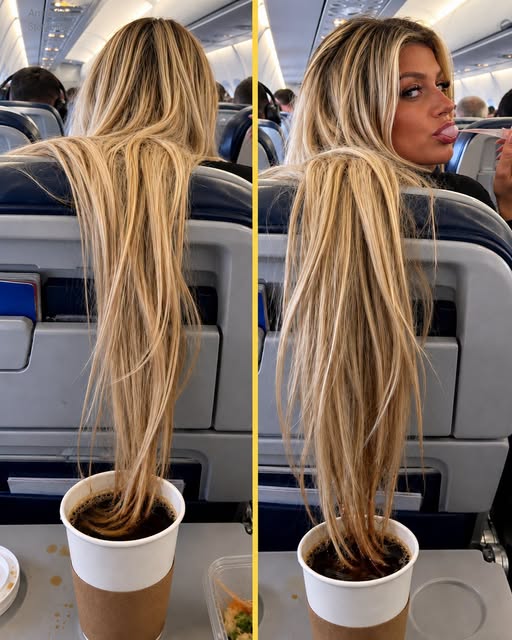
She had long, blonde hair extensions that fell nearly to her waist. Every few minutes, she tossed her head backward, sending the heavy strands spilling over the top of her airplane seat. At first, the movement seemed accidental. Then the hair landed in my coffee.
I gently moved it aside.
A few minutes later, it swept across my face.
Then it brushed against the lunch tray resting in front of me.
I had spent decades believing that most disagreements could be resolved with a calm voice and a little courtesy. So, rather than immediately calling for assistance, I leaned forward and addressed the woman as politely as I could.
“Excuse me, dear. Would you mind keeping your hair on your side of the seat?”
She turned around slowly.
Her expression suggested that I had interrupted something far more important than the comfort of another passenger. Her long artificial nails tapped against her phone, and she continued chewing her gum while looking me up and down.
“What?”
“Your hair keeps falling over the seat,” I explained. “It’s getting into my coffee and food.”
She glanced at the strands resting near my tray and shrugged.
“It’s just hair.”
“I understand that,” I replied. “But I’m trying to eat.”
She rolled her eyes so dramatically that I wondered whether she had practiced the gesture in front of a mirror.
“Then move your food.”
For a moment, I thought I had misunderstood her.
I was seventy-three years old, traveling alone, and hoping to enjoy a peaceful flight. I had not asked for special treatment. I had not complained about the temperature, the noise, or the limited space. I simply wanted to eat my lunch without someone else’s hair falling into it.
“That would be difficult,” I said quietly. “The tray is attached to the seat.”
She turned back toward her phone.
“Whatever.”
I looked down at my meal and took a slow breath.
Perhaps she was having a bad day, I thought. Perhaps she was tired or nervous about flying. I had always tried to give people the benefit of the doubt, especially when I knew nothing about their circumstances.
So I decided to let it go.
That decision lasted approximately five minutes.
The woman shifted in her seat, tossed her head backward, and sent another wave of blonde extensions spilling over the seat.
This time, the ends dragged across the edge of my lunch.
I pulled my tray closer and stared at the hair lying beside my sandwich.
“Ma’am,” I said, making another effort to remain calm, “please keep your hair in front of you.”
She turned around so quickly that several strands swung across my shoulder.
“Don’t touch my hair!”
“I haven’t touched it deliberately. I’m asking you to keep it away from my food.”
“Then stop acting like it’s the end of the world.”
A woman sitting across the aisle looked up from her book.
“Honestly,” she said, “I don’t think she’s asking for much.”
The blonde passenger gave her a sharp look.
“Nobody asked you.”
The other woman raised her eyebrows, closed her book, and returned her attention to the window.
I felt my cheeks grow warm, not because I was ashamed, but because I could not understand why a simple request had become such a confrontation.
I had grown up in a time when people generally tried to respect the small boundaries that made shared spaces comfortable. Of course, rude people had always existed. But I had never understood the appeal of turning an ordinary situation into a battle of pride.
I folded my napkin and placed it beside my tray.
“There’s no reason for us to argue,” I told her. “I’m sure we can both enjoy the flight if you simply keep your hair on your side.”
She gave me a thin smile.
“Maybe you should have booked a better seat.”
That remark stung more than I wanted to admit.
I had saved for months to make this trip. My granddaughter, Emily, was the first person in our family to graduate from her university with honors. I had promised her that I would be there, sitting in the audience when she walked across the stage.
My husband had died four years earlier, and since then, family celebrations had become even more precious to me. I wanted to be present for the moments that mattered, especially the ones that reminded me how much life could still offer.
I had carefully planned the journey, packed my small suitcase, and arrived at the airport hours before departure.
All I wanted was to reach my destination without unnecessary trouble.
Yet the woman in front of me seemed determined to make even a simple lunch difficult.
I turned toward the window and watched the clouds drifting beneath the aircraft.
Perhaps if I stopped responding, she would eventually become bored.
Unfortunately, she appeared to interpret my silence as permission.
A few minutes later, her hair came over the seat again.
It brushed my cheek.
I leaned away.
Then I heard a tiny pop as she blew a bubble with her gum.
“Oops,” she said.
The word was delivered with a smile.
I looked at her reflection in the darkened window.
She was watching me.
There was no confusion in her expression. She knew precisely what she was doing.
Something inside me changed at that moment. I was no longer interested in persuading her to understand why her behavior was inconsiderate. I had already explained the problem several times.
Instead, I decided to handle the situation properly.
I pressed the call button above my seat.
A flight attendant arrived a short while later. She was a young woman with dark hair neatly tied back, a blue uniform, and the kind of patient expression that suggested she had dealt with countless difficult passengers.
“Is everything all right here?” she asked.
I explained the problem without raising my voice.
The flight attendant listened, then turned toward the blonde woman.
“Ma’am, could you please make sure your hair stays on your side of the seat? We need everyone to be comfortable during the flight.”
The passenger sighed loudly.
“Fine.”
“Thank you,” the attendant replied.
She gave me a reassuring smile before continuing down the aisle.
For several minutes, everything remained quiet.
The blonde woman faced forward, her hair resting against her own seat. I began to think the problem had finally been resolved.
I opened my book and tried to concentrate on the pages.
Then I noticed her reflection in the window again.
She was looking backward.
Our eyes met for a brief moment.
She smiled.
Then she tossed her head, allowing another section of her extensions to spill over the seat.
The strands brushed against the corner of my tray.
I closed my book.
That was enough.
I was not going to spend the remainder of the flight arguing with a stranger, and I was certainly not going to let her spoil the occasion I had been looking forward to for months.
I pressed the call button again.
This time, when the flight attendant returned, I asked whether she could help me move to another available seat.
The attendant glanced toward the front of the cabin and checked her tablet.
“I’ll see what I can arrange,” she said.
The blonde passenger turned around.
“Are you serious? You’re calling her again?”
I looked at her calmly.
“Yes. I’d like to enjoy my lunch without your hair in it.”
She laughed.
“You people are unbelievable.”
I did not answer.
The flight attendant returned a moment later and explained that an appropriate seat was available farther back in the cabin. She offered to help me move once the aisle was clear.
I thanked her.
For the first time since boarding, I felt that I had a practical solution.
Then I remembered something I had noticed earlier.
When the blonde woman had been leaning over the seat to retrieve her phone charger, she had dropped a folded banknote near her feet. I had pointed it out to her, assuming she would want to pick it up.
She had grabbed it, slipped it into her purse, and thanked me without checking whether it belonged to her.
It had been an awkward moment, but I had thought little of it at the time.
Now, as I prepared to gather my belongings, I noticed that she was once again looking at her phone rather than paying attention to the people around her.
I considered saying something about the money, but I decided against it. It was not my responsibility to investigate another passenger’s finances, and I had no desire to turn an unpleasant encounter into a larger confrontation.
Instead, I began packing my book, glasses case, and reading material into my handbag.
Across the aisle, the teenage boy who had witnessed our earlier exchange leaned toward his mother and whispered something.
His mother glanced at me, then toward the blonde passenger.
She gave her son a small, warning look.
He covered his mouth, trying not to laugh.
The blonde woman noticed them.
“What?” she demanded.
“Nothing,” the mother replied.
The passenger narrowed her eyes.
“Then why are you looking at me?”
The mother calmly returned to her book.
I could see that several nearby passengers had become aware of the disturbance, but nobody seemed eager to become involved.
I could hardly blame them.
Traveling in a crowded airplane requires a certain amount of cooperation. People have limited space, shared facilities, and very few opportunities to escape an uncomfortable situation. Most passengers simply want to reach their destination without an argument.
The flight attendant returned to help me with my belongings.
“Whenever you’re ready, ma’am,” she said.
I stood slowly, using the armrest for support.
At seventy-three, I had learned not to rush simply because someone else was impatient. My knees sometimes complained after sitting too long, and I preferred to move carefully when walking through a narrow aisle.
As I stepped away from my seat, the blonde passenger turned toward me again.
“Happy now?”
I looked at her.
“Quite,” I replied.
She appeared disappointed that I had not offered a sharper response.
I gathered my handbag and followed the flight attendant toward the rear of the plane.
Behind me, I heard the passenger mutter something about people who made a fuss over nothing.
I kept walking.
The new seat was near a window, with an empty space beside it. The flight attendant helped me settle in and placed my handbag beneath the seat in front of me.
“Please let us know if you need anything else,” she said.
“Thank you. You’ve been very kind.”
She smiled and continued down the aisle.
For the first time that afternoon, I could relax.
I looked out at the clouds, which had gathered into soft white layers beneath the aircraft. Sunlight reflected off their surfaces, creating a view that reminded me of the peaceful mornings I used to spend with my husband on the porch of our old home.
I thought about Emily.
She had been a curious little girl who asked endless questions and collected leaves, stones, and interesting pieces of ribbon. When she was eight, she had announced that she wanted to become a scientist because she wanted to understand everything in the world.
Now she was graduating from college.
I could hardly believe how quickly the years had passed.
I smiled as I imagined her waiting at the airport, probably carrying a sign even though I had told her not to bother. She had always enjoyed making ordinary moments feel special.
That thought reminded me of something my husband used to say.
“You cannot control how other people behave,” he would tell me, “but you can decide how much of your day you are willing to give them.”
He had been right.
I had spent too much of the flight thinking about a stranger’s behavior when I could have been enjoying the journey.
I opened my book again.
Several chapters later, the captain announced that the aircraft had begun its descent. The cabin lights adjusted, and passengers started putting away their belongings.
The flight attendants moved through the aisles, checking that seat belts were fastened and tray tables were secured.
I closed my book and looked toward the front of the plane.
The blonde woman was still sitting in her original seat.
Her hair now rested neatly against her shoulders. She was looking at her phone, apparently watching a video.
For a moment, I wondered whether she had learned anything from the experience.
Then I reminded myself that her personal growth was not my responsibility.
I focused on the approaching airport instead.
As the aircraft descended, the familiar patchwork of roads, buildings, and green fields appeared through the window. I could see the airport buildings in the distance and the vehicles moving slowly along the service roads.
My stomach fluttered with excitement.
Emily’s graduation was only hours away.
When the plane finally touched down, a gentle wave of applause came from somewhere near the middle of the ca