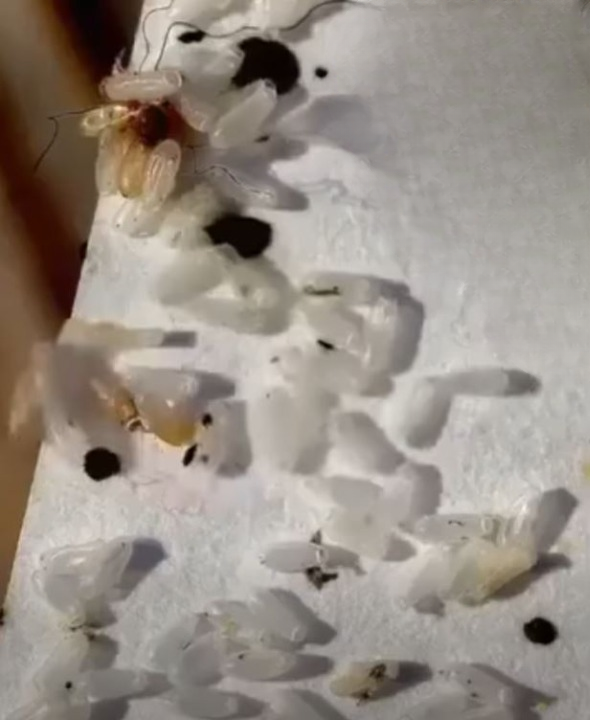
I Thought I Had Found Grains of Rice on the Bed—Then I Looked More Closely
What started as an ordinary weekday morning became an unexpected lesson in paying attention to the small details around the home.
The bedroom looked completely normal.
The bed was made, the curtains were open, and the morning light was coming through the window.
Then I noticed several tiny, pale objects scattered across the bedding.
At first glance, they looked like grains of rice.
I assumed that perhaps something had been carried into the bedroom accidentally. Maybe a piece of food had fallen from clothing, or perhaps a small amount of material had been left behind after changing the sheets.
There was nothing particularly unusual about the shape.
They were tiny.
Pale.
Oval.
And easy to overlook.
But when I looked more carefully, I realized they weren’t rice.
That raised a completely different question:
What were these tiny objects?
The answer turned out to be a reminder that unfamiliar marks and particles around a home can sometimes provide useful clues about a household pest problem.
In this case, the concern was bedbugs.
Finding something unusual on a mattress doesn’t automatically mean bedbugs are present. Many ordinary materials can resemble insect eggs, shed skins, stains, or droppings.
Still, knowing what to look for can help homeowners recognize a possible problem early and take sensible steps toward confirming it.
Why Bedbug Signs Can Be Easy to Miss
Bedbugs are small insects that feed on blood and commonly hide in areas close to where people sleep or rest.
One reason infestations can be difficult to notice initially is their size.
Adult bedbugs are relatively small, and younger stages are even smaller.
They can hide in seams, cracks, folds, joints, and other narrow spaces.
This means that a room can appear perfectly clean while a small number of insects remain hidden nearby.
Bedbugs aren’t necessarily a sign of poor housekeeping.
They can be introduced into homes through luggage, clothing, furniture, bedding, bags, or other items.
They may also spread between nearby living spaces in some buildings.
That is an important point because pest problems are often associated with cleanliness when the reality is more complicated.
Keeping a home clean is valuable for many reasons, but ordinary cleaning alone doesn’t guarantee that bedbugs won’t be introduced.
What Bedbug Eggs Actually Look Like
The tiny objects on the bed immediately made me think of grains of rice, but bedbug eggs are much smaller.
Bedbug eggs are generally pale or whitish and are extremely small—roughly around 1 millimeter in length.
They can be difficult to see without looking closely.
Fresh eggs may appear pearly or translucent, while older material can look somewhat different depending on environmental conditions.
They may also be attached to surfaces rather than simply scattered loosely across a bed.
This is an important distinction.
If you find several loose, rice-sized pieces on a mattress, don’t automatically conclude that they are bedbug eggs.
They could be many other things.
Lint.
Food particles.
Fibers.
Plant material.
Dust.
Small pieces of debris.
Or another type of insect-related material.
Identification should be based on several clues rather than appearance alone.
Other Signs Are Often More Useful
When investigating a possible bedbug problem, it is helpful to look for multiple signs.
One of the most commonly discussed clues is the presence of small dark spots.
These can appear on mattresses, sheets, pillowcases, bed frames, or nearby surfaces.
However, dark spots can have many causes, so they should not automatically be identified as bedbug droppings.
Other clues may include shed skins, live insects, eggs, or small pale eggshells.
The location also matters.
Bedbugs tend to stay close to areas where people spend extended periods, particularly sleeping areas.
That means the mattress, box spring, bed frame, headboard, and nearby furniture can be useful places to inspect.
The Bed Is Only One Part of the Investigation
One common mistake is focusing exclusively on the top of the mattress.
Bedbugs can hide in many locations.
Check the seams and edges of the mattress.
Look around the underside.
Inspect the box spring if present.
Examine cracks and joints in the bed frame.
Look behind or around the headboard.
Check nearby furniture.
Inspect seams in upholstered chairs or couches if there are signs elsewhere in the home.
The purpose isn’t to dismantle the entire bedroom immediately.
A careful visual inspection can often provide more useful information than simply looking at the center of the mattress.
Why Bed Frames Matter
The structure supporting the mattress can provide hiding places.
Wooden and metal frames contain joints, holes, cracks, and connections.
Depending on the design, these areas may provide sheltered spaces.
Headboards can also contain seams and gaps.
This is why a mattress that appears clean doesn’t necessarily rule out bedbugs.
The insects may be nearby rather than directly on the sleeping surface.
A flashlight can be useful when inspecting darker areas.
Move slowly.
Look along seams and corners.
Pay attention to areas that are rarely disturbed.
What About the Tiny “Rice” Pieces?
The original discovery raises an important question: if the pieces looked like rice, what were they actually?
Without laboratory examination or a clear photograph, it isn’t responsible to identify an unknown object with certainty.
There are many household materials that can look surprisingly similar to insect eggs or other pest evidence.
For example, small fragments of food can become dry and pale.
Fibers can curl into oval shapes.
Tiny pieces of packing material can break away.
Plant material can be carried indoors.
Other insects can leave eggs or shed material that looks different from what people expect.
This is why pest identification should be based on multiple signs.
One unfamiliar object is a clue to investigate—not proof of an infestation.
Why Misidentification Happens
Humans are naturally good at recognizing familiar shapes.
When we see something unfamiliar, our brains compare it with things we already know.
A tiny pale object might resemble a grain of rice.
A dark spot might resemble dirt.
A small shell might look like an insect egg.
A piece of lint might look like an insect shed skin.
This can lead to either unnecessary concern or false reassurance.
The best approach is to slow down and examine the entire situation.
Where was the object found?
Was it attached to anything?
Were there multiple pieces?
Were there other signs nearby?
Has anyone noticed unexplained bites or irritation?
Are there dark marks on the bedding?
Have any live insects been seen?
These questions provide much more information than appearance alone.
Bedbugs and Cleanliness
One of the most persistent misconceptions about bedbugs is that they only occur in dirty homes.
That isn’t accurate.
Bedbugs can live in very clean homes.
Their presence is primarily related to access and opportunity rather than whether someone regularly vacuums or cleans.
A person can unknowingly bring bedbugs home after traveling.
Used furniture can potentially introduce them.
Shared buildings can provide opportunities for movement.
Visitors can unintentionally transport insects or eggs.
The insects are interested in access to a host and suitable hiding places.
They aren’t attracted to a home because the homeowner failed to clean the kitchen floor.
This distinction is important because shame can make people delay asking for help.
A pest problem is a household issue that can happen to many different types of people.
How Bedbugs Can Enter a Home
There isn’t one single route by which bedbugs enter a property.
Travel is one commonly discussed possibility.
Hotels, hostels, rental properties, dormitories, and other accommodations can provide opportunities for insects to travel with luggage or personal belongings.
Used furniture is another consideration.
Mattresses, upholstered furniture, bed frames, and other items can potentially carry pests if they haven’t been properly inspected.
Shared laundry facilities may also require attention, particularly when transporting clothing and bedding.
In apartment buildings and other connected structures, insects can sometimes move between units through cracks, wall voids, or other pathways.
This is why a suspected infestation should be taken seriously without assuming that someone did something wrong.
What Travelers Can Do
Travelers can take several practical precautions.
Before unpacking, inspect luggage after returning home.
Keep suitcases away from beds when possible.
Wash clothing according to the garment’s care instructions.
Dry items appropriately when possible.
Inspect luggage seams and pockets.
Don’t immediately place suitcases on the bed after returning from a trip.
These steps don’t guarantee prevention, but they can reduce opportunities for unwanted pests to enter the home.
A flashlight can make luggage inspection easier.
Pay particular attention to seams, folds, zippers, and other sheltered areas.
Used Furniture Deserves Careful Inspection
Buying secondhand furniture can be a practical way to save money or find unique pieces.
But upholstered furniture and sleeping-related items deserve extra attention.
Before bringing used furniture inside, inspect seams, joints, undersides, and cracks.
Look for live insects or other signs of pest activity.
If you aren’t confident that an item is free of pests, consider whether bringing it into the home is worth the risk.
Mattresses and upholstered furniture can be especially difficult to inspect thoroughly.
A bargain can become expensive if it introduces a pest problem that requires professional treatment.
What Should You Do If You Find a Possible Bedbug?
The first step is to avoid panic.
A single unexplained object doesn’t establish that an infestation exists.
Instead, gather information.
Inspect the surrounding area carefully.
Look for additional evidence.
Take clear photographs if possible.
If you find a live insect, avoid crushing it if you can safely contain it for identification.
An intact specimen can be more useful to a pest professional than a smear on a surface.
If the evidence strongly suggests bedbugs, professional identification can be helpful.
Correct identification matters because different pests require different control methods.
Why Identification Comes Before Treatment
It can be tempting to immediately start using pesticides when something unusual is found.
That isn’t always the best approach.
Using the wrong product can be ineffective and may create unnecessary exposure to chemicals.
Some people also respond to suspected bedbugs by applying excessive amounts of household insecticide.
This can create additional risks without solving the underlying problem.
Before treating a suspected infestation, confirm what you’re dealing with whenever possible.
A qualified pest-control professional can help identify the pest and recommend an appropriate treatment strategy.
Don’t Move Everything to Another Room
If you suspect bedbugs, one instinct may be to move bedding, clothing, or furniture from the affected room to another part of the house.
That can sometimes make the situation more complicated.
Moving infested items without precautions can potentially spread insects to new locations.
Instead, consider isolating and handling items carefully according to reliable pest-control guidance.
Avoid creating unnecessary movement between rooms.
The goal is to contain the problem rather than accidentally expand it.
Washing Bedding Can Help With Certain Items
Laundry is an important part of many bedbug-control plans.
Bedding, clothing, and washable fabrics can be handled according to appropriate laundering and drying instructions.
Heat from a properly used dryer can be particularly useful against bedbugs and their eggs.
However, laundry alone may not eliminate an infestation because insects can remain in mattresses, furniture, bed frames, cracks, and other areas.
That is why treatment needs to consider the entire environment rather than just the sheets.
Vacuuming Can Be Useful
Vacuuming can help remove insects and debris from certain areas.
Pay attention to mattress seams, bed frames, nearby flooring, and cracks where practical.
If you use a vacuum for suspected bedbugs, follow appropriate disposal and cleaning procedures afterward.
The goal is to avoid simply moving insects from one location to another.
Vacuuming should generally be viewed as one part of a broader management approach rather than a guaranteed solution.
Encasements Can Provide Another Tool
Special mattress and box-spring encasements can make inspection easier and can help isolate bedbugs inside those components when used correctly.
These products are designed specifically for pest management and differ from ordinary mattress covers.
If using one, follow the manufacturer’s instructions carefully.
An encasement doesn’t automatically eliminate bedbugs elsewhere in the room.
It is one component that may be useful alongside other control methods.
Why Professional Treatment May Be Necessary
Bedbugs can be difficult to eliminate because of their hiding behavior and life cycle.
They may be present in locations that are difficult to reach.
A homeowner might successfully remove visible insects while others remain hidden.
For larger or persistent infestations, professional pest control can be the most practical option.
A qualified professional can assess the extent of the problem and determine which treatment methods are appropriate.
Depending on the circumstances, professional treatment may involve careful inspection, targeted applications, heat-based methods, monitoring, or combinations of approaches.
The exact strategy depends on the property and the level of infestation.
Be Careful With Internet Home Remedies
When people discover possible bedbugs, they often search online for quick solutions.
Some suggestions may involve household products, extreme temperatures, or improvised chemical treatments.
These approaches are not necessarily safe or effective.
Never mix pesticides or household chemicals.
Don’t apply products to mattresses or clothing unless the product label specifically allows that use.
Don’t use excessive amounts of insecticide.
Don’t attempt dangerous heating methods inside a home.
Don’t rely on unverified remedies simply because someone online claims they worked.
Pest control should prioritize both effectiveness and household safety.
Bites Are Not a Reliable Identification Tool
Another common misconception is that bedbugs can be identified based on bites alone.
Skin reactions vary significantly between people.
Some people may develop noticeable marks.
Others may have little or no visible reaction.
Different insects and skin conditions can also cause similar-looking irritation.
Therefore, bites by themselves are not enough to confirm bedbugs.
Physical evidence of the insect or its presence in the environment is much more useful.
If someone has persistent or concerning skin symptoms, a healthcare professional can provide appropriate medical guidance.
Pets and Bedbugs
People sometimes wonder whether their pets are responsible for bedbugs.
Bedbugs primarily feed on blood and are associated with human sleeping environments, although they can bite animals as well.
Pets can potentially be exposed when they share environments with an infestation, but blaming a pet isn’t helpful.
The important step is to investigate the environment.
If there is a confirmed infestation, ask a pest professional about appropriate measures involving pets.
Never apply household pesticides to animals unless the product is specifically intended for that animal and use.
Keeping the Bedroom Easier to Inspect
A bedroom with less clutter can be easier to inspect and maintain.
This doesn’t mean a perfectly organized room prevents bedbugs.