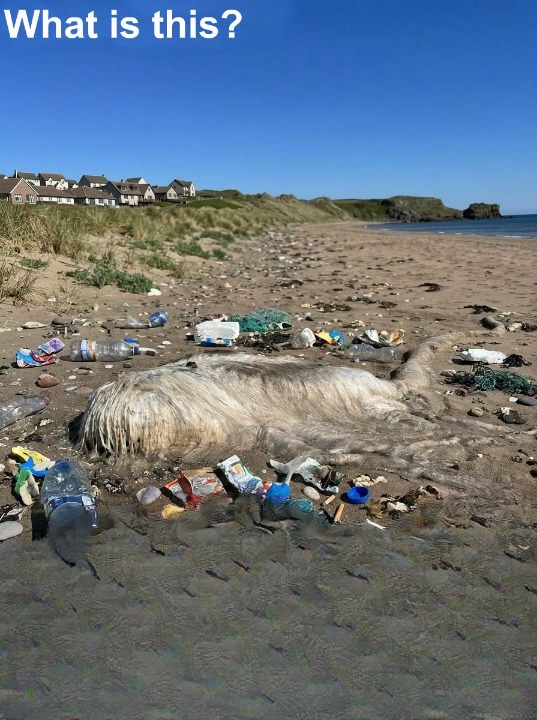
The Strange Thing I Found on the Shore Made Me Look at the Ocean Differently
Some beach walks are memorable because of the weather.
Others are remembered because of the people you meet, the wildlife you see, or the simple feeling of having a quiet morning beside the water.
And then there are walks when you notice something you weren’t expecting.
One morning, I took my dog to the beach expecting nothing more than an ordinary walk.
The tide was low, the shoreline was relatively empty, and the early morning air had that familiar combination of salt, cool wind, and damp sand.
My dog moved ahead of me, stopping every few moments to investigate something interesting.
I wasn’t in a hurry.
There was no particular destination.
The plan was simply to walk along the shoreline, enjoy the morning, and head home.
Then I noticed something lying near the edge of the water.
At first, it looked like a piece of driftwood.
I almost walked past it.
But something about its shape made me stop.
It wasn’t large enough to immediately attract attention, yet it looked different from the surrounding shells, stones, seaweed, and pieces of wood scattered across the sand.
I stood there for a moment.
My dog was already interested in it.
I took a closer look but didn’t immediately know what I was seeing.
That small moment of uncertainty ended up changing the way I thought about beaches.
Not because the object turned out to be something extraordinary.
Instead, it reminded me how much is constantly moving through the ocean before eventually reaching the shore.
A beach is not simply a strip of sand beside the water.
It is a constantly changing collection of natural materials, biological remains, minerals, human-made objects, and fragments transported by wind, waves, currents, and tides.
And sometimes, all it takes is one unfamiliar object to make you notice that process.
The Shoreline Is Always Changing
When people visit a beach, it can appear remarkably stable.
The sand seems to stretch into the distance.
The water moves in and out.
Waves arrive, disappear, and are replaced by the next set.
But beneath that simple appearance, the shoreline is constantly changing.
Every wave moves sediment.
Some sand is carried away.
Other sand is deposited.
Shells are moved.
Small pieces of rock are shifted.
Seaweed can be transported from one location to another.
Driftwood may travel considerable distances.
Even objects that appear heavy can gradually move as waves repeatedly act on them.
Tides add another layer to this process.
A location that is underwater in the afternoon may be exposed in the morning.
An object hidden beneath the water can become visible for only a short period.
That means the beach you see today may look noticeably different from the same beach a few days later.
The difference may be subtle.
But it is there.
Why the Tide Matters
The tide played an important role in my discovery.
Because the water was relatively low that morning, areas of the beach that are normally covered were exposed.
That expanded the amount of shoreline available to explore.
It also meant that material recently moved by the water was easier to see.
Low tide can reveal small channels in the sand, exposed rocks, tide pools, shells, seaweed, and other things that remain hidden during higher water levels.
For beachcombers, these periods can be particularly interesting.
But low tide isn’t simply a better time to explore.
Conditions can change.
Water can return quickly in some locations.
Waves can become stronger than expected.
Sandbars and rocks can create unexpected hazards.
That is why anyone exploring a shoreline should remain aware of the tide, weather, surf, and local conditions.
Curiosity is part of the fun.
Awareness keeps it enjoyable.
What I Initially Thought I Had Found
When I first saw the object, my brain immediately tried to categorize it.
That is something people do automatically.
We look at an unfamiliar shape and compare it with things we already know.
Was it a shell?
A piece of wood?
Part of a plant?
A stone?
Something manufactured?
Something from the ocean itself?
From a distance, it was difficult to tell.
The surface had been affected by exposure to water and sand.
Its edges weren’t perfectly clear.
That made identification even more difficult.
The longer I looked at it, the more possibilities came to mind.
And that was part of what made the experience interesting.
An unfamiliar object doesn’t always have an immediate answer.
Sometimes the best response is simply to observe.
The Ocean’s Natural Recycling System
One of the things the discovery made me think about was how much material enters and leaves the ocean every day.
The ocean is constantly interacting with the land.
Rivers carry sediment toward the coast.
Rainwater moves soil and organic material.
Waves erode rocks and cliffs.
Wind transports sand.
Marine animals and plants contribute biological material.
Storms can rearrange entire sections of shoreline.
Over long periods, these processes can dramatically change coastal landscapes.
A piece of rock can be broken into smaller fragments.
Shells can be ground down.
Wood can become weathered and smooth.
Seaweed can be carried along the coast.
Eventually, many of these materials become part of the beach itself.
The shoreline is therefore something of a collection point.
It records what has recently moved through the coastal environment.
Driftwood Has a Story Too
One possibility I considered was driftwood.
Beaches around the world contain pieces of wood that have been transported by rivers, storms, currents, and waves.
The wood may come from trees that fell near waterways.
It may come from branches carried downstream.
In some areas, larger pieces can be moved during storms.
Once in the water, wood changes.
Saltwater, freshwater, sunlight, microorganisms, and physical abrasion gradually alter its surface.
Edges become smoother.
The color changes.
Bark disappears.
Small pieces break away.
A branch that once looked unmistakably like part of a tree can eventually become difficult to recognize.
That is one reason objects found on beaches can look so different from their original forms.
The environment changes them.
Shells Can Be Surprisingly Difficult to Identify
Another possibility is a shell or fragment of a shell.
Most people recognize common shells, but not every shell found on a beach is complete.
Waves can break shells into pieces.
Other organisms can bore into them.
Sand can wear away their surfaces.
Pieces can become rounded over time.
A fragment may therefore look completely different from the original shell.
Shells also vary dramatically depending on the species and region.
Some are smooth.
Some are ridged.
Some are brightly colored.
Others are pale and almost indistinguishable from small stones.
Even experienced beachcombers occasionally encounter specimens that require closer examination.
Seaweed Can Take Strange Forms
Seaweed is another common source of unusual shapes along the shore.
Fresh seaweed can be recognizable.
After spending time on the beach, however, it can dry, twist, flatten, break apart, and become covered with sand.
Some types have branches or air-filled structures that can make them resemble unfamiliar objects.
Because of that, a strange-looking item isn’t necessarily unusual at all.
It may simply be a familiar natural material that has changed appearance through exposure.
The Possibility of Human-Made Objects
Of course, not everything found on a beach comes from nature.
Human-made material can also reach the shoreline.
Plastic containers, rope, fishing equipment, fragments of packaging, pieces of foam, glass, and other objects can be transported by currents or wind.
This is one reason coastal litter has become an important environmental issue.
A small piece of plastic may look insignificant.
But when thousands or millions of small fragments accumulate across beaches and marine environments, the impact becomes much more meaningful.
Some objects can also become heavily weathered.
Sunlight can make plastic brittle.
Saltwater can change surfaces.
Waves can break larger objects into smaller pieces.
After enough time, identifying the original item may become difficult.
A fragment may no longer resemble the product it came from.
Why Microplastics Are a Growing Concern
One of the most important environmental lessons associated with beach debris is the difference between visible litter and smaller plastic particles.
Larger plastic objects can break down into increasingly small fragments through exposure to sunlight, heat, mechanical abrasion, and other environmental processes.
These particles can become difficult to see and may move through marine environments.
This is one reason responsible waste disposal matters.
A plastic item doesn’t simply disappear when it is thrown away.
Depending on where it ends up, it can remain in the environment for a long time.
The small object I saw on the beach reminded me of this broader reality.
The shoreline isn’t separated from human activity.
What people use, discard, and transport can eventually become part of the coastal environment.
Why Beach Objects Can Be Hard to Identify
There is another interesting reason beach discoveries can be confusing.
The ocean changes the appearance of almost everything it touches.
A smooth stone may once have been part of a much larger rock.
A rounded piece of glass may once have been a container fragment.
A pale piece of wood may have originally been dark.
A shell may have lost its original pattern.
A piece of plastic may have become faded.
Seaweed may have dried into an unfamiliar shape.
Even color can become misleading.
Salt, sand, sunlight, and water all influence appearance.
This means that identification based solely on visual resemblance can be unreliable.
Context matters.
Texture matters.
Weight matters.
Material matters.
Location matters.
And sometimes, even those clues aren’t enough.
The Brain Loves Familiar Shapes
There is also a psychological reason unfamiliar beach objects can appear strange.
Human beings are very good at recognizing patterns.
We see faces in clouds.
We recognize shapes in shadows.
We interpret random arrangements according to familiar objects.
This tendency is often referred to as pareidolia.
It is a normal part of perception.
When an unfamiliar object has a shape vaguely resembling something recognizable, the brain may immediately assign meaning to it.
That can make an ordinary piece of driftwood look like an animal.
A shell fragment can resemble a tooth.
A stone can look like a piece of pottery.
A piece of seaweed can appear almost plant-like.
Recognizing this tendency can help us remain objective when we encounter something unusual.
What I Learned From Looking Instead of Guessing
Rather than immediately deciding what the object was, I began looking at the area around it.
There were other clues.
The sand showed the marks left by the retreating water.
Small shells were scattered nearby.
Pieces of seaweed had collected along a line where the waves had recently reached.
A few pieces of driftwood were mixed into the debris.
That context was important.
The object wasn’t sitting in isolation.
It was part of a larger collection of material that had been deposited by the water.
That made several explanations more plausible.
Perhaps it had arrived with the tide.
Perhaps it had been there for some time and was only visible because of the lower water level.
Perhaps it had been moved from another section of the beach.
The important point was that there was no need to invent a dramatic explanation.
The ocean itself could explain much of what I was seeing.
Beachcombing Is a Form of Observation
People have collected interesting objects from beaches for centuries.
Today, beachcombing is often treated as a relaxing hobby.
People search for unusual shells, sea glass, interesting rocks, driftwood, fossils where permitted, and other natural curiosities.
But beachcombing is also a form of observation.
It encourages people to notice differences.
Why are certain shells concentrated in one area?
Why is the seaweed forming a particular line?
Why are some rocks smooth while others are rough?
Where did the driftwood come from?
What does the tide reveal?
These questions can turn a simple walk into an informal lesson in coastal science.
You don’t need specialized equipment.
You simply need curiosity and patience.
Respecting Wildlife Is Important
One important part of exploring beaches is remembering that the shoreline is a habitat.
Birds feed along the water’s edge.
Crabs and other small animals live beneath rocks and sand.
Tide pools can contain delicate ecosystems.
Marine organisms may depend on specific areas of the shoreline.
That means beach visitors should avoid unnecessary disturbance.
Don’t remove living animals from their habitats.
Don’t destroy tide pools.
Don’t disturb nests or wildlife.
Be careful when moving rocks because animals may be sheltering underneath them.
If you aren’t sure whether something is alive, observe it rather than handling it.
A good beach walk should leave the environment as close as possible to how it was found.
Be Careful With Unfamiliar Objects
Another lesson from the experience is that not everything found on a beach should be touched.
Most objects are harmless.
But an unfamiliar item can occasionally have sharp edges or contain materials that shouldn’t be handled casually.
Broken glass, metal fragments, fishing hooks, chemical containers, and other debris can pose obvious risks.
If an object looks unusual or potentially hazardous, keep your distance and contact the appropriate local authority or beach-management service if necessary.
Children should be taught the same principle.
The beach is full of interesting things, but not everything belongs in someone’s pocket.
Curiosity should come with common sense.
Why Beach Safety Matters
The ocean is beautiful, but it is also a powerful natural environment.
Conditions can change quickly.
Waves may become stronger.
Tides can rise.
Weather can shift.
Wet rocks can be slippery.
Cliffs and dunes can be unstable.
That means exploring the shoreline should always involve awareness of the surroundings.
Stay away from unstable edges.
Watch children closely.
Keep dogs under control where local rules require it.
Pay attention to posted warnings and local regulations.
Avoid entering the water when conditions are unsuitable.
And remember that taking a closer look at an interesting object is never worth putting yourself in an unsafe position.
The Importance of Leaving Beaches Clean
Perhaps the most significant lesson from the morning walk was how clearly the shoreline reflects what happens both in nature and in human communities.
Natural material belongs to a constantly changing cycle.
Human-made waste is different.
It can remain in the environment for long periods and may affect wildlife and ecosystems.
That is why simple actions matter.
Take your belongings home.
Use appropriate waste containers.
Don’t leave fishing line behind.
Avoid intentionally releasing balloons or other objects into the environment.
Pick up small pieces of litter when it is safe to do so.
Even a short walk can become an opportunity to make a small positive difference.
A Beach Is Like a Moving Photograph
The more I thought about the discovery, the more I realized that a shoreline is almost like a photograph that is constantly being replaced.
Every tide changes the picture.
Every storm rearranges the materials.
Every season affects the coastline.
Every wave contributes to the process.
The beach captures temporary evidence of everything moving through the coastal system.
That is why visiting the same beach repeatedly can be surprisingly interesting.
The view may appear familiar.
But look closely, and there are always differences.
A new sandbar appears.
A section of beach becomes narrower.
More driftwood arrives.
A cluster of shells disappears.
A different type of seaweed washes ashore.
The shoreline is never completely still.
What Happens After a Storm?
Storms can dramatically change beaches.
Stronger waves can move larger amounts of sand and debris.
Objects that have been buried for months may become exposed.
Material from farther offshore can be deposited along the coast.
Likewise, objects that had been sitting on the beach may be carried back into the water.
This explains why beachcombers sometimes discover unusual items after rough weather.
The storm has effectively rearranged the shoreline.
However, post-storm exploration requires additional caution.
Waves can remain powerful after the worst weather has passed.
Cliffs and dunes can become unstable.
Debris may be sharp or hazardous.
The safest approach is to follow local guidance and avoid areas where conditions remain dangerous.
What Makes an Object Worth Investigating?
Not every unusual object requires a detailed investigation.
But certain characteristics can make something particularly interesting.
A distinctive shape.
An unusual material.
A fossil-like pattern.
An old-looking manufactured component.
An unfamiliar shell.
A piece of naturally polished glass.
A geological feature.
The key is to remain curious without immediately deciding what the object represents.
If you’re interested in identification, photographs can be useful.
A ruler or another familiar object can provide a sense of scale.
Photographing the object alongside its surroundings can also help provide context.
If appropriate, local museums, natural-history groups, geological organizations, or experienced beachcombers may be able to help identify unfamiliar natural materials.
The Discovery Changed the Walk
Before noticing the object, I had been thinking about the walk as exercise.
Afterward, I began paying attention to everything around me.
I noticed how the wet sand reflected the morning light.
I noticed the lines created by the retreating tide.
I noticed clusters of shells gathered in certain areas.
I noticed pieces of driftwood that had clearly been shaped by the water.
I noticed how different sections of the shoreline contained different materials.
Nothing about the beach had necessarily changed.
My attention had changed.
And that may be one of the most valuable things a small discovery can do.
It can make us slow down.
What We Usually Miss
Modern life encourages people to move quickly.
We walk somewhere while looking at our phones.
We drive past landscapes without noticing them.
We visit beaches and take photographs without examining what lies beneath our feet.
But slowing down reveals details.
A shell has a pattern.
Sand has different textures.
Water leaves temporary marks.
Rocks reveal geological differences.
Birds follow feeding patterns.
Seaweed collects accord