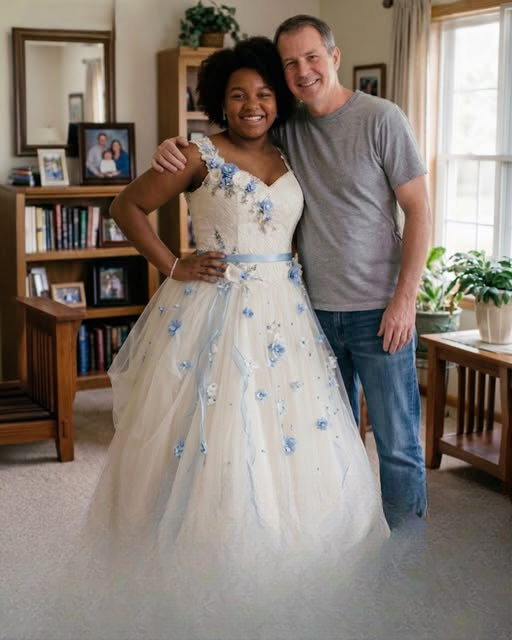
My Dad Turned My Late Mom’s Wedding Dress Into My Prom Dress — Then an Unexpected Visitor Changed the Evening
I was five years old when my mother died.
For a child that young, it was difficult to understand what losing someone really meant. I knew my mother was no longer coming home, but I didn’t understand all the ways her absence would shape the years ahead.
What I did understand was that my father was suddenly the only parent I had.
From that point forward, it was the two of us.
My dad wasn’t a wealthy man. He worked as a plumber and often accepted extra jobs whenever they were available. Some weeks he came home exhausted, his clothes carrying the smell of dust, metal, and whatever work he had been doing that day.
But no matter how tired he was, he always made time for me.
He packed my lunches, helped me with school projects, attended parent meetings when he could, and somehow found a way to make birthdays and holidays feel special even when money was limited.
I grew up knowing that we couldn’t always afford the things other families could.
But I also grew up knowing that I was loved.
That distinction became especially important as I got older.
By the time prom season arrived, I was in my final years of school and understood exactly how expensive the event could be.
There were shoes, hair appointments, transportation, photographs, tickets, and, of course, the dress.
I knew my dad was already doing everything he could to cover the things that mattered most.
So I decided not to ask him for an expensive dress.
I would borrow one.
If that didn’t work, I would look at a thrift store.
I didn’t mind.
To me, going to prom wasn’t really about wearing something expensive. I simply wanted to experience the evening with my friends and have a memory I could keep.
One evening, while we were eating dinner, my dad noticed that I was looking through photographs of dresses on my phone.
“You don’t have to worry about the dress,” he said.
I looked up.
“What do you mean?”
“I’ll take care of it.”
I laughed because I thought he was joking.
“Dad, you don’t have to buy me one.”
“I’m not buying one.”
He didn’t explain any further.
I assumed he had found someone who was willing to lend me a dress.
I didn’t think much about it.
Then, over the next several weeks, something strange started happening.
My dad began staying up late.
After dinner, instead of watching television or going straight to bed, he would sit in the living room with a small sewing machine.
At first, I thought he was repairing something.
Maybe a work shirt.
Maybe a curtain.
Whenever I walked into the room, he would quickly move pieces of fabric aside.
“What are you making?” I asked one night.
“Nothing you need to worry about.”
That made me laugh.
“You’ve been saying that for weeks.”
“Then you’ll have to be patient.”
I didn’t realize how much time he was putting into the project.
There were evenings when I could hear the quiet sound of the sewing machine from my bedroom.
Sometimes I woke up early and found him still working.
He would carefully examine pieces of fabric, measure something, write down numbers, and then begin sewing again.
I became curious.
But I didn’t want to spoil whatever surprise he was preparing.
Then, about a week before prom, he finally called me into the living room.
“Come here,” he said.
When I walked in, he was standing beside the couch.
There was a dress hanging from a simple wooden hanger.
For several seconds, I couldn’t speak.
The dress was beautiful.
It was made from soft ivory fabric decorated with delicate blue flowers. Small embroidered details ran along parts of the material, giving the dress an old-fashioned but elegant appearance.
I walked closer.
“Where did you get this?”
My dad smiled.
“I made it.”
I stared at him.
“You made this?”
He nodded.
Then he told me something I hadn’t expected.
The fabric came from my mother’s wedding gown.
My mother had worn it years before I was born.
I had seen photographs of her wearing it, but I had never imagined that one day I would wear the same fabric myself.
My father had carefully taken the old gown apart and transformed it into something that would fit me.
He had spent almost a month learning, measuring, adjusting, and sewing.
I touched the fabric with my fingertips.
Suddenly, the dress wasn’t just a dress anymore.
It was a connection to a mother I barely remembered.
My father watched me quietly.
“Your mom would have loved seeing you go to prom,” he said.
I looked at him.
He continued.
“I know you wish she could be there. I wish she could be there too. But maybe this way, you’ll have a little piece of her with you.”
I started crying.
So did he.
Neither of us said much after that.
We didn’t need to.
The dress carried a story.
It represented my mother’s life, my father’s effort, and all the years the two of us had spent moving forward together.
Prom night finally arrived.
I put the dress on carefully.
My father stood in the doorway and smiled.
For a moment, I wondered what my mother might have thought if she could have seen me.
Would she have liked the dress?
Would she have helped me with my hair?
Would she have taken dozens of photographs?
Those questions made me emotional, but they didn’t make me want to stay home.
Instead, they made me want to enjoy the evening.
I wanted to create a happy memory.
When I arrived at the school, the hall was already filled with students.
Music was playing.
People were taking photographs.
Teachers were walking around making sure everything was organized.
For a while, everything felt normal.
Then I saw my English teacher, Mrs. Tilmot.
My relationship with her had never been easy.
I often felt that she was more critical of me than she was of some of the other students.
There had been disagreements over assignments and comments about my writing. Sometimes I felt embarrassed when she corrected me in front of classmates.
I had learned to keep my distance.
That evening, however, I didn’t expect her to pay attention to my dress.
Unfortunately, she did.
She walked toward me and looked at the dress for several seconds.
Then she said, loudly enough for several students nearby to hear:
“Where did you get that?”
I immediately felt uncomfortable.
I tried to answer calmly.
“My dad made it.”
She looked surprised.
“Your father made this?”
I nodded.
She didn’t seem impressed.
Instead of asking about the story behind the dress, she made a dismissive comment about its appearance.
A few students nearby turned their heads.
I felt my face become warm.
For a moment, I wished I had chosen something else.
I wished I could disappear into the crowd.
Then I remembered what my father had told me.
Your mom would have loved seeing you.
I took a breath.
The dress wasn’t made to impress my teacher.
It wasn’t made to win anyone’s approval.
It was made because my father had spent weeks creating something meaningful for his daughter.
That mattered more.
I decided to step away from the conversation.
Before I could say anything else, something unexpected happened.
The main doors to the hall opened.
A police officer walked inside.
At first, nobody paid much attention.
School events sometimes have officers present for security, especially at large gatherings.
But this officer wasn’t simply looking around.
He spoke briefly with one of the school administrators and then began walking toward Mrs. Tilmot.
The conversation around us gradually became quieter.
I watched as the officer approached her.
Mrs. Tilmot looked confused.
“Can I help you?” she asked.
The officer showed her identification and spoke quietly.
I couldn’t hear everything he said.
But I could see her expression change.
The confidence she had shown only moments earlier disappeared.
She looked toward the school administrator.
Then she looked back at the officer.
Whatever had happened had nothing to do with my dress.
And that was an important realization.
For several minutes, people around us tried to understand what was happening.
Eventually, the administrator asked students to continue enjoying the evening while the adults handled the situation.
I never learned every detail immediately.
Later, I discovered that the officer had come to speak with Mrs. Tilmot about an unrelated matter involving school administration and information that required clarification.
It wasn’t the dramatic confrontation that people might have expected.
There was no public argument.
There was no grand speech.
There was simply an unexpected interruption that reminded everyone in the room that we rarely know everything happening in another person’s life.
That night taught me something I have remembered ever since.
It is easy to believe that a difficult moment has to end with someone being humiliated.
It doesn’t.
Sometimes the better ending is simply understanding that another person’s behavior doesn’t have to define your own experience.
I could have allowed my teacher’s comments to ruin my evening.
Instead, I went back to my friends.
We took photographs.
We danced.
We laughed.
And I wore the dress my father had made.
Later that night, when I came home, I carefully hung it in my room.
My father was waiting for me.
“How was it?” he asked.
I smiled.
“It was wonderful.”
He looked relieved.
Then I told him about the incident with my teacher and the unexpected arrival of the police officer.
He listened quietly.
When I finished, he looked at the dress.
“Did you enjoy yourself?”
“Yes.”
“Then that’s what matters.”
I looked at the dress again.
I realized something.
For years, I had thought of my mother’s death as the moment my childhood changed.
And it was.
But that night showed me that losing someone doesn’t mean every memory connected to them has to remain painful.
Sometimes the things people leave behind can become part of new memories.
My mother’s wedding dress had once represented the beginning of her marriage.
Years later, its fabric became part of one of my most important teenage memories.
And my father, who had spent weeks sitting at a sewing machine because he couldn’t afford an expensive prom dress, had given me something far more valuable than a fashionable outfit.
He had given me a story.
A reminder of my mother.
A reminder of his love.
And a reminder that meaningful things don’t always come from expensive stores.
Sometimes they come from old fabric, patient hands, and someone who cares enough to stay up late making something special.
The Meaning Behind a Handmade Dress
Looking back, I also understand why my father chose to reuse my mother’s wedding gown.
Clothing can carry memories in a way that photographs sometimes cannot.
A photograph allows you to see a person.
An item they once owned can make you feel connected to a particular moment in their life.
For my father, the wedding dress represented a major chapter of his life.
For me, it became part of another chapter.
That doesn’t mean the dress replaced my mother.
Nothing could.
Instead, it gave me a physical reminder of her that I could carry into a new stage of my life.
Why Small Gestures Can Matter So Much
My father wasn’t able to give me everything growing up.
There were things other teenagers had that I didn’t.
There were expensive vacations we couldn’t take and purchases we had to think carefully about.
But he taught me something I didn’t fully understand until I became an adult.
Love isn’t measured by how much money someone spends.
Sometimes love looks like working an extra shift.
Sometimes it looks like repairing something instead of buying a replacement.
Sometimes it looks like learning a completely unfamiliar skill because your child wants something special.
And sometimes it looks like sitting in a living room late at night, carefully sewing an old piece of fabric into something new.
A Prom Night I Still Remember
Years later, I don’t remember every song that played that night.
I don’t remember every conversation.
I don’t even remember exactly what shoes I wore.
But I remember the dress.
I remember my father standing in the living room when he showed it to me.
I remember realizing where the fabric came from.
And I remember how emotional I felt when I understood that he had spent weeks creating it.
Most importantly, I remember that I didn’t let an uncomfortable interaction ruin the evening.
That may have been one of the first times I truly understood that other people’s opinions don’t have to control our memories.
My teacher could have made me feel embarrassed.
Instead, I chose to remember why I was wearing the dress.
I wasn’t wearing it for her.
I was wearing it for myself, for my father, and for the memory of my mother.
And that was enough.
The Memory That Lasted Longer Than Prom
Today, the dress is still important to me.
It reminds me of where I came from and the people who helped shape who I became.
My mother is part of my history.
My father is part of my everyday story.
And that dress sits somewhere between the two.
It began as a wedding gown.
It became a handmade prom dress.
But in the end, it became something even more meaningful: a symbol of how memories can be carried forward.
Life doesn’t always give us the circumstances we expect.
Sometimes families face loss.
Sometimes money is limited.
Sometimes people misunderstand us.
Sometimes an ordinary evening takes an unexpected turn.
But those moments don’t have to define us.
What matters is what we choose to carry forward.
For me, I chose to carry forward the memory of a mother I lost too young, the dedication of a father who never stopped showing up for me, and the lesson that something old can become part of something beautiful.
That is what I remember when I think about prom.
Not the criticism.
Not the awkward moment in the hall.
Not even the unexpected arrival of the police officer.
I remember my father’s hands carefully working with a piece of fabric that once belonged to my mother.
And I remember putting that dress on for the first time and realizing that, in a small but meaningful way, I wasn’t walking into prom alone.