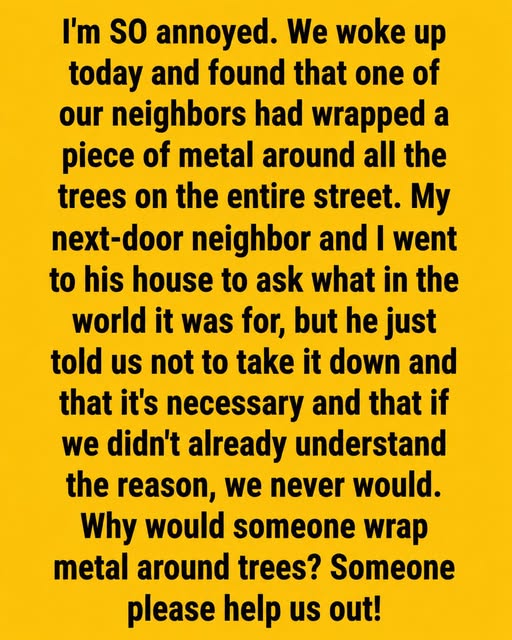
If you have ever walked through an older neighborhood, visited a public park, or explored a wooded area, you may have noticed something unusual around the trunk of a tree.
It might look like a wide metal band wrapped around the trunk.
Sometimes it is a smooth sheet of metal.
Other times it looks more like a rigid cylinder, a protective sleeve, or a section of metal flashing that extends several feet above the ground.
At first glance, it can seem completely out of place.
Why would anyone deliberately put metal around a living tree?
Is it decorative?
Is it connected to construction?
Is someone trying to protect the tree?
Or is there another practical reason that isn’t immediately obvious?
In many cases, the explanation is much simpler than it appears.
Metal barriers around tree trunks are often used as a form of tree protection. Depending on the location and design, they can help discourage animals from climbing the tree, prevent certain types of damage to the bark, protect young trees from equipment, or create a physical barrier around a particularly valuable or vulnerable trunk.
However, not every metal structure around a tree serves the same purpose.
The size, height, material, location, and way it is attached can provide clues about why it was installed.
Understanding those differences can turn what initially looks like a strange sight into a fairly practical piece of landscaping or property management.
Why Would Someone Put Metal Around a Tree?
Trees are remarkably durable, but their trunks can be vulnerable to certain kinds of damage.
The bark protects the living tissues underneath it. If the bark is repeatedly damaged, the tree can become more susceptible to disease, insects, decay, or structural problems.
This is especially important for young trees.
A newly planted tree may spend years developing a strong root system and establishing itself in its environment. During that period, damage from animals, lawn equipment, vehicles, or other sources can create problems that are much more serious than they appear.
For this reason, property owners sometimes install physical barriers around trees.
Metal is one material that can be used because it is relatively durable and can withstand outdoor conditions for a long time.
A properly designed barrier can serve as a protective layer between the tree and whatever is causing the problem.
The important word here is barrier.
The metal usually isn’t intended to help the tree grow.
It is there to prevent something else from reaching the trunk.
One Common Reason: Protecting Trees From Animals
One of the most familiar reasons for metal tree guards is animal protection.
Certain animals can damage trees by climbing, rubbing against trunks, chewing bark, or using trees as access points.
In rural areas, woodland properties, orchards, and large gardens, wildlife can create significant challenges for young trees.
For example, animals may be attracted to tender bark or branches.
Rodents can sometimes gnaw on young trees.
Larger animals may rub against trunks or use them as part of their normal movement through a property.
A physical barrier can make that more difficult.
This is especially useful when the tree is young and has relatively thin bark.
A mature tree with thick, established bark may be able to tolerate some minor surface damage.
A young tree may not have the same level of protection.
That is why tree guards are often seen around newly planted trees.
Metal Can Discourage Climbing
Another possible reason for a metal sleeve is to make the trunk difficult to climb.
This can be particularly useful in locations where people are trying to prevent animals from reaching something higher in the tree.
For example, a tree may contain a birdhouse, nesting area, fruit, or another feature that property managers want to protect.
A smooth metal surface provides very little grip.
Unlike rough bark, branches, or wooden boards, a properly installed metal surface can be difficult for some animals to climb.
This doesn’t mean that every animal will be stopped by it.
Wildlife is adaptable, and determined animals can sometimes find alternative routes.
But even a simple physical obstacle can make access considerably more difficult.
In certain situations, that is all the property owner needs.
Protecting Trees From Lawn Equipment
Another explanation has nothing to do with wildlife.
Sometimes metal or other protective material is installed around a tree because of lawn maintenance.
Think about how frequently a lawnmower, string trimmer, or other equipment passes around a tree.
When grass grows right up against a trunk, someone maintaining the lawn may accidentally strike the bark.
A lawnmower blade can cause severe damage.
A string trimmer can remove sections of bark surprisingly quickly.
Even repeated minor impacts can weaken the protective outer layer of the tree.
Some properties therefore use physical barriers to create a small buffer around the trunk.
The barrier reminds workers to keep equipment away from the tree.
In some cases, the protection may consist of metal.
In others, it may be a decorative border, wooden structure, plastic guard, or simple area of mulch.
The goal is essentially the same:
Keep equipment from making direct contact with the trunk.
Construction Sites Are Another Possibility
Metal around a tree can also be associated with construction or property improvements.
When construction takes place near established trees, there can be a risk of damage to trunks and roots.
Heavy equipment may operate close to the tree.
Materials may be moved around the property.
Workers may need to carry tools and supplies through areas containing existing vegetation.
A protective structure can help reduce the chance of accidental contact.
This is particularly important when the tree is being intentionally preserved during construction.
A mature tree may have significant landscape value, and replacing it isn’t as simple as planting a new sapling.
An established tree may have taken decades to reach its current size.
It may provide shade, privacy, habitat, erosion control, and visual character.
Protecting it during a construction project can therefore be worthwhile.
Tree Protection During Road Work
You may also see metal barriers around trees near roads, sidewalks, parking areas, or other infrastructure.
Trees located close to vehicles face a different set of risks.
A driver may accidentally bump the trunk.
A delivery vehicle may swing too close.
Maintenance equipment may strike the tree.
Even repeated low-level impacts can eventually cause visible damage.
A sturdy barrier can create additional separation between the tree and nearby traffic.
In urban environments, these protective structures can sometimes be designed as part of the streetscape.
They may serve a practical purpose while also fitting into the surrounding landscape.
Why Metal Instead of Wood?
If the purpose is simply to protect a tree, you might wonder why someone would choose metal.
There are several possible reasons.
Metal can be durable.
It can resist moisture better than some untreated materials.
It may remain effective for years.
It can also provide a smooth surface that is difficult for animals to grip.
Another consideration is maintenance.
Wood can eventually rot, split, or become damaged by insects.
Plastic can become brittle depending on the material and environmental conditions.
Metal, when properly selected and maintained, can provide a long-lasting protective structure.
That doesn’t make metal automatically better.
The correct material depends on the situation.
A small garden may require nothing more than a simple tree guard.
A rural property dealing with wildlife may require a different design.
A construction site may need temporary protective fencing rather than a permanent sleeve.
The Height of the Metal Can Tell You Something
One useful clue is how high the metal extends up the trunk.
A short protective ring close to the ground may be intended to prevent damage from lawn equipment or small animals.
A taller, smooth barrier may be intended to discourage climbing.
A very large structure extending significantly above the ground may be associated with a specific property-management concern.
However, height alone doesn’t provide a definite answer.
The surrounding environment matters too.
A tree in a backyard has different risks from a tree beside a busy road.
A tree in a forest has different challenges from one growing inside an orchard.
That’s why it is better to look at the entire setup rather than assuming every metal-covered tree has the same explanation.
What About Fruit Trees?
Orchards are another place where protective structures can sometimes be found.
Fruit trees can attract a wide range of animals.
Birds, rodents, insects, and larger wildlife may all be interested in fruit or young growth.
Protective guards can be used to reduce certain types of damage.
The exact design depends on what the property owner is trying to prevent.
A barrier designed to stop small animals near the ground may look very different from one designed to discourage larger animals from climbing.
Orchard management can involve multiple layers of protection, including fencing, netting, trunk guards, and other methods.
A metal sleeve around the trunk can therefore be just one component of a broader strategy.
Sometimes It Is About Tree Health
There is an important distinction to make here.
A metal guard is generally not a treatment for a sick tree.
People sometimes assume that wrapping a tree must be intended to heal or strengthen it.
Usually, that’s not the main purpose.
Instead, the protective material is designed to reduce external damage.
For example, if a tree has repeatedly suffered damage from animals, preventing additional damage may give it a better chance to continue growing normally.
But wrapping a trunk too tightly or using inappropriate materials can potentially create problems of its own.
Trees grow.
Their trunks increase in diameter over time.
Any permanent structure placed around a trunk therefore needs to account for that growth.
Why Tight Wrapping Can Be a Problem
A tree trunk isn’t a fixed object.
As the tree grows, the trunk becomes wider.
A barrier that was appropriate when the tree was young can eventually become restrictive if it isn’t adjusted or removed.
This is one reason proper tree protection requires attention.
A protective guard should not simply be forgotten after installation.
If it becomes too tight, it can interfere with normal trunk development and potentially cause injury.
The same principle applies to wires, ropes, straps, ties, or other materials that are placed around trees.
Something that looks harmless when first installed may become a problem years later.
That’s why professionally installed tree protection is generally designed with growth in mind.
Metal Flashing and Animal Barriers
One particular type of metal protection is sometimes associated with animals that climb trees.
A smooth strip of metal can be placed around the trunk to create a slippery surface.
The goal is not necessarily to harm the animal.
Instead, it creates a physical obstacle.
This type of barrier may be used around trees supporting bird feeders, nesting boxes, or other structures.
If an animal can easily climb the trunk, it may be able to reach whatever is positioned above.
A smooth metal band can make that route more difficult.
The design needs to be appropriate for the situation, however.
Simply wrapping random sheet metal around a tree does not guarantee effective protection.
It May Also Protect Something Attached to the Tree
Sometimes the metal isn’t primarily protecting the tree at all.
It may be protecting something located on or near the tree.
For example, a property owner might install a barrier to discourage animals from reaching:
- Birdhouses
- Nesting platforms
- Feeders
- Electrical equipment
- Signs
- Outdoor fixtures
- Decorative structures
In these cases, the tree is essentially being used as a support or part of the surrounding environment.
The metal structure may therefore have a very specific purpose that isn’t obvious from a distance.
What If the Tree Is in a Public Park?
Public parks sometimes use protective structures around trees for several reasons.
Young trees planted in high-traffic areas are particularly vulnerable.
Visitors may accidentally walk into them.
Bicycles may be parked against them.
Maintenance equipment may come close.
Dogs and other animals may interact with them.
In busy areas, a protective barrier can help create a small buffer around the trunk.
Some parks also use protective guards to make young plantings easier to identify.
A recently planted tree can be surprisingly easy to damage simply because people don’t realize how vulnerable it is.
A visible structure helps signal:
Give this tree some space.
Urban Trees Face Unique Challenges
Trees growing in cities have to deal with conditions that forest trees may never encounter.
There are sidewalks, roads, vehicles, construction projects, pedestrians, bicycles, utility infrastructure, and compacted soil.
A tree growing beside a sidewalk may be surrounded by concrete and asphalt.
Its trunk can be only a few feet from moving traffic.
Its roots may be competing with underground infrastructure.
In such environments, protective structures can be part of routine urban tree management.
The metal may look unusual, but it is often simply a practical response to the challenges of growing trees in heavily developed areas.
Could It Be Decorative?
Yes.
Not every piece of metal around a tree is strictly functional.
Some homeowners install decorative metal tree guards as part of landscaping.
These may feature patterns, ornamental shapes, or custom designs.
They can create a visual border around a tree while also providing some protection.
In older properties, decorative metalwork may even be part of the architectural character of the landscape.
That’s why appearance can sometimes be misleading.
A structure that looks purely decorative may have a practical function.
Likewise, a very utilitarian-looking piece of metal may have been installed for a highly specific reason.
What You Shouldn’t Assume
Seeing metal around a tree doesn’t automatically mean the tree is sick.
It doesn’t necessarily mean the property owner is trying to remove the tree.
It doesn’t mean the tree is dangerous.
And it doesn’t necessarily indicate a problem.
In many situations, the metal is simply there because someone wants to protect the tree from a known risk.
The exact reason depends on the location and design.
If you see one in a neighborhood, you may be able to figure out its purpose by looking at what surrounds it.
Is the tree beside a road?
Is there a bird feeder above it?
Is it a newly planted tree?
Are there signs of wildlife?
Is construction taking place nearby?
Is it located inside a public park?
These clues can tell you much more than the metal itself.
Why Mature Trees Are Worth Protecting
The effort people put into protecting trees becomes easier to understand when you consider how long trees take to mature.
A young tree can be planted in a few minutes.
Growing it into a large, established tree can take decades.
During that time, the tree may become part of the identity of a property or neighborhood.
It can provide shade during hot weather.
It can help reduce wind exposure.
It can provide habitat for birds and insects.
It can contribute to the character of a street.
It can even become a visual landmark.
Removing an established tree and replacing it with a young one isn’t an equivalent exchange in the short term.
The new tree has to grow.
That’s one reason property owners and communities sometimes invest in protective measures.
A Simple Piece of Metal Can Have a Practical Story Behind It
The next time you see metal wrapped around a tree trunk, you don’t necessarily need to wonder whether something strange is happening.
There may be a perfectly ordinary explanation.
The metal could be protecting the trunk from animals.
It could discourage climbing.
It could reduce damage from lawn equipment.
It could protect a young tree from vehicles or construction activity.
It could help protect something attached to the tree.
Or it could simply be a decorative landscaping feature.
The details matter.
The height, shape, material, location, and surrounding environment can all provide clues.
And sometimes the reason is even more specific than any general explanation.
A property owner may have experienced a recurring problem and found that a physical barrier was the simplest solution.
Look at the Whole Picture
One of the interesting things about everyday surroundings is how many objects have practical explanations that aren’t immediately obvious.
A metal band around a tree can look strange because most people don’t expect to see metal and living trees together.
But once you understand the possible reasons, the sight becomes much less mysterious.
Trees need protection from some of the same things that affect other parts of a property.
Animals interact with them.
People maintain lawns around them.
Vehicles pass nearby.
Construction occurs around them.
Weather affects them.
And young trees can be particularly vulnerable while they become established.
A protective barrier is simply one tool people can use to reduce those risks.
The Next Time You Notice One
If you happen to see a metal sleeve or band around a tree, take a closer look from a safe distance.
Notice where the tree is growing.
Look at how high the metal extends.
See whether the tree is young or mature.
Check whether something is attached above it.
Look for nearby fencing, landscaping, roads, buildings, or signs of construction.
Those details may reveal the purpose.
What initially looks like an unusual object may actually be a simple example of property maintenance, wildlife management, landscaping, or tree protection.
And that’s perhaps the most interesting part.
The ordinary world is full of small details that seem strange until you understand the practical reason behind them.
A piece of metal wrapped around a tree may not be mysterious at all.
It may simply be someone trying to give a tree a little extra protection so it can continue growing for many years to come.