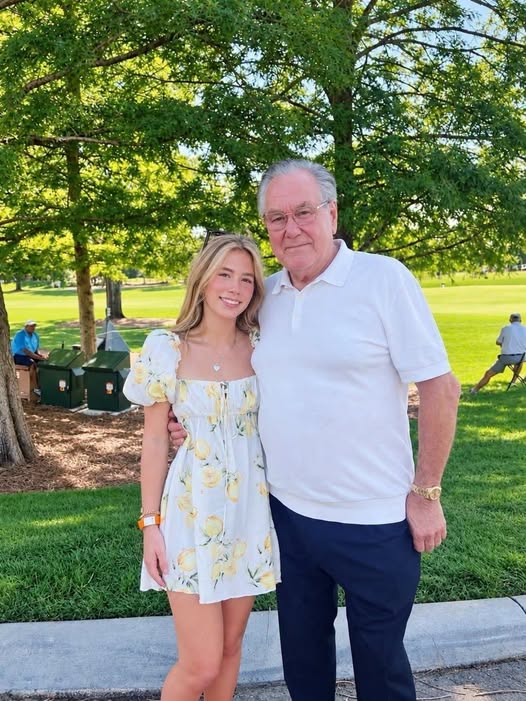
For seven years, I had worked for the same man.
His name was Richard Bennett.
He was seventy-eight years old, the owner of a successful company, and the kind of person who could make an entire office become quiet simply by walking through the door.
He wasn’t cruel.
He never shouted at employees.
He never humiliated people in meetings.
But Richard had a presence that made everyone take their work seriously.
If he looked at you over the top of his glasses, you immediately wondered whether you had forgotten something important.
I had been twenty-four when he hired me.
I had almost no professional experience.
During my interview, my hands were shaking so badly that I accidentally knocked over the glass of water sitting beside me.
I was convinced I had ruined my chances.
Instead, Richard simply handed me a napkin.
“Relax,” he said. “Everyone has to start somewhere.”
I got the job.
Seven years later, I was his personal assistant.
I knew his schedule almost as well as he did.
I knew which clients preferred phone calls and which insisted on email.
I knew which meetings could be moved and which ones absolutely could not.
I even knew that Monday mornings were not the best time to bring Richard a complicated problem.
Over the years, we developed something that went beyond the usual relationship between a boss and an employee.
I respected him.
He trusted me.
At least, I thought he did.
That’s why what happened that week left me completely confused.
It started on a Monday.
Richard called me into his office.
“Emily, do you have anything planned after four o’clock on Friday?”
“No.”
“Good.”
He looked down at the papers on his desk.
“Wait for me downstairs at four.”
I hesitated.
“Is there a meeting?”
He looked up.
“No.”
Then he paused.
“Just you and me.”
I walked out of his office wondering what that meant.
At first, I assumed it was something routine.
Maybe a client dinner.
Maybe an errand.
Maybe he wanted to discuss a project outside the office.
But the next few days made me increasingly nervous.
On Tuesday, I saw the head of accounting carrying my personnel file into Richard’s office.
That was unusual.
On Wednesday, I noticed Richard speaking with the company lawyer.
Twice.
On Thursday afternoon, I walked into his office to leave some documents on his desk.
A folder was sitting there.
My full name was written across the top.
Richard immediately closed it.
I stopped.
“What is that?”
He looked at me.
“Not yet.”
“Not yet what?”
“Tomorrow.”
Then he returned to his work.
I walked back to my desk with a knot in my stomach.
That night, I barely slept.
I began thinking about everything that had happened at the company over the previous few months.
Revenue had been down.
Several employees had already been let go.
There had been discussions about reducing expenses.
Maybe my position was being eliminated.
Maybe the company no longer needed a personal assistant.
Maybe I had made some mistake that I hadn’t noticed.
I replayed every conversation I’d had with Richard.
Every email.
Every appointment.
Every decision.
Nothing stood out.
Still, I couldn’t shake the feeling that Friday was going to change everything.
The problem was that I couldn’t afford to lose my job.
My mother lived with me.
My younger brother was still finishing school.
I was the only person in the household with a reliable income.
My salary wasn’t extraordinary, but it paid the bills.
It covered our rent.
Groceries.
Utilities.
My brother’s school expenses.
There wasn’t much room for an unexpected crisis.
So I spent Thursday night imagining the worst.
At exactly four o’clock on Friday, Richard came downstairs.
He wasn’t wearing his usual suit and tie.
Instead, he had on a simple jacket.
He picked up his keys.
“Let’s go.”
I followed him outside.
“Where are we going?”
“You’ll see.”
Ten minutes later, we arrived at a small neighborhood park.
It wasn’t anything special.
There were trees along the walking path, a children’s playground, and several benches overlooking a small pond.
Richard walked toward one of the benches.
He sat down.
Then he looked at me.
“Sit.”
I remained standing.
“Mr. Bennett…”
He waited.
“If you’re going to fire me, please just tell me.”
He looked at me for several seconds.
Then he said something I had been expecting all week.
“As of today, you no longer work for me.”
My stomach dropped.
Even though I had prepared myself to hear those words, they still hurt.
I sat down slowly.
“Can I ask why?”
Richard folded his hands.
“Because I’ve made a decision.”
“Did I do something wrong?”
“No.”
“Did I make a mistake?”
“No.”
“Then why are you firing me?”
He looked toward the pond.
“I’ll explain.”
I waited.
He turned back toward me.
“I can keep you with the company.”
I stared at him.
“But only on one condition.”
My mind immediately went to the worst possibilities.
“What condition?”
Richard spoke calmly.
“Starting tomorrow, you will no longer work for me for a salary.”
For a moment, I honestly didn’t understand.
“I’m sorry?”
“You heard me.”
“You want me to work for free?”
He didn’t answer immediately.
I felt something inside me collapse.
Seven years.
Seven years of early mornings.
Late nights.
Last-minute meetings.
Emergency calls.
Travel arrangements.
Client problems.
Missed lunches.
Canceled weekends.
There had been countless times when I stayed at the office long after everyone else had gone home.
I had never complained.
And now I was being told that my only option was to work without being paid.
My eyes filled with tears.
“I thought you were a different kind of man.”
Richard looked at me.
“Emily—”
“No.”
I stood up.
“Please don’t.”
He stopped speaking.
I was embarrassed by the tears.
I tried to wipe them away.
“I don’t understand what I did to deserve this.”
“You didn’t do anything.”
“Then why are you asking me to work for free?”
“I think you’re misunderstanding me.”
I shook my head.
“I don’t think I am.”
I took a breath.
“If you don’t want me at the company anymore, just say that. I can accept being fired. I can’t accept being told that my work suddenly isn’t worth paying for.”
Richard remained silent.
That silence made me even more upset.
“I have bills,” I said. “I have a family depending on me.”
He nodded.
“I know.”
That stopped me.
“How?”
“I know more about your circumstances than you realize.”
I stared at him.
He reached into the folder he had brought with him.
Then he placed it on the bench.
“Open it.”
I didn’t want to.
But eventually, I did.
The first page contained my employment information.
The second contained company documents.
Then I saw something that made me stop.
There was a letter.
My name was on it.
I read it carefully.
It wasn’t a termination notice.
It was an offer.
Not from the company.
From Richard personally.
I looked at him.
“What is this?”
He smiled slightly.
“I told you that you no longer work for me.”
“Yes.”
“I meant it.”
“But this says…”
“I’ve decided to retire from the company.”
I stared at him.
Richard continued.
“I’ve been planning this for more than a year.”
He explained that he had been gradually preparing to step away from day-to-day operations.
The meetings with the lawyer.
The accounting department.
The personnel file.
All of it had been part of the transition.
He hadn’t been preparing to fire me.
He had been preparing to change my role.
And then he said the sentence I hadn’t expected.
“I don’t want you to be my assistant anymore.”
I looked at him.
“Then what do you want me to do?”
“Run the company.”
I laughed.
Not because it was funny.
Because I thought he had to be joking.
“Me?”
“Yes.”
“You’re asking me to run your company?”
“I’m offering you the opportunity.”
I looked down at the paperwork again.
There were details about a management role, compensation, responsibilities, and a long-term transition plan.
I was still confused.
“But why did you tell me I wouldn’t be paid?”
Richard smiled.
“Because you wouldn’t be working for me.”
He pointed to the agreement.
“You would be working for yourself.”
I stared at the documents.
“You want me to buy the company?”
“Not exactly.”
He explained that he had created a structure that would allow me to become the managing partner while he gradually transferred ownership interests over time.
The arrangement included a salary, performance-based compensation, and a path toward ownership.
I read the documents twice.
Then a third time.
My hands were still shaking.
“Why me?”
Richard looked at me.
“Because I’ve watched you for seven years.”
I didn’t know what to say.
“You were twenty-four when you started,” he continued. “You made mistakes. Everyone does. But you learned quickly.”
He paused.
“You became the person everyone came to when something went wrong.”
I remembered those moments.
A client couldn’t reach someone.
I handled it.
A meeting needed to be reorganized.
I handled it.
A contract had an unexpected issue.
I found the right people.
A new employee needed help.
I trained them.
Richard continued.
“You’ve been acting like a leader for years.”
“I was your assistant.”
“You were.”
He smiled.
“But that’s not all you were.”
I looked at him.
He told me that he had been deliberately giving me more responsibility over the previous two years.
He had watched how I handled pressure.
How I treated employees.
How I handled difficult clients.
How I reacted when something went wrong.
He wasn’t looking for someone who knew everything.
He was looking for someone who could learn.
“And you chose me?”
“I did.”
“Why didn’t you tell me?”
“Because if I told you too early, you would have started trying to prove yourself.”
I laughed despite myself.
“That sounds like me.”
“It does.”
For the first time that afternoon, I smiled.
Then I looked back at the paperwork.
“But why the park?”
Richard looked around.
“When I was younger, my father used to bring me here.”
I hadn’t known that.
“He taught me that important decisions shouldn’t always be made behind a desk.”
I sat quietly.
Richard continued.
“I wanted you to hear this without phones ringing, employees interrupting us, or people standing outside my office door.”
Then he said something I’ll never forget.
“I didn’t want to offer you a promotion. I wanted to offer you a future.”
That was when I started crying again.
But this time, they weren’t tears of fear.
They were relief.
And something else.
Gratitude.
I thought about the twenty-four-year-old version of myself who had walked into Richard’s office with shaking hands.
I had been terrified that I wasn’t qualified.
Terrified that I wasn’t good enough.
Terrified that one mistake would prove everyone right.
And now, seven years later, the man who had given me my first real opportunity was telling me he believed I could lead the entire organization.
I looked at him.
“What if I fail?”
Richard smiled.
“You will.”
I blinked.
“What?”
“You’ll fail at something.”
He leaned back.
“Everyone does.”
I laughed.
“That’s not very reassuring.”
“It should be.”
He explained that leadership wasn’t about avoiding mistakes.
It was about learning from them without letting them define you.
Then he gave me one final piece of advice.
“Don’t become the kind of boss people are afraid of.”
I looked at him.
“Was I ever afraid of you?”
He raised an eyebrow.
“Extremely.”
We both laughed.
That afternoon changed my life.
But the biggest surprise came a few weeks later.
Richard didn’t simply hand me a new title and disappear.
He stayed involved during the transition.
He introduced me to key clients.
He explained the company’s financial structure.
He taught me how he evaluated major investments.
He showed me mistakes he had made decades earlier.
And he encouraged me to make decisions without constantly asking for his approval.
“I’m not training you to replace me,” he told me.
“What are you training me for?”
“To become better than I was.”
I didn’t know how to respond to that.
Over the next year, I grew into the role.
It wasn’t easy.
Some decisions kept me awake at night.
Some employees questioned whether I was ready.
There were moments when I missed having Richard in the next office.
But slowly, I became more confident.
The company stabilized.
We improved several internal systems.
We hired carefully.
We expanded into new areas.
And eventually, I understood why Richard had chosen that unusual way of telling me.
He wanted me to understand something.
My value wasn’t tied to being his assistant.
He wanted me to stop thinking of myself as someone waiting for instructions.
He wanted me to start thinking like someone capable of making them.
Years later, Richard officially retired.
On his last day, the entire company gathered for a small celebration.
He gave a short speech.
He thanked everyone.
Then he turned toward me.
“I’ll leave you with the same advice I gave you in the park.”
I smiled.
“Which one?”
“Don’t become the kind of boss people are afraid of.”
Everyone laughed.
Then he shook my hand.
After the celebration, we sat outside together.
I asked him why he had chosen me all those years ago.
He thought for a moment.
“Because you cared.”
“About the company?”
“About people.”
He explained that skills could be taught.
Processes could be learned.
Financial knowledge could be developed.
But genuine responsibility was harder to teach.
“You never treated your job like a list of tasks,” he said. “You treated it like something that affected real people.”
I thought about that.
Then I asked him whether he had ever regretted hiring me.
He laughed.
“Several times.”
I smiled.
“Seriously?”
“No.”
He looked at me.
“Not once.”
That meant more to me than any promotion ever could.
I still think about that afternoon in the park.
For several minutes, I believed I had lost everything.
I thought my employer of seven years had decided my work wasn’t worth paying for.
I thought I was going to have to go home and tell my family that our financial security had suddenly disappeared.
Instead, I learned that sometimes the information you fear most is not the full story.
Richard wasn’t taking my future away.
He was asking me to take responsibility for it.
And perhaps that’s why he chose such a strange way to deliver the news.
He wanted me to understand that there was a difference between having a job and building a career.
Between following instructions and taking responsibility.
Between working for someone and eventually becoming someone others could trust.
I went to that park expecting to be fired.
I left with a new opportunity.
But more importantly, I left with something I had never had at twenty-four.
Someone’s complete confidence in me.
Richard gave me my first job.
Seven years later, he gave me something far more valuable.
He gave me the chance to believe I was ready for the next one.