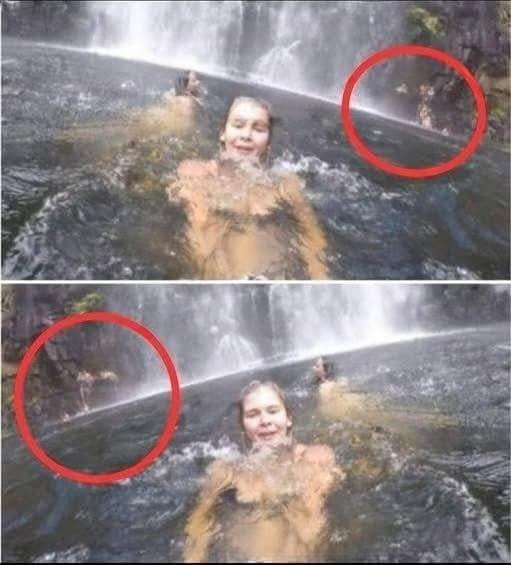
Why We Sometimes Miss Hidden Details in Ordinary Images — and How a Second Look Changes Our Perspective
At first glance, an ordinary photograph or short video may seem to contain nothing unusual. The scene appears familiar, the objects seem to be where they belong, and nothing immediately attracts attention. Yet after someone points out a particular detail, the same image can suddenly look different.
This experience is common. People often overlook small features when looking at a busy scene, especially when they are distracted, viewing content quickly, or expecting to see something familiar. A second look can reveal details that were present all along but did not initially receive attention.
The experience can be surprising because it changes how we interpret something we believed we had already understood. It may be a small object in the background, an unusual arrangement, a visual pattern, or a detail that becomes noticeable only after we know where to look.
However, not every image contains a secret, and there is no guarantee that a hidden feature exists simply because someone claims that viewers are missing it. Sometimes the explanation is straightforward: people notice different things because attention, experience, and expectations influence what they see.
Understanding how visual attention works can make these everyday experiences more interesting. It can also explain why people disagree about photographs, why certain puzzles are difficult, and why a detail that seems obvious to one person may remain unnoticed by another.
Why the First Look Can Be Misleading
Human vision is remarkably capable, but it does not work like a camera that records every detail with equal importance. The eyes receive information from the environment, while the brain organizes that information into a useful interpretation of the scene.
This process allows people to recognize faces, read signs, follow movement, and navigate familiar surroundings without consciously examining every object.
The trade-off is that attention is selective. When looking at a photograph, people may focus on the main subject and overlook smaller features around the edges. They may notice a person’s expression but miss an object on a nearby table. They may understand the overall scene without remembering exactly where every item appears.
This is not necessarily a failure of vision. It is part of how people manage large amounts of information.
Imagine looking at a photograph of a family gathered in a garden. Your attention may naturally go toward the people, their faces, and the central activity. A small bird resting on a fence in the background might receive little attention, even if it is clearly visible.
If someone later asks whether you noticed the bird, you may look again and wonder how you missed it.
The bird did not suddenly appear. Your attention simply shifted toward a feature that had previously been overlooked.
The Difference Between Seeing and Noticing
Seeing and noticing are closely related, but they are not identical experiences.
A person can look directly at a scene without consciously registering every detail within it. Visual information is processed at different levels, and only some of it becomes the focus of deliberate attention.
This helps explain why someone may look at a photograph several times before recognizing an unusual feature.
The first viewing might establish the general scene. The second may involve a search for specific objects. A third may focus on a detail another person has mentioned.
Each viewing has a different purpose, and the resulting interpretation can change accordingly.
Attention Has Limited Resources
People frequently divide their attention among several activities. They may look at an image while reading a caption, listening to someone speak, checking notifications, or thinking about another task.
When attention is divided, small visual details are easier to overlook.
Even when someone is looking directly at a screen, the mind may be occupied with interpreting the main subject rather than examining the background.
A photograph viewed carefully on a large display may reveal features that are difficult to notice on a small phone screen. Lighting, image quality, screen brightness, and viewing distance can also influence what is visible.
For this reason, missing a detail should not automatically be interpreted as a lack of intelligence or observational ability.
It is often a normal result of selective attention.
Familiar Scenes Encourage Quick Judgments
When a scene looks familiar, people may recognize its general category almost immediately.
A picture of a kitchen is understood as a kitchen. A photograph of a street is recognized as a street. A family portrait is interpreted as a picture of people posing together.
Once the brain has established this general understanding, the viewer may not examine every part of the scene in equal detail.
This efficient process is useful in everyday life. People do not need to inspect every object in a familiar room each time they enter it.
However, a quick interpretation can also make unusual features easier to miss. If an image appears ordinary, viewers may have little reason to search for anything unexpected.
A second look changes the task. Instead of simply identifying the scene, the viewer begins examining how its individual elements fit together.
How Expectations Influence What We Notice
Expectations play an important role in visual perception.
When people believe they know what an image contains, they often direct their attention toward the features that support that interpretation. Details that do not fit their expectations may receive less attention.
This does not mean that the brain invents everything it sees. Rather, perception combines incoming sensory information with context, memory, and expectations.
Consider a photograph of a crowded living room. If someone tells you to look for a red object, you may begin searching for red cushions, books, clothing, or decorations. You may notice an item that was visible all along but was not important to your original interpretation.
The instruction changes what you are looking for.
The same principle applies to visual puzzles. A picture may appear confusing until a viewer receives a hint about the relevant shape, location, or relationship between objects.
Once the hint is provided, the visual search becomes more focused.
Why a Hint Can Change the Entire Image
A useful hint does not necessarily add information to a photograph. Instead, it can direct attention toward information that was already present.
For example, someone might ask you to examine the upper-left corner of an image. You may then notice a small object partly obscured by another item.
Before receiving the hint, your eyes may have moved across the center of the scene without spending much time in that corner.
The hint gives you a specific search target.
This is one reason visual puzzles often seem easier after the answer is explained. Once the relevant relationship is understood, the viewer no longer needs to consider every possible interpretation.
The challenge is often not simply seeing the details but identifying which details matter.
The Role of Background Details
Photographs contain more information than viewers can usually examine consciously in a single glance.
The main subject tends to attract attention because it occupies a prominent position, has a distinctive shape, or carries obvious meaning. Background elements may be less noticeable, even when they contribute to the image’s overall interpretation.
A small sign, a reflection, a shadow, or an object near the edge of a photograph can sometimes change how the scene is understood.
However, background details should be interpreted carefully. A photograph may be cropped, compressed, or taken from an unusual angle. What appears significant at first may have an ordinary explanation when more context is available.
Reflections and Shadows
Reflections can create interesting visual effects because they reproduce parts of a scene from a different perspective.
A window may reflect objects from outside, a polished surface may mirror nearby shapes, or a body of water may distort the appearance of buildings and trees.
These effects can initially confuse viewers who focus on the main scene rather than the reflected image.
Shadows can produce similar surprises. A shadow may resemble an object, create an unusual shape, or make two separate objects appear connected.
In many cases, a second look helps the viewer distinguish the physical object from its reflection or shadow.
The experience demonstrates how context influences visual interpretation.
Objects Partly Hidden by Other Objects
An object does not need to be completely invisible to escape attention. If it is partly covered, similar in color to its surroundings, or positioned behind a more prominent subject, viewers may not immediately recognize it.
This is common in crowded scenes, where several objects overlap.
A person looking for a specific item may need to examine the boundaries between objects rather than focusing only on their centers.
Visual puzzles often use this principle by placing a shape among similar textures or arranging several objects so that their outlines create another recognizable form.
Unusual Arrangements
Sometimes the important feature is not a hidden object but the relationship between objects.
A group of items may form a pattern that is difficult to recognize when viewed individually. Once the viewer steps back and considers the whole arrangement, a larger shape may become apparent.
This is related to the way people organize visual information into groups.
The brain often interprets nearby objects as belonging together, recognizes similarities, and searches for continuous patterns. These tendencies make scenes easier to understand, but they can also encourage an initial interpretation that overlooks another possible arrangement.
A second viewing allows the viewer to reconsider those relationships.
Why Visual Puzzles Can Be So Difficult
Visual puzzles challenge people to look beyond their first interpretation.
Some ask viewers to find a particular object in a crowded picture. Others rely on differences in shape, color, orientation, or perspective. Some use optical illusions that make a single image appear to contain two different scenes.
The difficulty depends on how the image directs attention.
A puzzle may place the target near the edge of the frame, use colors similar to the background, or arrange objects in a way that supports a misleading interpretation.
The viewer may scan the image repeatedly without finding the answer because the search strategy remains unchanged.
A hint can help by encouraging a different way of examining the picture.
Search Methodically Instead of Looking Randomly
When searching for a hidden object, it can help to divide the image into sections.
Begin with the upper portion, then move across the center and lower areas. Examine the edges and corners rather than repeatedly focusing on the most prominent subject.
If the puzzle involves a particular color or shape, search specifically for that feature.
Changing the viewing strategy may be more useful than simply staring at the same part of the image for longer.
Consider Multiple Interpretations
Some images can be interpreted in more than one way.
An arrangement of lines may resemble a face from one perspective and an ordinary collection of objects from another. A shadow may appear to form a separate shape until the viewer identifies the object casting it.
When an image seems confusing, ask what other interpretation could explain the visible features.
This does not mean every unusual