-
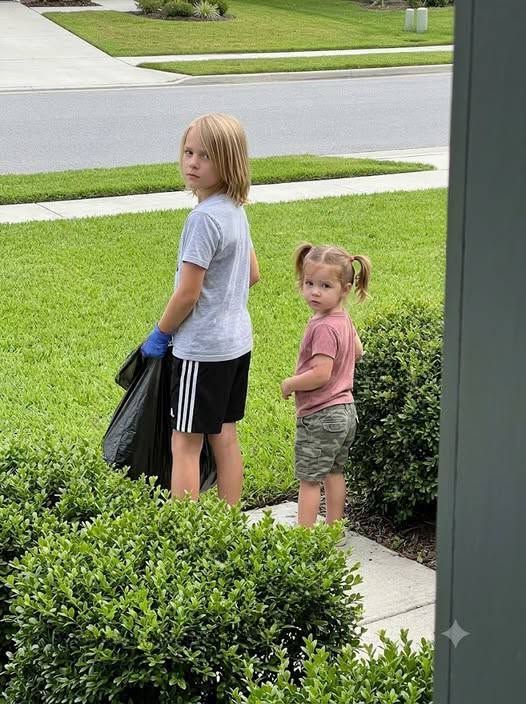
Every Sunday afternoon, twelve-year-old Mia and nine-year-old Ben walked slowly along our street carrying a black trash bag.
Everyone assumed they were picking up litter.
I did too.
They wore old gloves, collected bottles and cans, and occasionally stopped beside a hedge or mailbox. It looked like an ordinary neighborhood cleanup routine.
Then one Sunday, I saw Ben kneel beside my bushes.
He looked around before pushing something into the dirt.
Something about the movement bothered me.
After the children left, I walked over and searched beneath the branches.
I found a small plastic bag.
Inside was a silver flash drive.
There was also a folded piece of paper with my name on it.
I opened it.
If Mom disappears, contact the police. Do not tell Rick.
I read it twice.
Then I locked my front door.
I connected the flash drive to my computer.
There were dozens of folders.
Photographs.
Audio recordings.
Bank statements.
Scanned documents.
Screenshots of text messages.
And one video file.
I opened it.
Mia and Ben appeared on the screen.
They looked frightened.
Mia spoke first.
“If you’re watching this, something happened to Mom.”
Ben sat beside her, gripping the sleeve of his sweatshirt.
“Rick doesn’t know we’re doing this.”
Mia explained that their mother, Laura, had been trying to leave her husband for months.
Rick controlled her bank cards.
He had taken her passport.
He monitored her phone.
He told her she would never be able to survive without him.
Then the video showed photographs of bruises on Laura’s wrist and screenshots of threatening messages.
One recording captured Rick’s voice.
“If you try leaving again, I’ll take everyone somewhere nobody can find us.”
Another recording was even more disturbing.
He described an isolated cabin in the woods where nobody would interfere.
I stared at the screen.
The children hadn’t been collecting trash.
They had been building a backup plan.
I called the police.
Within an hour, Detective Vasquez arrived with several officers.
I showed her the flash drive and explained exactly where I’d found it.
She listened without interrupting.
“Do you know where the children are?”
“Not right now.”
“And their mother?”
“At home, I believe.”
Detective Vasquez immediately requested a welfare check.
We drove to Laura’s house.
Nobody answered the front door.
The lights were on.
A car sat in the driveway.
One officer walked around the side of the house.
Then he stopped.
“Wait.”
Everyone became quiet.
A faint knocking sound came from inside.
He tried the back door.
Locked.
The knocking came again.
Louder.
“Help!”
The officers forced the door open.
They found Laura trapped inside the laundry room.
She had been locked in from the outside.
Her phone was gone.
Her hands were shaking.
“My children,” she cried. “Where are Mia and Ben?”
Detective Vasquez looked at the empty driveway.
“Where is Rick?”
Laura’s face changed.
“He took them.”
Laura explained everything.
She had suspected Rick might eventually try to isolate the family.
That was why Mia and Ben had started collecting evidence.
But what shocked us was how carefully they had planned it.
The children had created twelve identical flash drives.
They had copied everything they could find.
Then, every Sunday, they distributed the drives around the neighborhood.
One went behind a mailbox.
Another was hidden inside a loose section of a stone wall.
One was tucked beneath a garden planter.
They weren’t trying to make the evidence disappear.
They were making sure it couldn’t disappear with them.
If Rick found one drive, eleven others would remain.
“If he takes us away,” Laura whispered, “they wanted someone to know what happened.”
Detective Vasquez immediately issued an alert for Rick’s truck.
Traffic cameras soon picked it up heading north.
Toward the wooded property Laura had described.
The cabin.
Then investigators noticed something unusual.
The truck stopped briefly at a gas station.
Mia had apparently found an old mobile phone inside the vehicle several days earlier.
The children had secretly charged it.
When Rick took them, Mia activated its emergency location function.
The signal was weak, but it was enough.
Police followed it.
Officers intercepted Rick’s truck before it reached the cabin.
Mia and Ben were frightened but unharmed.
When Detective Vasquez opened the back door, Ben immediately asked:
“Did you find Mom?”
“Yes,” she told him.
“She’s safe.”
Mia started crying.
Then she whispered:
“We did it.”
The search of the cabin uncovered even more evidence.
Investigators found forged identification documents.
There were typed letters designed to make it appear Laura had voluntarily left town.
There were maps of remote roads.
There were notes describing how Rick planned to isolate the family.
He hadn’t simply wanted to take them somewhere quiet.
He had planned the story that would follow.
If Laura disappeared, he wanted everyone to believe she had chosen to leave.
But the children had destroyed that plan before he could begin.
Investigators also discovered evidence that Rick had been improperly accessing security systems belonging to some of his clients.
The case suddenly became much larger than a family dispute.
Laura and the children were moved to protected housing.
Rick eventually accepted a plea agreement and received a lengthy prison sentence.
But the strangest part of the story happened afterward.
For weeks, neighbors kept finding flash drives.
Mrs. Alvarez discovered one behind her mailbox.
Mr. Patel found another inside a stone wall.
Someone found one beneath a park bench.
Twelve drives.
Twelve chances for the truth to survive.
Our quiet neighborhood had unknowingly become part of two children’s escape plan.
Months later, I received a letter from Mia.
She thanked me for finding the first flash drive.
Then she explained why they had chosen my house.
Ben had broken my flowerpot the previous year.
I hadn’t yelled at him.
I had simply helped him clean up the pieces and told him accidents happened.
Mia wrote that she remembered.
“You were the neighbor who didn’t make him feel bad when he was scared.”
That was why she trusted me.
I sat at my kitchen table for a long time after reading that.
I had thought I had simply been kind to a child.
I never imagined that small moment would matter so much.
Today, almost a year later, our neighborhood still has a Sunday cleanup.
But now there are nearly a dozen adults walking the streets with gloves and trash bags.
We pick up bottles.
We clear weeds.
We check on elderly neighbors.
And, occasionally, we laugh about how nobody will ever look at a black trash bag quite the same way again.
Mia and Ben are safe.
Laura is rebuilding her life.
And Rick’s carefully constructed story never had the chance to become reality.
He thought controlling information would give him control over his family.
The children understood something he didn’t.
Truth doesn’t have to be loud to survive.
Sometimes it only needs to be hidden somewhere safe.
A flash drive beneath a bush.
A note inside a stone wall.
A secret passed from one frightened child to a trusted neighbor.
And enough people willing to look closely when something doesn’t feel right.
Every Sunday, when I see children walking down our street with their trash bags, I remember Mia and Ben.
They weren’t cleaning up litter.
They were leaving breadcrumbs.
And because someone finally noticed, those breadcrumbs led their family home.