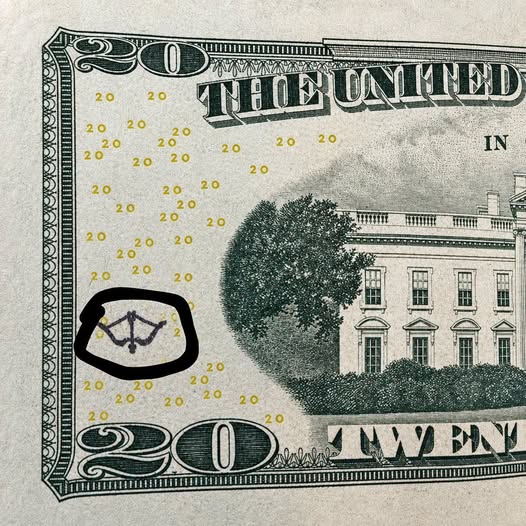
Why Some U.S. Bills Have Unusual Symbols and Stamps: The History Behind Chop Marks
If you have ever handled a stack of old U.S. currency, you may have noticed that not every bill looks exactly the same.
Some notes are crisp and nearly new. Others have been folded hundreds of times, carried in wallets, passed between businesses, or kept in drawers for years.
And occasionally, a bill may contain something even more unusual: a small symbol, stamp, set of initials, geometric design, or other marking that does not appear on ordinary currency issued by the U.S. government.
Among the most interesting examples are marks sometimes described by collectors as chop marks.
A small symbol can look mysterious at first.
Why would someone stamp a mark onto money?
Was it placed there by the government?
Does it indicate that the bill is rare?
Does it make the note more valuable?
Or is it simply evidence of the journey that particular piece of currency took before ending up in someone’s wallet?
The answers are connected to the long history of international trade, private businesses, merchants, collectors, and the movement of currency between different parts of the world.
Understanding these marks also reveals something fascinating about physical money.
A banknote is officially produced for a specific monetary system, but once it enters circulation, people interact with it in ways that are largely outside the control of the institution that originally printed it.
A bill can travel from a bank to a store, from a store to a customer, from one city to another, and eventually across international borders.
Along the way, it may acquire marks that tell part of its story.
What Is a Chop Mark?
The term chop mark has a long history, particularly in connection with trade in Asia.
Historically, merchants and businesses sometimes used stamps or seals to identify goods, documents, or transactions.
The practice was particularly associated with commercial activity in China and other parts of Asia.
A chop, in this context, was essentially a seal or stamp.
Rather than signing a document in the way people commonly sign paperwork today, a person or business could use an identifiable stamp as a form of authentication or identification.
These marks could contain characters, symbols, names, or other designs associated with the person or organization using them.
The practice eventually became relevant to foreign goods and currency as international commerce expanded.
As American silver coins and later U.S. currency circulated through international markets, some pieces acquired additional marks.
The marks could be placed on coins or, in some cases, paper currency.
For collectors, those markings can provide evidence that a particular piece of money participated in commercial activity beyond the ordinary domestic circulation system.
The Bow and Arrow Symbol
Among the symbols that attract attention from collectors is a design resembling a bow and arrow.
When someone discovers such a mark on a U.S. banknote, it can immediately look official.
The symbol may be neat and deliberate.
It may appear to have been carefully applied.
That can lead people to assume it must have been part of the original printing process.
But that assumption isn’t necessarily correct.
Marks of this kind may have been added after the note was originally produced.
That distinction is important.
U.S. currency has specific designs, security features, serial numbers, seals, denominations, and other characteristics established by the issuing authorities.
A privately applied mark is something different.
It represents an additional layer of history that happened after the currency entered circulation.
Why Would Someone Mark Money?
At first, marking a banknote might seem strange.
After all, modern currency is designed to circulate freely.
A $20 bill doesn’t belong permanently to the person who first receives it.
It can change hands repeatedly.
So why would a merchant or other individual want to place a mark on it?
Historically, one reason was identification.
A stamp could indicate that a particular business or merchant had examined or accepted an item.
In some commercial environments, marks could function as a form of authentication.
They could also serve as a record of participation in a transaction.
In markets where people handled large volumes of goods and money, identifiable marks could have practical value.
This is one reason collectors often describe these markings as part of a note’s provenance or circulation history.
The mark does not necessarily tell us everything about the bill.
But it can provide a clue.
The Connection to International Trade
To understand why American money might have acquired unusual marks outside the United States, it helps to look at international commerce during the nineteenth and early twentieth centuries.
American merchants increasingly participated in trade across the Pacific.
Ships carried manufactured goods, agricultural products, metals, textiles, and other commodities between different countries.
Money traveled along with those commercial networks.
Coins were especially important in international trade.
Silver coins had long been used in commercial exchanges in parts of Asia.
American silver dollars became widely recognized in international markets, particularly the famous Morgan dollar and other U.S. silver coins.
These coins sometimes received chop marks from merchants who handled them.
The marks could indicate that the coin had been examined or accepted within a particular commercial network.
For modern collectors, a coin covered with historical chop marks can therefore be an unusually interesting artifact.
Each mark represents an interaction between the coin and someone who handled it.
Coins and Paper Currency Are Not the Same
One important distinction is that chop-mark history is particularly well known among collectors of coins.
American silver dollars with Chinese or Asian merchant marks are a recognized collecting area.
Paper currency is different.
Banknotes can receive all sorts of marks during circulation, including:
- Business stamps
- Bank markings
- Writing
- Ink impressions
- Cancellation marks
- Collector annotations
- Promotional stamps
- Foreign exchange markings
- Identification marks
Not every unusual mark on a banknote should automatically be classified as a traditional chop mark.
This is where careful identification becomes important.
A photograph of a symbol alone may not be enough to determine when, where, or why it was applied.
Collectors often examine the location of the mark, the type of ink, the design, the condition of the note, and whether similar examples are documented.
How Collectors Study Marked Currency
Currency collectors are often interested in details that an ordinary person would never notice.
They may examine:
- Serial numbers
- Printing varieties
- Signatures
- Treasury or Federal Reserve identifiers
- Paper quality
- Ink characteristics
- Watermarks
- Seals
- Historical dates
- Condition
- Folding patterns
- Stamps and annotations
An unusual mark becomes especially interesting when it can be connected to documented historical circumstances.
For example, if several notes are found with the same distinctive stamp and researchers can establish that the stamp was associated with a particular business or organization, the mark becomes more meaningful.
Without that evidence, it may simply be an unexplained stamp.
This is why experienced collectors generally avoid assigning a dramatic story to an unusual banknote without supporting information.
Does a Mark Make a Bill Valuable?
This is one of the most common questions.
The answer is: sometimes, but not automatically.
A strange mark does not guarantee that a bill is rare or valuable.
In fact, writing or stamping on currency can reduce its desirability to some collectors because collectors often prefer notes in clean, original condition.
However, a historically significant marking can sometimes make a note interesting to a specialized collector.
Value depends on many factors.
These may include:
- The denomination
- The date of issue
- Rarity
- Condition
- Serial number
- Type of mark
- Historical significance
- Documentation
- Collector demand
- Authenticity
Two notes that look almost identical may have very different values because one has a documented historical connection while the other has an ordinary ink mark added recently.
That is why it is risky to assume that an unusual symbol automatically means a large payday.
Why Condition Matters
Collectors often use specialized terminology to describe the condition of currency.
A note that has spent years circulating may show folds, stains, creases, discoloration, tears, or other signs of handling.
A note preserved immediately after issuance can remain much closer to its original condition.
Generally, condition can have