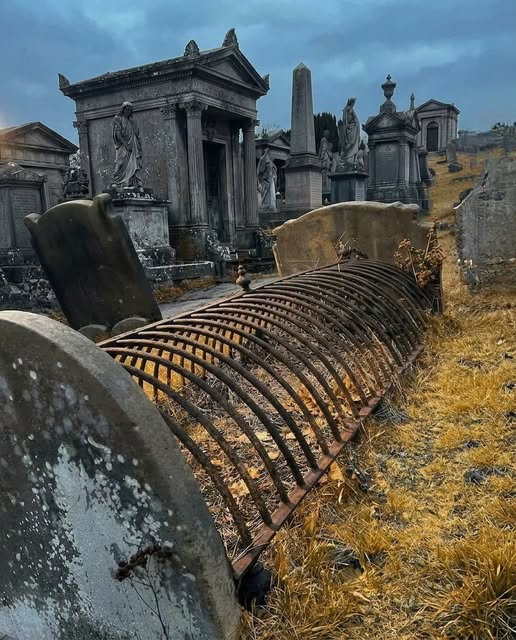
Throughout history, cemeteries have served as places of remembrance, reflection, and respect. They preserve the memories of loved ones while offering future generations a glimpse into local history and cultural traditions. Among the many fascinating features found in older burial grounds, one of the most unusual is the presence of heavy iron structures placed over certain graves. At first glance, these metal coverings may appear to be decorative monuments or elaborate protective frames, but they were created for a very practical purpose.
These remarkable iron enclosures were commonly known as mortsafes. They became especially noticeable during the late eighteenth and early nineteenth centuries in several parts of Europe, particularly in Scotland. Rather than being symbols of wealth or artistic expression, mortsafes were designed to provide temporary protection for newly buried graves during a unique period in medical history.
At the time, medical education was expanding rapidly. Universities and teaching hospitals needed human bodies to help students learn anatomy, yet legal sources for anatomical study were extremely limited. This shortage encouraged a market in which recently buried bodies could be removed from graves and sold to medical schools. As a result, many families became deeply concerned about protecting the resting places of their loved ones.
To reduce the risk of unauthorized disturbance, local communities developed practical solutions. One of the most effective was the mortsafe. These sturdy iron frameworks were placed directly over a grave and secured into the ground. Their weight and strong construction made it extremely difficult to access the burial site during the weeks immediately following a funeral.
Unlike permanent grave monuments, mortsafes were usually intended for temporary use. After a period of time, when natural decomposition made the remains unsuitable for anatomical study, the iron cover was removed and reused for another burial. This practical approach allowed communities to protect multiple graves without creating a permanent iron structure over every burial site.
Many villages and church communities even shared these protective devices. Families could borrow or rent a mortsafe when needed, making the system more affordable and accessible. Some parishes maintained several of these iron covers specifically for community use, reflecting the importance people placed on preserving the dignity of their loved ones.
The appearance of a mortsafe could vary considerably. Some resembled heavy iron cages, while others looked more like solid metal frames with closely spaced bars. Although their designs differed, they all served the same purpose: creating a strong physical barrier over a recently filled grave.
Over time, changes in legislation and medical practice reduced the need for such protective measures. Laws were introduced to provide medical schools with lawful sources for anatomical education, reducing the demand that had encouraged grave disturbances. As these legal reforms took effect, mortsafes gradually disappeared from regular use.
Today, surviving examples can still be found in a number of historic cemeteries and museums. They are valued not only as rare artifacts but also as reminders of an important chapter in social and medical history. Visitors are often surprised to discover these iron structures and learn that they were created out of a community’s desire to safeguard the dignity of the deceased.
Modern historians view mortsafes as evidence of how ordinary people responded to the challenges of their era. Instead of relying solely on laws or authorities, communities designed practical engineering solutions that reflected their determination to protect local burial grounds. Their existence illustrates the relationship between scientific progress, legal reform, and public concern during a period of significant change.
Historic cemeteries continue to attract visitors because they preserve stories that extend far beyond individual gravestones. Architectural styles, inscriptions, monuments, and protective devices such as mortsafes all reveal how societies adapted to changing circumstances. These features remind us that burial traditions have evolved over time while maintaining their central purpose of honoring those who have passed away.
Today, iron-covered graves are viewed with curiosity rather than concern. They have become educational landmarks that encourage people to learn about local history, historical craftsmanship, and the development of medical education. Rather than symbols of mystery, they stand as examples of the practical solutions communities once employed to address the unique challenges of their time.
Although they are no longer used, mortsafes remain among the most distinctive objects found in historic cemeteries. Their durable construction has allowed many examples to survive for generations, giving historians, researchers, and visitors an opportunity to better understand life in earlier centuries. They continue to remind us that every historic cemetery contains stories waiting to be discovered, and that even the simplest iron structure can represent an important piece of cultural heritage.