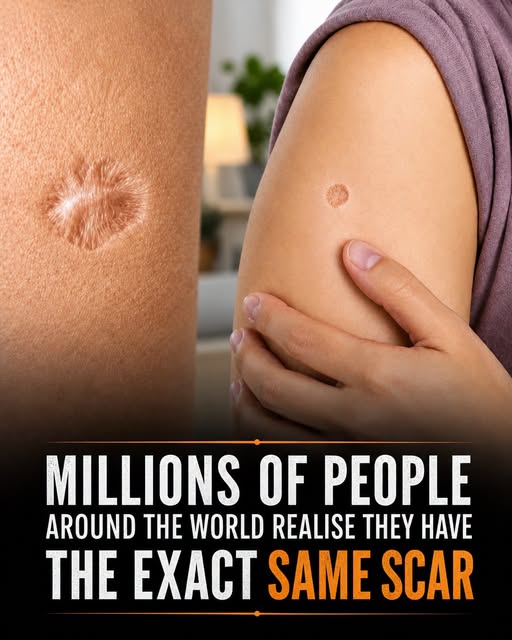
Why So Many People Have a Small Scar on Their Upper Arm
Have you ever noticed a small, round scar on the upper part of your arm and wondered where it came from?
For many people, the mark has been there for so long that they cannot remember getting it. They may have first noticed it as a child, perhaps while getting dressed, looking in a mirror, or comparing their arm with someone else’s.
Sometimes a parent explains its origin. Other times, the scar is simply accepted as part of the body, with no particular story attached to it.
Yet millions of people around the world have a remarkably similar-looking mark.
It is usually small, circular, and slightly raised or textured. In some people it is barely noticeable. In others, the pattern is much more obvious, with a shallow depression or several small points forming a distinctive shape.
So why does this happen?
In many cases, the answer is connected to vaccination history, particularly the smallpox vaccine used widely during the twentieth century.
The familiar upper-arm scar became associated with vaccination programs in many countries because of the way the smallpox vaccine was traditionally administered. The technique was different from the injection methods most people are familiar with today, and the resulting local skin reaction could eventually leave a permanent mark.
That small scar therefore became more than an ordinary feature of the skin.
For generations of people, it served as a quiet reminder of a major chapter in public health history.
The Smallpox Vaccine Connection
The smallpox vaccine was historically administered using a technique that involved placing vaccine material into the skin through a series of small punctures or scratches.
This method was different from a typical injection given with a modern syringe.
The vaccination site could become irritated and develop a localized reaction. After the skin healed, some people were left with a permanent scar.
Because the vaccine was frequently administered on the upper arm, the resulting mark often appeared in the same general location.
This explains why people from different parts of the world can have scars that look surprisingly similar.
The similarity is not necessarily evidence of a shared family trait.
It is often the result of a shared medical practice.
Why Was the Vaccine Given on the Upper Arm?
The upper arm became a common vaccination site for practical reasons.
It provided an accessible area of skin where the vaccination could be administered and later checked if necessary.
Using a consistent location also made vaccination records and visual identification easier in some settings.
Over time, generations of people became accustomed to seeing the small marks on one another’s arms.
Parents had them.
Teachers had them.
Doctors had them.
Neighbors had them.
Children grew up noticing the same distinctive scar on adults around them.
In countries where smallpox vaccination was routine, the mark became almost ordinary.
Smallpox Was Once a Major Public Health Concern
To understand why this scar became so widespread, it helps to understand the history of smallpox.
Smallpox was an infectious disease caused by the variola virus.
Before worldwide eradication efforts succeeded, the disease caused enormous suffering and death across many populations.
It was highly contagious, and outbreaks could affect communities repeatedly.
Survivors could also be left with permanent scars.
Some experienced serious complications, including vision problems and other long-term effects.
Because of the severity of the disease, preventing smallpox became an important goal for health authorities around the world.
Vaccination played a central role in that effort.
An Important Chapter in Medical History
The development of smallpox vaccination is often associated with the work of English physician Edward Jenner at the end of the eighteenth century.
Jenner observed that exposure to cowpox appeared to provide protection against smallpox.
His work helped establish the foundation for vaccination as a major public health practice.
Over the following centuries, vaccination methods evolved.
Governments and health organizations increasingly organized vaccination campaigns, particularly as scientific understanding of infectious disease improved.
Eventually, international cooperation transformed smallpox prevention from a collection of local efforts into a global eradication campaign.
The small scar seen on many people’s arms is therefore connected to a much larger historical story.
Why Did the Vaccination Leave a Scar?
The scar was largely related to the way the vaccine was delivered and the body’s response at the vaccination site.
Unlike many modern vaccines, the traditional smallpox vaccine was not simply injected into muscle tissue with a standard syringe.
A specialized technique was used to introduce the vaccine into the skin.
The area could develop a localized lesion as the immune system responded.
After healing, scar tissue could remain.
The appearance of the scar varied from person to person.
Some people developed a small circular mark.
Others developed a more pronounced scar.
Age, individual healing characteristics, vaccination technique, and other factors could influence the final appearance.
This is why not every smallpox vaccination scar looks exactly the same.
Why Does the Scar Sometimes Have Several Small Dots?
One interesting feature of some smallpox vaccination scars is the presence of several tiny indentations or points.
This appearance can be related to the multiple punctures used during the vaccination process.
The technique involved repeated applications to a small area rather than a single needle injection.
As the skin healed, the pattern of the original procedure could sometimes remain visible.
That is one reason some scars have a distinctive textured appearance.
However, it is important not to assume that every circular mark on the upper arm is a smallpox vaccination scar.
Many other types of scars and skin marks can look similar.
Not Every Upper-Arm Scar Has the Same Origin
The widespread association between an upper-arm scar and smallpox vaccination can make the connection seem universal.
It is not.
People can have scars for many different reasons.
A childhood injury, surgical procedure, burn, insect bite, infection, or other skin injury can leave a circular or textured mark.
Some people also have birthmarks or other harmless skin features that resemble scars.
Therefore, appearance alone cannot always establish the cause of a mark.
For someone who does not know the history of a particular scar, family medical records or childhood vaccination records may provide more useful information than trying to identify it visually.
Why Some People Have the Scar and Others Do Not
One of the most interesting aspects of the mark is that it is strongly influenced by generation and location.
Smallpox vaccination policies changed over time.
As countries reduced or stopped routine vaccination, younger generations became less likely to receive the traditional smallpox vaccine.
The result is a noticeable difference between age groups.
A person born during a period when smallpox vaccination was routine may have the characteristic scar.
Someone born decades later may not.
This creates an unusual generational marker.
In some families, grandparents and parents may have the scar while younger family members do not.
The End of Routine Smallpox Vaccination
The reason routine smallpox vaccination eventually stopped is one of the most remarkable successes in public health.
Through widespread vaccination, surveillance, outbreak investigation, and international cooperation, smallpox was gradually pushed out of human populations.
The World Health Organization declared smallpox eradicated in 1980.
That achievement represented the end of a disease that had affected humans for centuries.
Once smallpox was officially eradicated, routine vaccination of the general population was no longer necessary in most places.
As a result, the familiar vaccination scar became increasingly associated with older generations.
A Scar That Became a Historical Marker
Today, the small mark can function almost like a piece of personal history.
Someone might have no memory of receiving the vaccine.
They may have been too young to remember.
Their parents may have taken them to a clinic when they were an infant or young child.
The scar remained long after the original event had been forgotten.
In that sense, the mark can represent something unusual.
It is a physical reminder of a medical decision made decades earlier.
And because the same vaccination practice was used across many countries, the mark can also connect people who otherwise have very different backgrounds.
The Difference Between Older and Modern Vaccination Methods
Modern vaccination programs generally use methods designed to deliver vaccines safely and consistently, often through intramuscular, subcutaneous, or other established routes depending on the vaccine.
The smallpox vaccination technique was different.
That difference is one reason the scar became so distinctive.
Many people today are accustomed to receiving vaccines that leave little or no visible evidence afterward.
A small injection may cause temporary redness or tenderness, but most people do not develop a permanent mark.
The traditional smallpox vaccination method could produce a more lasting local reaction.
This is why the resulting scar became so recognizable.
Why the Scar Could Be So Persistent
Scar tissue forms when the skin repairs itself after an injury or significant inflammation.
Instead of rebuilding exactly the same way as undamaged skin, the body produces collagen and other structural components to close and strengthen the affected area.
The final appearance depends on the depth and type of the original injury, the individual’s healing response, and other factors.
In the case of vaccination scars, the local reaction could be sufficient to leave a permanent change in the skin.
Once the scar matured, it could remain for decades.
That explains why someone may still have the mark many years after childhood.
Why the Scar May Become Less Noticeable With Age
Although some vaccination scars remain quite visible throughout life, their appearance can change.
Skin changes naturally with age.
Sun exposure, changes in skin texture, weight changes, and normal aging can affect how scars look.
A scar that was obvious during childhood may become less noticeable later.
In other cases, it may remain clearly visible.
The variation is normal.
Scars do not all behave the same way, even when they originate from similar procedures.
The Scar and Family Conversations
For many people, discovering the mark can lead to an interesting conversation with parents or grandparents.
A child may notice the scar and ask, “What happened here?”
A parent might explain that it came from a vaccination.
That conversation can then lead to questions about what life was like when certain diseases were still common.
In this way, a small mark can become an opportunity to learn about family history.
Older relatives may remember vaccination campaigns, school health programs, medical appointments, or public health announcements that younger family members never experienced.
The scar becomes a starting point for a much larger story.
Why It Appears in So Many Countries
Smallpox was a global disease, and vaccination campaigns eventually became international in scope.
Different countries introduced vaccination programs at different times and used different policies.
But the broad goal was the same: reduce transmission and eventually eliminate smallpox.
As vaccination became widespread, large populations received the vaccine.
That produced a generation-spanning pattern.
A person could meet someone from another country and notice that they had a similar scar.
Despite having completely different lives, languages, and cultural backgrounds, both people might share the same medical history.
That is one reason the scar can feel surprisingly familiar.
A Public Health Success Hidden in Plain Sight
Modern discussions about vaccination often focus on current diseases and contemporary health programs.
The smallpox scar provides a physical reminder of an earlier era.
It demonstrates how a public health intervention could reach enormous populations.
Every scar represents an individual vaccination.
Millions of those individual vaccinations contributed to a global effort.
The final outcome was extraordinary: smallpox was eliminated as a naturally occurring human disease.
The scar therefore has historical significance beyond its appeara