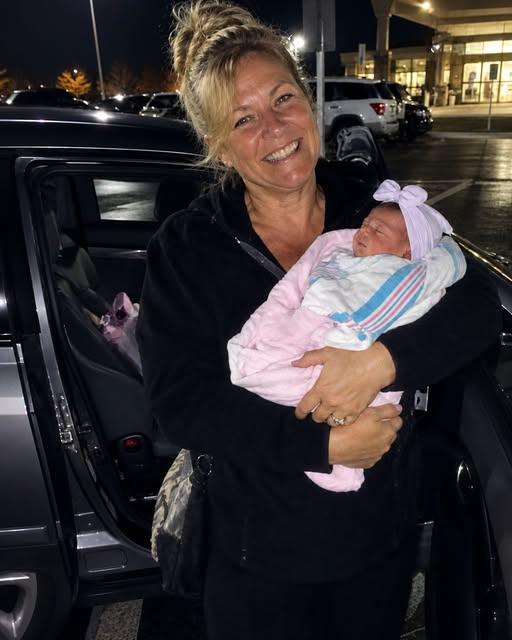
My Husband Brought Home a Newborn Baby Girl—Then the Hospital Asked Us to Come Back
At 2:06 in the morning, my phone began ringing.
I almost ignored it.
The house was completely quiet, and I had been asleep for several hours. At first, I thought the call might be an accident. But when I saw my husband’s name on the screen, I immediately sat up.
Michael rarely called me during the night.
He had left the house earlier that evening after telling me that someone he worked with had been taken to the hospital unexpectedly.
I had assumed he would be home sometime before sunrise.
Instead, he was calling me in the middle of the night.
I answered.
“Michael?”
There was a pause.
Then he said, “You need to get dressed and come to the hospital.”
I pushed the blankets aside.
“What happened?”
“Nothing happened to me. Just get ready.”
His voice sounded unusually serious.
“Is your coworker okay?”
“I don’t know yet. Please, just come.”
He didn’t explain anything else.
Twenty minutes later, I walked through the hospital entrance, still trying to understand why my husband had sounded so urgent.
I expected to find him sitting in an emergency room waiting area.
Instead, I saw him standing outside the maternity ward.
And he was holding a newborn baby.
I stopped walking.
For a few seconds, neither of us said anything.
The baby was wrapped in a pale blanket, with only her tiny face visible.
I looked at Michael.
Then I looked at the baby.
Then back at Michael.
“Who is that?”
He swallowed.
“Her name is Lucy.”
My heart began beating faster.
“Michael, whose baby is she?”
He stepped closer.
Then, very carefully, he placed the newborn in my arms.
I had no idea what to say.
For twenty-two years, Michael and I had raised three sons.
Our house had been filled with sports equipment, school projects, muddy shoes, loud arguments, late-night snacks, and the constant noise that comes with raising children.
I loved being a mother to my sons.
But I had always quietly imagined what it might have been like to have a daughter.
I had never expected that a little girl would suddenly be placed in my arms at two in the morning.
Michael looked at me.
“She’s been placed with us temporarily.”
I stared at him.
“Temporarily?”
He nodded.
“A few months ago, we applied to become emergency foster parents. Remember?”
I did remember.
We had discussed it many times.
Our sons were grown now. The house was quieter. We had reached a point in our lives where we had more time and stability than we had when the boys were young.
We thought perhaps we could provide a safe temporary home for a child who needed one.
We completed the paperwork.
We attended the required meetings.
We went through the background checks.
Then we waited.
Nothing seemed to happen.
Eventually, we stopped talking about it.
I assumed the application had gone nowhere.
Now Michael was telling me that the hospital had called him.
“There was an emergency placement situation,” he explained. “The agency needed someone approved for immediate placement. They contacted me because our paperwork had been completed.”
I looked down at the baby.
She was sleeping peacefully.
“Why didn’t you call me?”
“I didn’t have time.”
“You could have called.”
“I know.”
His expression changed.
“I was scared you would think I wasn’t ready.”
I looked at him for a long moment.
Then I looked at Lucy again.
Despite the confusion, I felt something shift inside me.
She was so small.
Her hand moved slightly beneath the blanket.
I gently touched her fingers.
They curled around mine.
I began to cry.
Michael put his arm around my shoulders.
“We don’t have to make any decisions tonight,” he said. “The placement is temporary. We’re just supposed to give her a safe place until the agency determines what happens next.”
I nodded.
That sounded reasonable.
But before we could leave the hospital, something happened that changed everything.
The Phone Call
We had barely driven ten minutes when Michael’s phone rang.
He answered through the car’s hands-free system.
“Hello?”
A woman’s voice came through the speaker.
It was someone from the hospital.
Her tone was urgent.
“Mr. Carter, where are you?”
Michael glanced at me.
“We’re on our way home.”
“Please turn around.”
He immediately slowed down.
“Why?”
“We need you to return to the hospital with the baby.”
Michael’s expression changed.
“What happened?”
“There was an issue with the records.”
“What kind of issue?”
“I can’t discuss it over the phone. Please come back as soon as you can.”
Michael looked at me.
Then he made a U-turn.
I held Lucy closer.
“What is happening?”
“I don’t know.”
Neither of us spoke for several seconds.
The baby remained asleep.
The entire situation felt increasingly strange.
When we arrived back at the hospital, a nurse met us near the entrance.
This time, there were several people waiting.
A doctor was there.
So was a hospital administrator.
And two members of hospital security stood nearby.
My stomach tightened.
The doctor introduced himself and asked us to follow him to a private consultation room.
He closed the door.
“I’m sorry to bring you back under these circumstances,” he said.
Michael looked frustrated.
“Can you please tell us what is going on?”
The doctor nodded.
“We discovered a discrepancy in the baby’s preliminary records.”
“What kind of discrepancy?”
“Her identification information doesn’t match one of the records we received.”
I looked down at Lucy.
“Is she in danger?”
“No,” the doctor said quickly. “The baby is medically stable.”
That was the first thing that made me breathe easier.
“Then what is wrong?”
The doctor hesitated.
“We need to verify exactly who she is and who is legally authorized to care for her.”
Michael looked at me.
The doctor continued.
“During the review, another laboratory result appeared in the system.”
“What result?”
He looked at a document in his hands.
“It concerns a genetic test.”
I felt confused.
“Why would there be a genetic test?”
The doctor looked at Michael.
Then at me.
“That’s what we’re trying to determine.”
The Unexpected Report
The doctor handed us a preliminary report.
I looked at the page without understanding what I was seeing.
There were numbers, reference codes, and laboratory terminology.
Then I noticed my name.
I looked again.
“That’s my name.”
The doctor nodded.
“It is.”
Michael leaned closer.
“What does this mean?”
The doctor took a breath.
“The preliminary result suggests a very strong biological relationship between you and the baby.”
I stared at him.
“That can’t be right.”
He nodded.
“That’s why we’re not treating the preliminary result as conclusive.”
I almost laughed from disbelief.
“I am fifty-one years old.”
“I understand.”
“I have never had another child.”
“I understand.”
“I didn’t donate eggs. I never had embryos frozen. Nothing like that.”
The doctor remained calm.
“That’s why the result needs to be independently confirmed.”
I looked at Michael.
He seemed just as confused as I was.
“What does the report actually say?”
The doctor explained that the preliminary laboratory analysis had flagged a possible biological relationship.
But he emphasized something important.
A preliminary result is not the same thing as a confirmed result.
There could be an administrative error.
There could be a sample identification problem.
There could be a mix-up involving records.
There could be another explanation that none of us had considered.
For the moment, the only thing everyone knew for certain was that something needed to be investigated.
Then someone knocked on the door.
Hard.
Everyone turned.
The hospital administrator opened it.
A woman stood outside.
She was holding a folder.
She looked exhausted.
And the moment she saw the baby in my arms, she began to cry.
The Woman in the Hallway
“I’m sorry,” she whispered.
The administrator stepped toward her.
“You shouldn’t be here.”
“I had to come.”
The woman looked directly at me.
Then she looked at Lucy.
“I know that baby.”
Michael stood up.
“Who are you?”
She hesitated.
“My name is Rachel.”
The doctor asked her to sit down.
She refused.
“I made a mistake,” she said.
The room became silent.
“What kind of mistake?” Michael asked.
Rachel looked at me.
“The kind that started before Lucy was born.”
The administrator asked everyone to remain calm.
Rachel finally sat down.
She explained that she had recently given birth under complicated circumstances.
During her pregnancy, she had experienced serious personal difficulties.
She had initially planned to care for the baby herself.
But after the delivery, she realized she was not prepared to provide the stable environment the child needed.
She had voluntarily contacted social services.
That was why Lucy had entered the emergency placement system.
But there was something else.
Rachel had been involved in an older fertility-related medical procedure several years earlier.
According to her records, those files were supposed to be archived separately.
A database error had apparently connected information from an old record to the newborn’s current hospital record.
That was one possible explanation for the strange laboratory result.
But there was still a problem.
Why had my name appeared?
The Old Medical Record
The doctor asked me whether I had ever visited the hospital years earlier.
I had.
But not for anything involving pregnancy.
About eight years before, I had participated in a voluntary medical research program at another facility.
The program involved basic health information and family medical history.
I had completely forgotten about it.
Michael remembered.
“You told me about that.”
“I did?”
“Yes. You had to sign a lot of paperwork.”
I remembered.
It had seemed insignificant at the time.
The doctor asked whether the research program involved genetic information.
I couldn’t remember.
The administrator immediately began making calls.
Within an hour, they had located a reference to the program.
The research project had collected genetic material for medical research.
I had signed consent documents years earlier.
But I had never donated eggs.
I had never undergone fertility treatment.
I had never frozen embryos.
The distinction was important.
A genetic database can contain information about a person without that person having any reproductive connection to another individual.
The preliminary match had apparently been interpreted incorrectly.
The report was not saying that I had given birth to Lucy.
It was indicating a genetic similarity that required further investigation.
And because the initial data had been linked incorrectly, the situation became much more confusing than it should have been.
A Second Test
The hospital decided that no assumptions would be made until the proper tests were completed.
New samples were collected.
The laboratory staff carefully documented the identities of everyone involved.
This time, the samples were processed independently.
Michael and I waited.
Rachel waited.
The social worker waited.
Even the hospital staff seemed eager for an explanation.
For the first time that night, the situation began to feel less like a mystery and more like a problem that could actually be solved.
Still, I couldn’t stop thinking about Lucy.
She had nothing to do with the confusion.
She was simply a newborn who needed someone to care for her.
I looked down at her sleeping face.
I realized that all the paperwork, test results, databases, and administrative mistakes were surrounding one very simple fact.
She needed safety.
The Results
The new results came back the following morning.
The doctor asked Michael and me to return to the consultation room.
He sat across from us.
“This time, the results are conclusive.”
I held my breath.
“There is no biological parent-child relationship between you and Lucy.”
I closed my eyes.
For some reason, I felt relieved.
Not because I didn’t care about the baby.
Quite the opposite.
The result meant we could finally separate the emotional situation from the confusing laboratory report.
The doctor explained that the earlier result had been affected by a record-linking problem involving genetic information.
The corrected testing showed that I was not Lucy’s biological mother.
Michael wasn’t her biological father either.
The hospital apologized for the confusion.
But there was still another question.
What would happen to Lucy?
The Foster Placement
The social worker explained that Lucy’s placement with us could continue while the agency worked with her biological family.
Rachel had voluntarily asked for help.
She was not trying to disappear from the child’s life.
She was struggling and wanted to make sure her daughter was safe.
That changed the way I viewed her.
At first, I had imagined that someone had simply abandoned a baby.
The reality was more complicated.
Rachel was a person facing circumstances she did not know how to manage.
She had made mistakes.
She had also taken the difficult step of asking for help.
I respected that.
The social worker told us that the agency would evaluate the situation carefully.
There was no immediate decision about permanent custody.
Our role was simply to provide temporary care.
That was what we had originally agreed to do.
And so, despite the strange beginning, Lucy came home with us.
The First Night at Home
Our house had not contained a baby in years.
We had no crib.
No diapers.
No formula.
No bottles.
No baby clothes.
Our sons arrived that morning with supplies.
One brought a crib.
Another brought diapers.
The third showed up with an enormous bag filled with baby clothes.
They were all confused.
“Where did this baby come from?”
We told them the story.
They listened silently.
Then one of them said, “So we’re suddenly uncles?”
I laughed for the first time since the previous night.
“Apparently.”
The house changed almost immediately.
The quiet rooms were no longer completely quiet.
There were bottles on the kitchen counter.
Baby blankets appeared in the living room.
A crib was assembled in the spare bedroom.
Our sons began arguing about who would be the better uncle.
For the first time in years, our home felt like the early days of raising our children again.
The Meaning of a Temporary Home
I learned something during those first weeks.
Providing foster care is not the same as becoming a child’s permanent parent.
Sometimes the most loving thing you can do is give a child stability while other adults work through difficult decisions.
That can be emotionally complicated.
You grow attached.
You create routines.
You learn the child’s expressions.
You begin to recognize what different cries mean.
You celebrate small milestones.
And yet, you know the placement may not last forever.
That uncertainty is part of foster care.
We tried to focus on what we could control.
Lucy needed to be fed.
She needed to sleep.
She needed medical appointments.
She needed a safe environment.
She needed people who would respond when she cried.
Those things were enough to occupy us.
Michael and I Had to Adjust
Our lives had been built around older children for years.
Suddenly, we were waking up at night again.
We were checking bottles.
We were learning new routines.
We were rearranging schedules.
There were moments when we looked at each other and laughed because we couldn’t believe we were doing this again.
One evening, Michael stood in the kitchen holding a bottle.
“I thought we were done with this.”
“So did I.”
He smiled.
“But she’s worth it.”
I looked toward the living room.
Lucy was sleeping peacefully.
“Yes,” I said.
“She is.”
What Happened With Rachel?
Over the following months, Rachel continued working with social services.
She attended counseling.
She addressed the issues that had made caring for a newborn difficult.
She stayed involved in the process.
That mattered to us.
We never wanted Lucy to grow up believing that her biological mother simply disappeared.
The truth was more complicated.
Rachel had been overwhelmed.
But she was trying to make changes.
Eventually, the agency determined that Rachel had made enough progress to begin supervised visits.
Those visits were emotional.
The first time Rachel held Lucy again, she cried.
So did I.
There was no anger between us.
There was sadness.
There was uncertainty.
There was also hope.
A Different Kind of Family
Over time, Rachel became more stable.
The social workers continued monitoring the situation.
Michael and I remained Lucy’s foster parents.
Eventually, a decision had to be made about her long-term care.
Rachel had improved significantly, but she also recognized that she still needed support.
We discussed several possibilities with the agency.
Nothing happened overnight.
There were meetings.
Home visits.
Reports.
Legal reviews.
Conversations about what would provide Lucy with the greatest stability.
Throughout the process, we tried to remember one thing.
This was not about what Michael and I wanted.
It was about what was best for Lucy.
The Unexpected Conversation
One afternoon, Rachel asked to speak with me privately.
We sat in the kitchen while Lucy slept upstairs.
“I know this isn’t how any of us expected this to happen,” Rachel said.
“No,” I replied.
She smiled sadly.
“I was terrified when I realized I couldn’t do everything by myself.”
I told her that asking for help had not been easy.
She looked at me.
“Thank you for taking care of her.”
I didn’t know what to say.
So I simply answered honestly.
“She made it easy to love her.”
Rachel began crying.
I reached across the table and held her hand.
There was no competition between us.
There didn’t need to be.
She was Lucy’s biological mother.
I was the woman who had cared for her during an important period of her life.
Those two roles did not have to cancel each other out.
The Final Decision
After many months of evaluation, Rachel and the agency agreed on a long-term arrangement that allowed her to remain an important part of Lucy’s life while ensuring that Lucy continued living in a stable home.
Michael and I became Lucy’s permanent guardians.
Rachel retained a relationship with her daughter through an agreed visitation schedule.
It was not the outcome any of us had imagined at the beginning.
But it provided Lucy with stability while allowing her biological mother to remain part of her life.
Our three sons became an important part of the arrangement as well.
They adored Lucy.
The oldest called himself her “unofficial bodyguard.”
The middle one insisted he was her favorite uncle.
The youngest claimed he was obviously the funniest.
Lucy, of course, had no idea what any of them were talking about.
She simply smiled whenever they entered the room.
Years Later
The strange night at the hospital became a story we occasionally told.
Not because of the laboratory mistake.
Not because of the confusion.
But because it marked the beginning of something none of us expected.
Lucy grew up surrounded by people who cared about her.
She knew her biological mother.
She knew Michael and me.
She knew her brothers—who were technically her uncles, although they behaved much more like protective older brothers.
As she got older, we explained her story gradually and honestly.
We never told her that she was unwanted.
We never described her biological mother as someone who had abandoned her.
Instead, we told her the truth.
Sometimes adults face circumstances they are not prepared for.
Sometimes families look different from what people expect.
And sometimes love means making decisions that are difficult but necessary.
What the Hospital Incident Taught Me
I used to believe that family was defined primarily by biology.
The events surrounding Lucy changed that view.
Biology matters.
History matters.
A child’s connection to their biological family matters.
But family is also built through everyday actions.
It is built by showing up.
By preparing bottles at three in the morning.
By attending medical appointments.
By comforting a frightened child.
By keeping promises.
By creating a home where someone feels safe.
Those things cannot be measured by a laboratory report.
The Real Meaning of That Night
When I think back to that first phone call, I remember the confusion.
I remember walking into the hospital.
I remember seeing Michael holding a newborn.
I remember him placing Lucy into my arms.
I remember the second phone call telling us to return.
And I remember the strange laboratory report that made me question everything I thought I knew.
But those details are no longer the most important part of the story.
The most important part is what happened afterward.
A hospital mistake was corrected.
A mother received support.
A child received a safe home.
And two parents who thought they were finished raising children discovered that their family still had room for one more.
Final Thoughts
Life rarely follows the plans we make for it.
Michael and I thought the chapter of raising young children was over.
Our sons were grown.
Our home was becoming quieter.
We had started thinking about retirement, travel, and the next stage of our lives.
Then, one night, my husband called me from a hospital and placed a newborn baby girl in my arms.
Nothing about that night happened in the order we expected.
There was confusion.
There was a mistaken laboratory result.
There were questions about records and identity.
There were difficult conversations with social workers and family members.
But beneath all of that was a child wh