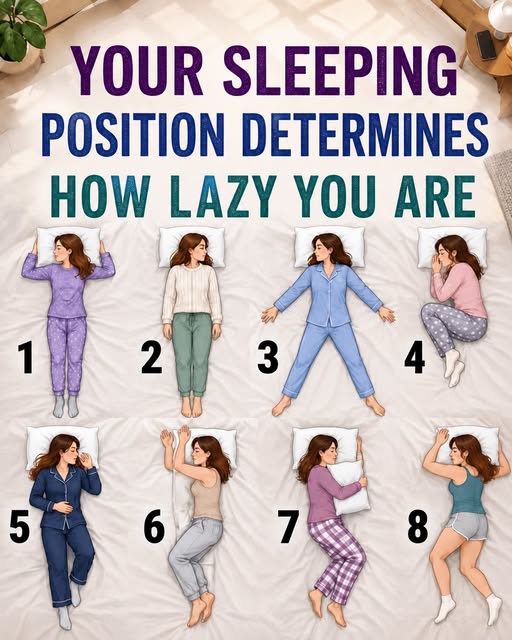
What Your Sleeping Position May Say About Your Sleep Habits
Have you ever woken up in exactly the same position you remember falling asleep in and wondered whether it says something about you?
Maybe you sleep comfortably on your back, with your arms resting beside you. Perhaps you naturally curl onto your side, bringing your knees slightly toward your chest. Or maybe you spend most of the night face down, only to wake up wondering how you ended up that way.
Sleep positions can be surprisingly interesting. They may influence comfort, breathing, pressure on different parts of the body, and even how easily someone settles into sleep.
But there is one important distinction worth making: your sleeping position cannot reliably determine whether you are lazy, hardworking, energetic, or unmotivated.
Personality is much more complicated than the way someone happens to position their body during several hours of sleep.
Still, different sleeping positions can tell us something about comfort and sleep habits. Here’s a closer look at some of the most common positions and what researchers and sleep specialists generally consider when discussing them.
Sleeping on Your Back
Back sleeping is sometimes called the supine position. In this position, the person lies flat with their back against the mattress and their face pointing upward.
For some people, this position feels natural because it allows the body to remain relatively straight. The head, neck, and spine can be supported by the mattress and pillow without requiring the body to twist to one side.
However, back sleeping is not equally comfortable for everyone.
Some people may notice that lying flat makes snoring more noticeable. This can happen because gravity can influence the position of tissues in the upper airway.
For people who already experience certain breathing problems during sleep, their sleeping position may be particularly relevant.
That doesn’t mean back sleepers have a particular personality type. It simply means that body position can affect the physical experience of sleeping.
Sleeping on Your Side
Side sleeping is one of the most common sleep positions.
A person may sleep on their left side, right side, or change sides throughout the night. Some people also place a pillow between their knees for additional comfort.
Side sleeping can feel natural because it allows the body to rest in a slightly curled or supported position.
The position can also influence pressure on the shoulders, hips, and knees. Mattress firmness and pillow height can therefore make a noticeable difference.
A pillow that is too low or too high may leave the neck in an uncomfortable position, while appropriate support can help keep the head and neck more comfortably aligned.
Again, none of this provides a reliable measure of motivation or productivity.
Someone who sleeps on their side might be highly energetic, extremely active, relaxed, or somewhere in between. Sleep position alone cannot tell us.
The Curled-Up Position
Some side sleepers naturally pull their knees toward their chest, creating a curled-up posture.
This position can feel comfortable and may provide a sense of physical security. It is especially common among people who naturally prefer sleeping on their side.
Some people barely move throughout the night, while others frequently change positions.
The curled-up posture can also vary considerably. One person may curl tightly, while another may keep their legs only slightly bent.
These differences are normal.
Rather than interpreting the position as a sign of personality, it may be more useful to think of it as a preference for physical comfort.
Sleeping on Your Stomach
Stomach sleeping, sometimes called the prone position, involves lying with the front of the body against the mattress.
Some people strongly prefer this position and find it easier to fall asleep this way.
However, stomach sleeping can place the neck in a rotated position because the head usually has to face to one side in order to breathe.
Depending on the mattress, pillow, and individual body structure, this may contribute to discomfort in the neck or back for some people.
If someone regularly wakes up with stiffness or soreness, examining their sleeping position and pillow setup may be worthwhile.
But once again, there is no reliable connection between stomach sleeping and being lazy or unmotivated.
The Starfish Position
Some people sleep on their backs with their arms spread out around the pillow or above their head.
This position is sometimes given playful names such as the “starfish” because of the way the body can appear to spread across the mattress.
It may simply be the most comfortable arrangement for someone who likes having plenty of space.
People also naturally change their positions while sleeping. A person who falls asleep in one posture may wake up several hours later in another.
That means trying to assign a personality description to one position can be misleading.
The Log Position
Another commonly discussed position is sleeping on the side with the legs relatively straight and the arms positioned alongside the body.
Because the body resembles a straight line, this posture is sometimes called the “log” position.
It is simply another variation of side sleeping.
Some people may naturally settle into this posture because it feels stable and comfortable. Others may move away from it during the night.
There is nothing about this position that can tell you whether someone is productive or inactive during the day.
Why Sleeping Position Changes
You might have a favorite sleeping position, but that doesn’t necessarily mean you stay in exactly the same posture all night.
During sleep, the body naturally moves.
People may roll from one side to another, adjust their legs, move their arms, change the position of their head, or briefly wake before settling again.
These movements can happen without the person remembering them the next morning.
Your sleeping position can also change because of factors such as:
- Mattress firmness
- Pillow height
- Room temperature
- Pregnancy
- Temporary soreness
- Physical activity during the day
- Changes in sleep habits
- Stress or discomfort
- Age and mobility
- Changes in the sleeping environment
This is one reason it is difficult to use sleep position as a simple personality test.
Does Your Sleep Position Reveal Your Personality?
This is where many popular articles become more confident than the evidence allows.
You may see claims suggesting that back sleepers are confident, side sleepers are dependable, stomach sleepers are independent, or people who curl up are sensitive.
These descriptions can be entertaining, but they should not be treated as scientific personality assessments.
There is no simple formula in which a particular sleeping position reveals someone’s character.
Human behavior is influenced by many factors, including genetics, experiences, environment, relationships, habits, education, stress, and individual circumstances.
A sleeping position is only one physical behavior—and one that can change from night to night.
What About “Lazy” Sleepers?
The idea that someone can be classified as lazy based on how they sleep is especially misleading.
Laziness is not something that can be diagnosed by observing whether someone sleeps on their back, side, or stomach.
A person who sleeps for eight hours may be highly productive during the day. Another person may sleep less and still struggle with fatigue.
Energy levels depend on many factors.
Sleep quality, sleep duration, work schedules, physical health, mental well-being, daily activity, diet, stress, medications, and many other circumstances can influence how energetic someone feels.
Therefore, a person’s sleep position should not be used as a judgment about their motivation or work habits.
Sleep Quality Matters More Than Sleep Position
If you are curious about your sleep habits, there are more useful questions to ask than which position you prefer.
For example:
Do you usually wake feeling rested?
Do you frequently wake during the night?
Do you experience persistent snoring?
Do you regularly wake with headaches or a dry mouth?
Do you have trouble staying awake during the day?
Do you frequently wake with neck, shoulder, or back discomfort?
These questions provide much more meaningful information about your sleep experience than whether you sleep on your side or back.
A comfortable position is useful, but good-quality sleep involves much more than body posture.
Your Pillow Can Make a Difference
The pillow supporting your head and neck can affect how comfortable a sleeping position feels.
Side sleepers often need enough pillow height to fill the space between the head and mattress. Back sleepers may prefer a pillow that supports the natural curve of the neck without pushing the head too far forward.
Stomach sleepers may prefer very little pillow height because the head is already turned to the side.
These are general considerations rather than strict rules.
The right pillow depends on factors such as body shape, mattress firmness, personal preference, and sleeping position.
If you frequently wake with neck discomfort, experimenting with pillow support may be more useful than trying to change your personality based on an online sleep quiz.
Your Mattress Matters Too
A mattress can influence how comfortable you feel in a particular position.
A mattress that is too firm may create pressure around areas such as the shoulders and hips. One that is too soft may allow parts of the body to sink more deeply.
The ideal balance varies from person to person.
This is another reason why two people can prefer completely different sleeping positions and both sleep comfortably.
There isn’t a universal sleeping posture that works perfectly for everyone.
Why We Sometimes Wake Up in Strange Positions
Have you ever fallen asleep in one position and woken up several hours later in a completely different one?
That’s normal.
Sleep involves different stages, and body movement can occur throughout the night.
You may not remember changing positions because brief movements don’t necessarily cause a full awakening.
This can make it difficult to know how you actually sleep for the majority of the night.
The position you remember being in when you fall asleep may not be the position you’ve maintained for hours.
Stress Can Affect Sleep Habits
Stress and emotional strain can influence sleep in many ways.
Some people find it harder to fall asleep when they are stressed. Others may wake more frequently or notice that their sleep feels less restorative.
When sleep quality changes, people may also move around more or adopt different positions while trying to get comfortable.
This doesn’t mean a particular position proves that someone is stressed.
Instead, it illustrates why sleep behavior should be considered in context.
A single night’s sleeping position tells us very little about what is happening in someone’s life.
Why Online Sleep Personality Tests Can Be Fun but Limited
There is nothing wrong with taking a lighthearted personality quiz based on sleeping positions.
These quizzes can be entertaining and may encourage people to think about their habits.
The problem begins when entertainment is presented as established science.
Statements such as “your sleeping position determines how lazy you are” sound definitive, but human personality cannot be reduced to one physical habit.
If you enjoy these quizzes, it is better to treat them as entertainment rather than as a serious psychological assessment.
Your Sleeping Position May Say More About Comfort
Instead of asking whether your sleeping position proves something about your personality, a more useful question is:
Does your sleeping position help you sleep comfortably?
If the answer is yes, there may be little reason to change it.
If you consistently wake with pain, stiffness, numbness, or other discomfort, then your sleep setup may deserve some attention.
You might experiment with your pillow, mattress, body alignment, or sleeping position to see whether your comfort improves.
There Is No Perfect Sleeping Position
People often search for the “best” sleeping position, but there isn’t one position that is ideal for every individual.
Different people have different bodies, preferences, medical circumstances, and sleep habits.
A position that feels excellent for one person may feel uncomfortable for another.
The goal is generally to find a position that allows you to sleep comfortably while supporting your body appropriately.
For some people, that means sleeping on their side. For others, it may mean sleeping on their back or another position.
When Sleep Problems Deserve Attention
While sleeping position itself is not a personality test, persistent sleep problems can be worth discussing with a healthcare professional.
If you regularly experience severe daytime sleepiness, persistent insomnia, significant breathing difficulties during sleep, loud habitual snoring, repeated nighttime awakenings, or ongoing pain, it may be useful to seek professional advice.
These symptoms can have many possible explanations, and a healthcare professional can consider the broader picture rather than focusing on one sleeping position.
The Bigger Picture
Your sleeping position is an interesting part of your nightly routine, but it doesn’t define who you are.
You may sleep curled up one night and stretched out the next. You may prefer your left side, right side, back, or stomach. You may barely move or change positions frequently.
All of these patterns can be part of normal sleep behavior.
What matters more is whether you are getting sufficient, comfortable, restorative sleep and whether you feel well during the day.
So the next time someone tells you that your sleeping position proves you’re lazy, confident, shy, ambitious, or anything else, take the claim lightly.
Your body position while sleeping can tell us something about physical comfort and sleep habits.
It cannot tell your whole story.
And certainly, it cannot measure your motivation.