Victorian Silver Purses: How Small Accessories Became Expressions of Fashion, Craftsmanship, and Social Status
During the Victorian era, clothing was rarely considered purely practical.
The way a person dressed could communicate age, occupation, social position, taste, family background, and even the occasions they attended. Accessories were particularly important because they could transform an outfit while also providing clues about the wearer’s circumstances.
Among the many accessories associated with the period, the Victorian silver purse is especially interesting.
Small, decorative, and often remarkably detailed, these purses combined fashion with craftsmanship. They could be practical objects for carrying coins and personal belongings, but they could also serve as carefully chosen accessories that complemented an entire outfit.
Today, surviving examples offer collectors and historians a glimpse into everyday life during the nineteenth century.
They tell us about changing fashion, advances in manufacturing, decorative arts, social customs, and the growing importance of accessories in personal presentation.
What looks like a small antique purse can therefore reveal much more than its original purpose.
What Was a Victorian Silver Purse?
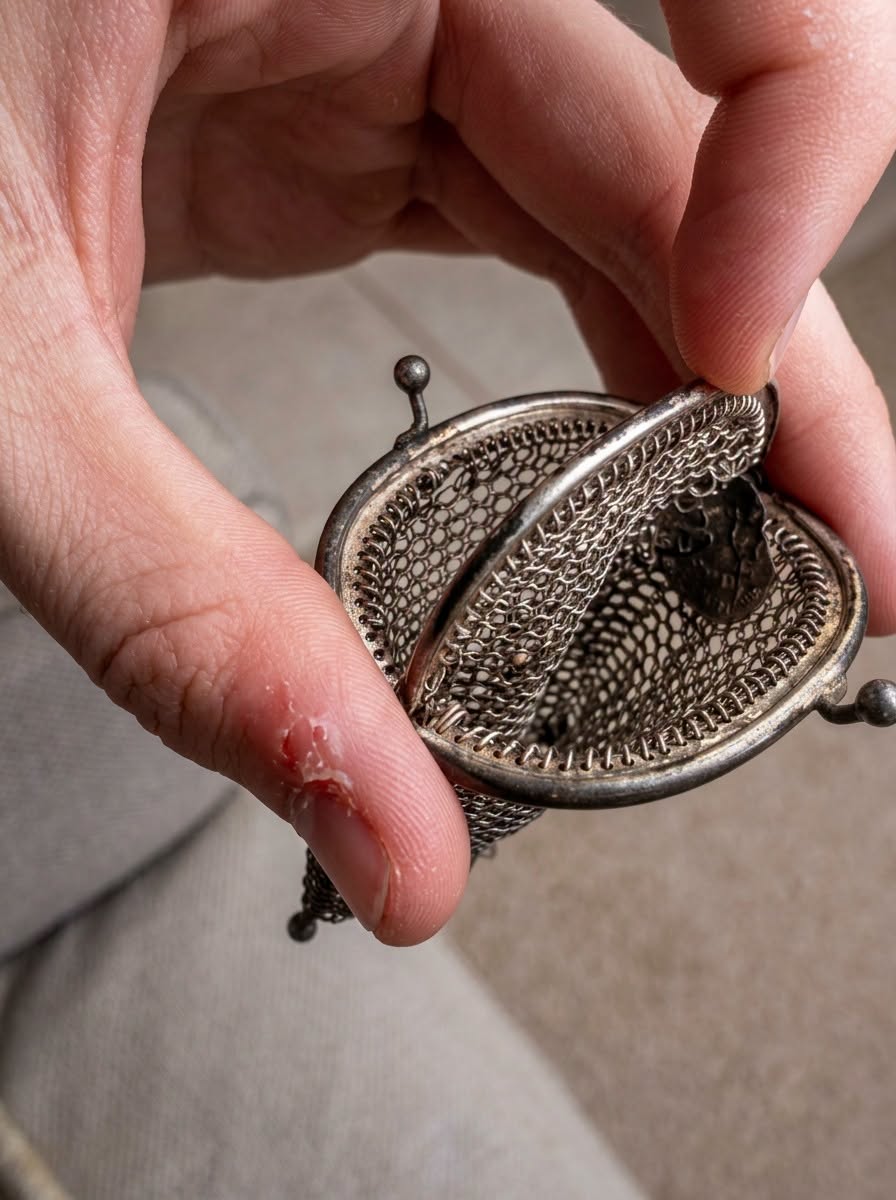
A Victorian silver purse was generally a small purse or mesh bag incorporating silver components, often including a decorative frame, clasp, chain, or silver mesh body.
Some examples were made almost entirely from metal mesh, while others combined silver elements with fabric or other materials.
Their designs varied considerably.
Some were relatively simple and understated.
Others featured elaborate patterns, engraved surfaces, floral motifs, geometric decorations, or ornamental clasps.
The purse could be carried by hand or suspended from a chain.
Its size also made it suitable for carrying small personal items, particularly coins.
Although modern handbags are often large enough to carry numerous everyday necessities, many nineteenth-century purses were much more compact.
Their purpose was different.
They were accessories as much as containers.
The Victorian Era and the Importance of Appearance
The Victorian period lasted from 1837 to 1901, corresponding broadly with the reign of Queen Victoria in Britain.
It was a period of enormous social, industrial, and cultural change.
Cities expanded.
Factories became increasingly important.
Railways transformed travel.
Mass production changed consumer goods.
New forms of entertainment and retail emerged.
At the same time, social expectations surrounding clothing remained highly structured.
Dress could communicate whether someone was attending an ordinary daytime activity, a formal gathering, a wedding, a theater performance, or another special occasion.
Accessories became part of this visual language.
A purse was therefore not simply something to carry money in.
It could be selected to coordinate with clothing and jewelry.
Why Silver Was Attractive
Silver had several qualities that made it desirable for decorative objects.
It was attractive, workable, and capable of being formed into intricate designs.
Skilled craftsmen could create detailed patterns through techniques such as engraving, casting, piercing, and other forms of metalworking.
Silver could also be polished to produce a bright appearance.
Over time, however, it could develop a darker surface as a result of tarnishing.
For modern collectors, that aged appearance can sometimes contribute to the character of an antique piece.
Silver also carried associations with quality and refinement.
Owning a silver accessory could therefore combine practical use with an element of prestige.
Not Every Victorian Purse Was Extremely Expensive
It is important not to assume that every Victorian silver purse represented enormous wealth.
The nineteenth-century consumer market included products made for different economic groups.
Industrial manufacturing allowed decorative goods to become more widely available.
Some items were handmade or highly elaborate.
Others were produced more efficiently and sold at more accessible prices.
This means Victorian accessories shouldn’t automatically be interpreted as evidence that their owners belonged to the wealthiest part of society.
The quality, materials, maker, design, condition, and historical context all matter.
The Growth of Decorative Metalwork
The Victorian period saw major developments in manufacturing.
Industrialization allowed many objects to be produced in greater quantities than before.
At the same time, consumers continued to value craftsmanship.
This created an interesting combination.
Factories could produce standardized components while skilled workers still contributed decorative details.
The result was a growing market for ornamental household goods, jewelry, accessories, and personal objects.
Silver purses existed within this broader culture of decorative consumer goods.
The Mesh Purse
One of the most recognizable forms of antique metal purse is the mesh purse.
These purses could be made from thousands of tiny interlocking rings.
The mesh construction allowed the purse to flex while maintaining its overall shape.
The technique required specialized equipment and careful manufacturing.
Metal mesh was not limited to purses, but the format became particularly associated with small accessories.
When viewed closely, the craftsmanship can be impressive.
Each tiny section contributes to the overall structure.
The Importance of the Frame
The upper frame of a purse often provides some of its most visually interesting details.
A frame could include a clasp, decorative patterns, engraved surfaces, or small ornamental elements.
It also served a practical purpose by holding the opening together.
Some frames were relatively simple.
Others were elaborate enough to become the main decorative feature of the accessory.
The frame can also be useful to collectors because maker’s marks and hallmarks may appear on silver components.
Hallmarks and What They Can Tell Us
One of the most important aspects of collecting antique silver is learning how to read marks.
Depending on the country and period, silver objects may carry various marks indicating information about purity, origin, maker, or date.
British silver is particularly well known for its hallmarking system.
A hallmark can potentially provide valuable information about an object.
However, interpreting marks requires care.
Not every mark is a hallmark in the formal sense, and similar-looking symbols can have different meanings.
Collectors should avoid relying on a single mark when identifying an antique.
The overall construction, materials, dimensions, design, and provenance should also be considered.
The Role of the Purse in Victorian Fashion
Victorian clothing could be elaborate.
Dresses often featured layers, structured silhouettes, decorative fabrics, ribbons, lace, embroidery, and other details.
Accessories helped complete the overall appearance.
A purse could be selected to complement the color, texture, or formality of an outfit.
A delicate evening accessory would not necessarily serve the same purpose as a sturdier daytime purse.
This distinction between different occasions was an important part of nineteenth-century fashion culture.
Small Accessories Could Make a Big Impression
One interesting characteristic of historical fashion is that small objects could have considerable visual importance.
A brooch might draw attention to a neckline.
A necklace could complement a dress.
Gloves could complete an outfit.
A purse could add another decorative element.
Because these accessories were often visible, they contributed to the overall impression created by a person’s clothing.
A carefully chosen purse therefore wasn’t necessarily an afterthought.
It could be an integral part of the ensemble.
The Connection Between Fashion and Social Expectations
Victorian society placed considerable emphasis on appearance and social behavior.
Different environments required different forms of dress.
Someone attending an elegant social event would likely dress differently from someone performing household work.
Accessories were part of that distinction.
A decorative silver purse could suggest that the wearer was attending an occasion where formal appearance mattered.
At the same time, it could simply reflect personal taste.
Fashion is rarely as straightforward as assigning a single meaning to an object.
A Purse Could Also Be a Conversation Piece
Decorative accessories often attracted attention.
An unusual clasp, intricate mesh, engraved design, or distinctive shape could become a topic of conversation.
This was particularly relevant during social gatherings.
People noticed clothing and accessories because fashion was one of the ways individuals presented themselves.
An attractive purse could therefore function both as an accessory and as a small display of craftsmanship.
Craftsmanship Behind the Decoration
Creating a decorative silver purse required more than simply shaping a piece of metal.
Depending on the construction, the manufacturing process could involve forming wire, creating mesh, assembling components, producing decorative patterns, attaching a frame, and finishing the surface.
Different workshops developed different styles.
Some emphasized delicate floral designs.
Others favored geometric patterns.
Some pieces were highly ornate.
Others relied on restrained decoration.
The variety makes surviving examples particularly interesting.
Floral Designs and Victorian Taste
Floral motifs were extremely popular during the Victorian period.
Flowers appeared in architecture, furniture, textiles, jewelry, ceramics, stationery, and fashion.
Purses were no exception.
A silver frame might feature leaves, blossoms, vines, or other botanical details.
These designs could be purely decorative, although nineteenth-century culture also attached symbolic meanings to many flowers.
Collectors today often appreciate these motifs simply because they provide a recognizable connection to Victorian design.
Geometric Decoration
Not every Victorian purse was covered in flowers.
Geometric patterns were also common.
Repeating shapes could create visual interest without relying on natural imagery.
These patterns could be incorporated into mesh construction or decorative frames.
The combination of geometry and metalwork demonstrates how Victorian design could range from delicate ornamentation to more structured visual styles.
How Purses Were Carried
Many small purses were designed to be held in the hand.
Others could be attached to chains.
A chain could allow the purse to be carried more securely while also adding another decorative feature.
Some examples were designed to hang from the wrist.
The method of carrying depended on the design and occasion.
The compact nature of these accessories also reflected the kinds of personal items people were expected to carry.
What Did People Put Inside?
Coins were an obvious use.
Before modern wallets became standard, small purses could provide a convenient way to carry money.
Depending on the purse’s size, it might also hold a few small personal items.
However, many Victorian purses were simply too small to function like modern handbags.
That difference is important.
The modern expectation that a bag should hold a phone, wallet, keys, cosmetics, chargers, and numerous other items would have been unfamiliar to someone using a small nineteenth-century purse.
The accessory was designed for a different lifestyle.
A Reflection of Changing Consumer Culture
Victorian Britain experienced major growth in consumer culture.
Department stores became increasingly influential.
Catalogs and advertisements introduced people to new products.
Improved transportation allowed goods to move more efficiently.
Manufacturing developments made decorative objects available to a wider range of consumers.
Accessories like purses existed within this expanding marketplace.
They demonstrate how fashion was increasingly connected to commercial production.
The Rise of the Department Store
Large retail establishments changed the shopping experience.
Instead of visiting many individual specialists, consumers could encounter a broad selection of goods in one location.
Clothing, accessories, household objects, and personal items became part of a growing retail culture.
This environment encouraged people to think about accessories as products worth selecting, comparing, and coordinating.
A purse could therefore be purchased not merely because it was necessary but because it suited a particular style.
Silver Purses and Special Occasions
Some elaborate purses were particularly suited to formal events.
A decorative silver accessory could complement evening clothing and jewelry.
It could be carried to social gatherings, theaters, dinners, weddings, or other events where appearance was important.
The small size was not necessarily a limitation.
For a formal occasion, carrying only a few essentials may have been perfectly practical.
The purse’s decorative quality could matter just as much as its storage capacity.
The Influence of Victorian Jewelry
Victorian jewelry styles influenced many accessories.
Brooches, bracelets, necklaces, earrings, and other pieces could feature similar motifs.
A purse might therefore form part of a larger coordinated appearance.
Silver accessories could be paired with silver jewelry.
Ornamental designs could repeat across different items.
This coordination helped create the carefully constructed appearance associated with formal Victorian fashion.
Why These Objects Survive Today
Many nineteenth-century accessories have disappeared.
Fabric deteriorates.
Leather can crack.
Textiles can fade.
Metal objects, however, can survive for very long periods when cared for appropriately.
This helps explain why antique silver accessories remain available to collectors.
Even when a purse is no longer usable as an everyday accessory, its metal components can preserve much of its original appearance.
The object becomes both a fashion artifact and a historical document.
The Importance of Condition
Condition is extremely important when evaluating antique accessories.
A purse with intact mesh, a functioning clasp, a well-preserved frame, and minimal damage may be more desirable than one with extensive repairs.
However, condition should always be considered alongside other factors.
Age alone doesn’t determine value.
A rare design by a known maker may be more significant than a common example in slightly better condition.
Collectors therefore examine several characteristics together.
Repairs Can Tell Their Own Story
Repairs aren’t necessarily negative from a historical perspective.
A repaired purse may reveal that its owner valued it enough to maintain it.
A replaced clasp or repaired mesh section can demonstrate that the object remained in use.
For collectors, however, repairs can affect market value depending on their visibility and quality.
This is why careful examination is important.
A repair may be historically interesting while also influencing how the item is assessed commercially.
The Importance of Provenance
Provenance refers to the documented history of an object.
For antiques, provenance can be particularly valuable.
Knowing who owned an object, where it was purchased, or how it passed through a family can add historical context.
A purse with a well-documented family history may be especially meaningful even if it isn’t exceptionally rare.
Personal stories give objects another dimension.
An antique accessory isn’t simply an old object.
It may have accompanied someone through important moments in their life.
Victorian Accessories as Family Heirlooms
Many antique accessories survive because they were passed through generations.
A grandmother might leave a purse to her daughter.
That daughter might eventually pass it to another family member.
Over time, the object becomes a physical connection between generations.
The purse itself may be small, but the family history surrounding it can be substantial.
This is one reason antique accessories can have emotional value beyond their market price.
Collecting Victorian Silver Today
Modern collectors are drawn to Victorian silver for many reasons.
Some appreciate the craftsmanship.
Others enjoy historical fashion.
Some focus on silver hallmarks.
Others collect pieces from particular manufacturers or design periods.
There are also collectors who simply enjoy owning beautiful objects with a story.
The variety of collecting approaches makes the field accessible to people with different interests.
What New Collectors Should Look For
Someone interested in collecting Victorian silver accessories can begin by learning the basics.
Look at genuine examples.
Study hallmark systems.
Compare construction techniques.
Learn about common designs.
Examine condition carefully.
Research makers and manufacturers.
Most importantly, avoid making purchasing decisions based solely on a dramatic description.
Antique markets contain both genuinely interesting objects and items whose age or significance may be overstated.
Research is one of the best tools available to a collector.
Don’t Assume Every Old Silver Object Is Rare
Age is often emphasized in antique sales, but age alone doesn’t establish rarity.
Many objects were produced in large numbers.
Some survived in considerable quantities.
Others were damaged, melted down, or discarded, making surviving examples less common.
Determining rarity requires research.
A collector should consider production numbers where available, survival rates, maker information, design characteristics, and comparable examples.
Silver Purity Matters Too
Different silver objects can contain different levels of precious metal.
Hallmarks can sometimes provide information about purity.
For British silver, established hallmarking conventions can be particularly helpful.
However, silver content should not be confused with overall collectible value.
An antique purse may have historical or artistic significance that exceeds the raw value of its silver.
Conversely, an item with significant silver content may have limited collector interest.
Both factors can matter.
Cleaning Antique Silver Requires Care
One common mistake is assuming that every antique silver object should be polished until it shines.
That isn’t always appropriate.
Aggressive polishing can remove surface details and alter the appearance of an older object.
Collectors sometimes prefer natural patina because it contributes to the item’s character.
Before cleaning a valuable or historically important purse, it can be w