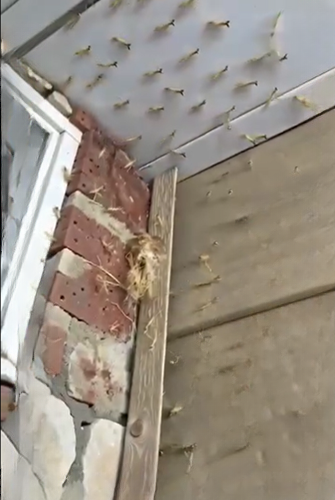
Spending time outdoors often brings unexpected encounters with wildlife. From butterflies visiting flowers to birds building nests, gardens and front yards are constantly changing with the seasons. Occasionally, one of nature’s most fascinating events happens right outside the front door—a praying mantis egg case hatches, releasing dozens of tiny insects into the surrounding area.
Although the sight may be surprising at first, it is a completely natural process and an exciting opportunity to observe one of the garden’s most beneficial predators beginning its life.
A Surprising Morning Discovery
One morning, I stepped outside expecting an ordinary start to the day.
Instead, I noticed dozens of tiny insects slowly making their way across the wall near my front entrance.
At first glance, they looked almost identical—small, delicate, and surprisingly quick for their size.
After taking a closer look, I realized they were newly hatched praying mantises.
Nearby, attached to a branch close to the doorway, was a small tan-colored egg case, known as an ootheca, from which the young insects had recently emerged.
Watching them spread into the garden was an unforgettable reminder of how much wildlife exists around us, often unnoticed until a special moment like this.
What Is a Praying Mantis Egg Case?
Female praying mantises lay their eggs inside a protective structure called an ootheca.
This foam-like casing hardens over time, helping protect the developing eggs through changing weather conditions during autumn and winter.
When temperatures become suitable in spring or early summer, the young mantises hatch and leave the egg case within a relatively short period.
Depending on the species, an individual egg case may contain dozens or even hundreds of developing eggs, although not all hatchlings survive to adulthood.
Why So Many Hatch at Once
Unlike many animals that produce only a few offspring, praying mantises hatch in large numbers.
This reproductive strategy increases the chances that at least some individuals will survive despite natural predators and environmental challenges.
After hatching, the tiny mantises quickly disperse into surrounding vegetation where they begin searching for food and shelter.
Within a short time, many become difficult to spot.
Are Baby Praying Mantises Harmful?
Although their appearance resembles miniature versions of adult mantises, young mantises pose no danger to people.
They are small, delicate insects that spend most of their time hunting tiny prey.
As they grow, they feed on insects such as:
- Aphids
- Small flies
- Mosquitoes
- Caterpillars
- Gnats
- Other soft-bodied garden insects
Because of this diet, praying mantises are often considered beneficial visitors in many gardens.
The Role of Praying Mantises in the Garden
Praying mantises are natural predators that help maintain ecological balance by feeding on a variety of insects.
While they are not selective hunters and may occasionally capture beneficial insects as well, they contribute to the diversity of healthy garden ecosystems.
Their presence often indicates an outdoor environment that supports a wide range of wildlife.
How Long Do They Stay Nearby?
After emerging, young mantises typically begin spreading throughout nearby plants within hours or days.
As they mature, they molt several times before reaching adulthood.
Throughout the growing season, they gradually become larger and more recognizable.
By late summer or early autumn, mature females may begin laying the next generation of egg cases, continuing the natural life cycle.
Should You Move an Egg Case?
If you discover a praying mantis egg case attached to a shrub, fence, or tree, it is generally best to leave it undisturbed whenever possible.
Relocating wildlife unnecessarily can reduce survival rates or interfere with natural development.
If maintenance work makes relocation unavoidable, local gardening or wildlife organizations may offer guidance on appropriate handling practices.
Encouraging a Wildlife-Friendly Garden
Creating a diverse garden benefits many forms of wildlife, including insects that contribute to pollination and natural pest control.
Simple ways to support biodiversity include:
- Growing a variety of flowering plants.
- Reducing unnecessary pesticide use.
- Providing native vegetation where appropriate.
- Leaving small areas of natural habitat undisturbed.
- Supplying shallow water sources for wildlife during warm weather.
Healthy gardens often become home to an impressive variety of beneficial insects throughout the year.
Appreciating Everyday Nature
Many remarkable events take place in our own neighborhoods without attracting much attention.
The hatching of a praying mantis egg case is one example of how even familiar outdoor spaces can offer opportunities to observe the natural world up close.
Moments like these encourage curiosity, patience, and a greater appreciation for the diversity of life that surrounds us.
Final Thoughts
Discovering newly hatched praying mantises near your home may be unexpected, but it is a fascinating reminder of the seasonal rhythms taking place just outside our doors.
These tiny insects will soon disperse into nearby plants, where they become part of the garden’s complex ecosystem.
Rather than seeing them as something unusual to fear, they can be appreciated as one of nature’s many remarkable visitors—quietly playing their role in maintaining the balance of the environment while offering an unforgettable glimpse into the life cycle of one of the world’s most recognizable insects.