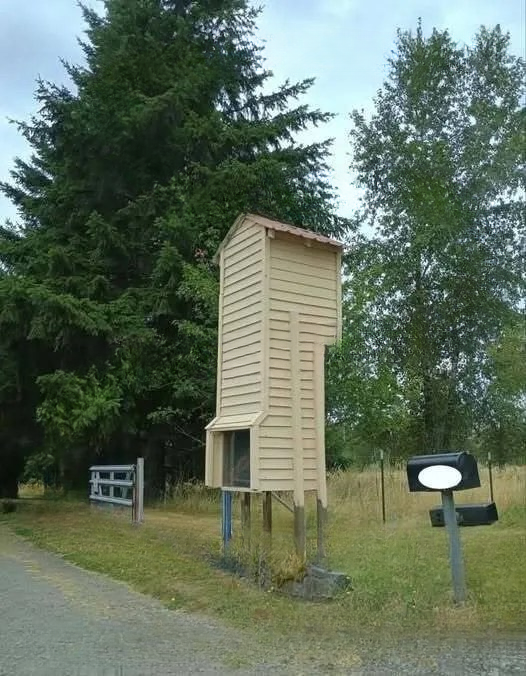
The Unseen Hero by the Road: How Simple Roadside Structures Can Improve Visibility and Safety
Introduction: The Unassuming Structure Beside the Road
When drivers travel along an unfamiliar road, they may notice structures that seem unusual at first glance. A tall, slender wooden post or tower standing near a driveway might appear to be nothing more than a weathered feature of the property. Yet, depending on its design and purpose, a roadside structure can serve a practical role in helping people identify entrances, recognize boundaries, and navigate areas where visibility is limited.
Imagine a wooden structure approximately fifteen feet tall, with a beige surface that has gradually faded under years of sunlight, rain, and seasonal weather. Standing near the entrance to a modest driveway, it may look like a decorative feature or an improvised marker. Its real purpose, however, cannot be determined from its appearance alone.
Structures located near roads can serve several different functions. Some support lighting, others display property numbers or signs, and some are designed to make an entrance easier to recognize from a distance. In rural locations, tall markers can also help distinguish a private driveway from surrounding fields, fences, and vegetation.
Understanding these possibilities offers a useful opportunity to explore how visibility, property identification, and thoughtful design contribute to safer movement around roads and driveways.
Why Visibility Matters Near Driveways
Road safety depends on more than the condition of a vehicle or the behavior of its driver. The surrounding environment also plays an important role. Road layouts, lighting, vegetation, signs, weather, and the visibility of entrances can all influence how easily drivers recognize potential hazards.
A driveway located directly beside a public road creates several points where drivers, pedestrians, cyclists, and vehicles entering or leaving a property may interact.
When an entrance is difficult to see, a driver may not recognize it until approaching closely. A vehicle leaving the driveway may also have limited visibility of approaching traffic, particularly if the entrance is positioned near a bend, hill, hedge, or other obstruction.
Clear visual cues can help people understand the layout of an area sooner. These cues may include reflective address signs, entrance posts, boundary markers, lighting, or landscaping that makes the driveway easier to distinguish from the surrounding property.
A tall roadside structure might contribute to this purpose if it has been designed and positioned appropriately. However, height alone does not guarantee better visibility or improved safety. The structure’s color, placement, lighting, and relationship to the road all influence how useful it is.
What Could a Tall Wooden Roadside Structure Be Used For?
A weathered wooden tower near a driveway could have several possible explanations. Without additional photographs, measurements, or information from the property owner, it would be misleading to assign it one specific purpose.
Nevertheless, several common functions are worth considering.
1. A Property or Driveway Marker
One possibility is that the structure helps identify a driveway or property entrance. Rural homes sometimes have long driveways that are difficult to recognize, particularly when they run alongside fields, trees, or similar-looking boundaries.
A prominent marker can make the entrance easier to locate. When combined with a clearly displayed address, it may also help visitors, delivery drivers, and emergency responders identify the correct property.
A marker does not necessarily need to be extremely tall to perform this function. Its usefulness depends on whether it can be seen clearly from the road without obstructing traffic or creating a hazard.
2. A Support for Lighting
Some properties use elevated structures to support outdoor lighting. A properly designed light can illuminate a driveway entrance, improve nighttime visibility, and make it easier for visitors to recognize the approach to a building.
Lighting must be positioned carefully. Bright lights that shine directly into drivers’ eyes can reduce visibility rather than improve it. Poorly directed illumination may also create unnecessary glare for neighbors.
Suitable fixtures should be selected for outdoor conditions and installed according to applicable electrical and building requirements.
A wooden structure that appears tall enough to support a light could potentially serve this purpose, although its appearance alone does not establish that it does.
3. A Sign or Information Display
Another possibility is that the structure supports a sign. Property names, house numbers, business identification, or directional information may be displayed on posts near entrances.
In areas where several driveways look similar, a clearly visible sign can reduce confusion. This can be especially useful for properties set back from the road or located along long private lanes.
The sign should use lettering that is easy to read without requiring drivers to stop suddenly or divert their attention from traffic.
Where permitted, reflective materials can improve nighttime recognition. Any sign positioned near a public road should comply with local requirements governing size, placement, and visibility.
4. A Decorative Landmark
Not every roadside structure has a direct safety function. Some are installed as architectural features intended to give a property a distinctive appearance.
Tall wooden posts, sculptural installations, rustic entrance markers, and custom-built features may reflect the owner’s personal style or the history of the property.
A decorative structure can make a driveway recognizable, even when identification is not its primary purpose. However, it should still be constructed and positioned with safety in mind.
Aesthetic value does not remove the need to consider stability, road visibility, and the potential consequences of a vehicle leaving the roadway.
5. A Support for Equipment
In some circumstances, a tall structure may support equipment used for communication, monitoring, or another property-related function. The specific possibilities depend on the equipment installed and the location.
It is important not to assume that an unfamiliar tower contains cameras, sensors, antennas, or other technology without evidence.
If the structure has visible equipment attached to it, its appearance may offer useful clues, but a reliable identification would require more detailed information.
How Roadside Markers Can Help Drivers
Roadside markers are useful because people make driving decisions using visual information. Drivers continually interpret the road ahead, estimate distances, recognize intersections, and respond to signs and other vehicles.
When an entrance is clearly marked, a driver may have more time to recognize it and prepare to turn. Visitors may also be less likely to mistake a neighboring driveway for the intended destination.
These advantages depend on proper placement and design.
A marker should be visible without distracting drivers from more important information, such as traffic signals, warning signs, pedestrians, or vehicles approaching from another direction.
Its position should also allow people entering and leaving the property to see the road as clearly as possible.
A tall structure that blocks sightlines or draws attention away from traffic could create the opposite effect. Therefore, roadside markers should be evaluated as part of the entire entrance rather than as isolated objects.
The Importance of Choosing Appropriate Materials
Outdoor structures must withstand a range of environmental conditions. Sunlight, rain, wind, temperature changes, and moisture can gradually affect the materials used in their construction.
Wood is popular for property markers and decorative structures because it has a natural appearance and can be shaped to suit different designs. However, untreated or poorly maintained wood may deteriorate over time.
Moisture can contribute to rot, while repeated wetting and drying may cause cracking or warping. Certain insects can also damage wooden components.
A structure that remains exposed to the weather for many years may develop a faded color, rough texture, or other visible signs of aging.
These changes do not automatically mean that it is unsafe. They do, however, make periodic inspection important.
Owners should look for signs of decay, loose connections, leaning, cracks, and damage around the base. Particular attention should be paid to areas where moisture can collect or where wood contacts the ground.
The appropriate maintenance method depends on the type of wood, the structure’s design, and the conditions in which it stands.
Why Weathering Changes the Appearance of Wood
Wood naturally changes appearance when exposed to outdoor conditions.
Sunlight can break down components near the surface, gradually altering the material’s original color. Rain and moisture can also affect the surface, while airborne dust and other environmental particles may accumulate over time.
As a result, a wooden structure that once had a rich brown or golden finish may eventually appear gray, beige, or faded.
Weathering is often most noticeable on surfaces that receive regular sunlight or are repeatedly exposed to rain.
Protective coatings can help maintain the appearance of wood and reduce moisture absorption, although their effectiveness depends on the product and how it is applied.
Before applying a new finish, the structure should be inspected to determine whether repairs are necessary. Covering damaged wood with paint or stain does not resolve underlying structural problems.
For a tall structure, maintenance should be planned carefully. Work at height may require specialized equipment and professional assistance.
Height Is Not the Only Factor in Visibility
A structure approximately fifteen feet tall may be visible from a considerable distance under suitable conditions. However, its effectiveness depends on more than its height.
A marker can be difficult to see if it blends into the background. A beige structure may stand out against dark vegetation but become less noticeable against dry grass, pale buildings, or a light-colored landscape.
The surrounding environment also matters. Trees, parked vehicles, fences, road curves, and changes in elevation can affect how early a driver notices an object.
Lighting conditions vary throughout the day and across the seasons. A structure that is easy to see in bright daylight may be less noticeable at dusk or during heavy rain.
For this reason, practical visibility improvements usually involve several complementary measures rather than simply increasing the height of a marker.
These measures might include clear address signs, appropriate reflective materials, carefully directed lighting, trimmed vegetation, and a driveway entrance designed to provide adequate sightlines.
Making Rural Driveways Easier to Identify
Rural properties sometimes have entrances that are separated from the main building by long stretches of land. A driveway may pass through trees, run alongside a field, or appear similar to nearby access roads.
In these situations, visitors can benefit from clear identification.
A visible house number placed near the entrance can help guests and service providers confirm that they have reached the correct property. If the address is difficult to locate, additional directional signs may be useful where permitted.
The sign should be positioned where it can be read without forcing a driver to stop abruptly or make an unexpected maneuver.
Vegetation should also be maintained so that it does not cover the address or obstruct views between the driveway and the road.
Where nighttime access is common, appropriate illumination may improve recognition. The lighting should be directed toward the entrance and away from the eyes of approaching drivers.
These relatively simple measures can make rural properties easier to navigate while reducing unnecessary confusion.
Landscaping and Roadside Safety
Landscaping can make a driveway more attractive, but it should also take road visibility into account.
Tall shrubs, dense hedges, decorative walls, and trees may obstruct views if they are placed too close to an entrance. Their effect can become more significant as vegetation grows over time.
Before adding a large marker or landscaping feature, property owners should consider how it will affect the view from a vehicle approaching in either direction.
A driver leaving a driveway needs to be able to assess approaching traffic safely. Likewise, drivers traveling along the road should have a reasonable opportunity to recognize vehicles entering the roadway.
The appropriate clearance depends on the road layout, speed environment, local regulations, and other site conditions.
In some places, local authorities specify visibility requirements or restrict structures near public roads. Property owners should check these rules before installing a tall post, sign, light, or decorative feature.
Thoughtful landscaping can preserve the character of a property without compromising visibility.
Nighttime Visibility and Outdoor Lighting
Driving conditions change after dark. Even familiar entrances can be harder to recognize when the surrounding landscape is poorly illuminated.
A properly designed lighting system can help reveal driveway edges, address signs, and changes in the entrance layout. It may also make it easier for pedestrians to move around the property.
However, more light is not always better.
Excessive brightness, poorly directed fixtures, and abrupt changes between light and darkness can create glare. Glare may interfere with a driver’s ability to see important details, especially when the road is wet or when headlights reflect from nearby surfaces.
Good outdoor lighting should provide useful illumination without shining directly toward approaching vehicles.
Energy-efficient fixtures, suitable mounting heights, and carefully selected beam directions can help achieve this balance.
Motion-activated lighting may be useful for some residential entrances, although it should not be relied upon as the only way to make an entrance visible.
Lighting equipment should be weather-resistant and installed safely. Electrical work should meet applicable local standards, with qualified professionals involved when necessary.
Reflective Materials and Clear Signage
Reflective materials can improve the visibility of signs and markers when illuminated by vehicle headlights.
They are commonly used for road signs, address markers, and certain safety devices because they return some of the incoming light toward its source.
For a private driveway, a reflective house