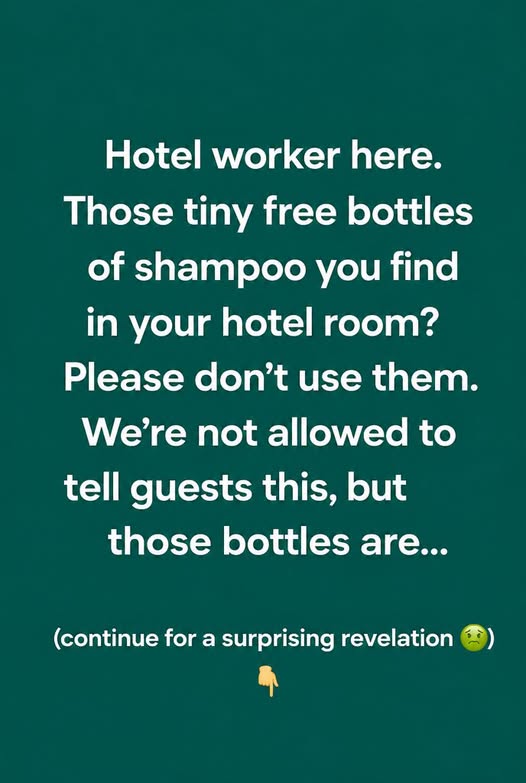
The Truth About Those Tiny Hotel Shampoo Bottles: What Guests Should Know Before Using Them
Walk into almost any hotel bathroom and you’ll probably see the same familiar collection of small toiletries waiting beside the sink.
A tiny bottle of shampoo.
A matching bottle of conditioner.
Perhaps a small container of body wash, lotion, or soap.
For many travelers, these miniature products are simply part of the hotel experience. They are convenient, neatly arranged, and often seem like a small luxury compared with carrying full-size bottles from home.
But how much do guests actually know about what happens to those products between stays?
A former hotel housekeeper says that the answer may be more complicated than many travelers realize.
The important thing, however, isn’t to assume that every hotel handles toiletries the same way. Housekeeping procedures vary significantly depending on the property, brand, local regulations, management policies, and type of product being used.
Still, there are several practical things travelers should understand before automatically reaching for every little bottle in a hotel bathroom.
The Bathroom Is Part of the Guest-Experience
When housekeeping prepares a room, the bathroom is one of the areas guests notice immediately.
A clean sink.
Fresh towels.
A spotless shower.
Neatly arranged toiletries.
Everything contributes to the impression that the room has been prepared specifically for the next guest.
Small shampoo and conditioner bottles are part of that presentation.
They may seem insignificant, but hotels spend considerable effort deciding how amenities should be displayed and replenished.
A housekeeper doesn’t simply walk into a room and randomly replace everything.
There is generally a routine.
Surfaces are cleaned.
Trash is removed.
Used linens are handled according to hotel procedures.
Supplies are checked.
Toiletries are inspected and replenished according to the property’s standards.
The exact process differs from one hotel to another.
And that’s where travelers sometimes develop misconceptions.
A Used Bottle Isn’t Automatically the Same as a New Bottle
One of the biggest assumptions guests make is that every small toiletry container must be replaced after every stay.
Sometimes that may be the hotel’s policy.
But not every property uses the same system.
Some hotels still provide individual miniature containers.
Others have moved toward larger refillable dispensers attached to the shower wall.
Some properties use sealed single-use packaging.
Others use systems designed specifically for controlled refilling.
Environmental concerns have also encouraged many hotels to reduce the amount of plastic associated with miniature toiletries.
This means the bathroom setup can tell you something about the hotel’s approach, but it doesn’t necessarily tell you exactly what happened to every product.
If a bottle appears opened, partially used, damaged, leaking, or otherwise questionable, the safest approach is simple:
Don’t use it.
Ask housekeeping or the front desk for a replacement.
Why Hotels Are Moving Away From Tiny Bottles
The traditional miniature bottle has been a familiar part of hotel bathrooms for decades.
Guests liked them because they were convenient.
Hotels liked them because they were easy to distribute and helped create a sense of hospitality.
But there is another side to the equation.
Millions of miniature containers can create substantial packaging waste.
A guest might use only a small portion of a shampoo bottle before leaving.
The remainder may then be discarded under the hotel’s normal procedures.
That has encouraged many hotels to explore alternatives.
Large dispensers can reduce packaging.
Bulk purchasing can reduce costs.
Refill systems can simplify inventory.
And some travelers appreciate having a larger amount of product available rather than trying to squeeze shampoo from a tiny container.
For environmentally conscious guests, the shift away from miniature toiletries can be a positive development.
Refillable Dispensers Are Different
If you enter a hotel bathroom and see a large shampoo or body-wash dispenser attached securely to the shower wall, don’t assume it works exactly like a miniature bottle.
These systems are designed differently.
Some are sealed cartridges.
Some are refillable containers managed by housekeeping.
Others use proprietary systems supplied by the hotel or a vendor.
The important point is that guests shouldn’t remove or tamper with them.
If a dispenser looks damaged, empty, dirty, or improperly secured, notify the hotel rather than attempting to fix it yourself.
A functioning dispenser should be part of the hotel’s normal housekeeping system.
What Housekeepers Actually Deal With
Hotel housekeeping involves much more than making a room look tidy.
Housekeepers work through a checklist of tasks designed to prepare the room for another guest.
Bathrooms require particular attention because they contain many surfaces that come into contact with water, soap, cosmetics, and personal-care products.
A typical cleaning routine may include cleaning the sink and counter, sanitizing appropriate surfaces, cleaning the toilet, maintaining the shower or bathtub area, replacing towels according to hotel policy, removing trash, and checking supplies.
The process can be time-sensitive.
A housekeeper may have several rooms to prepare within a limited period.
That’s why standardized procedures are important.
They help ensure that important tasks aren’t forgotten.
But procedures aren’t identical everywhere.
A luxury hotel may operate differently from a budget property.
A large chain may have detailed corporate standards.
An independently operated hotel may have its own checklist.
And extended-stay properties may have different expectations from traditional overnight hotels.
Don’t Assume a Housekeeper Has Unlimited Time
Travelers sometimes imagine hotel housekeeping as a leisurely cleaning process.
In reality, housekeeping can be physically demanding and highly scheduled.
A housekeeper may be responsible for multiple rooms in a single shift.
Each room has to be inspected, cleaned, restocked, and prepared for arrival.
The bathroom alone can involve numerous steps.
That doesn’t mean cleanliness should be compromised.
It means travelers should understand why standardized routines exist.
When procedures are followed consistently, they help housekeeping teams work efficiently while maintaining expected standards.
And when something appears wrong, the appropriate response is to report it.
The Best Way to Handle an Unopened Bottle
If you find a sealed, unopened shampoo bottle in your hotel bathroom, there is generally little reason to be concerned simply because it is small.
It’s a packaged personal-care product.
Check the packaging.
Look for obvious signs of damage or tampering.
If the seal appears intact and the product is within its normal usable condition, you can decide whether you’d like to use it.
However, if the packaging is broken or the product looks unusual, don’t use it.
Hotels should be able to provide another item.
The same principle applies to many hotel amenities.
If something looks damaged, dirty, leaking, or otherwise unsuitable, ask for a replacement.
What If the Bottle Is Already Open?
This is where common sense becomes particularly useful.
If a miniature bottle is clearly open or partially used when you enter your room, you don’t need to investigate its history.
You don’t know whether it was intentionally left there, overlooked during cleaning, or simply part of the hotel’s amenity system.
You don’t need to guess.
Don’t use it.
Contact the front desk or housekeeping.
A hotel employee can determine what should be done according to the property’s procedures.
This is much better than assuming the worst or attempting to decide what happened based solely on appearance.
Why Travelers Should Avoid Viral Assumptions
Hotel-related stories often become popular online because they contain an element of mystery.
Someone claims that a housekeeper revealed a hidden secret.
A traveler says something unusual happened in a bathroom.
A dramatic headline suggests that an ordinary hotel item is secretly dangerous.
These stories can spread quickly.
But there is an important distinction between a genuine housekeeping tip and a sensational claim.
Hotel procedures are not universal.
What happens at one property may not happen at another.
A former employee’s personal experience may be completely genuine while still not representing the entire hotel industry.
That’s why travelers should focus on practical information rather than fear.
The Real Issue Is Often Packaging
For many guests, the most interesting thing about miniature shampoo bottles isn’t cleanliness at all.
It’s waste.
Think about how many hotel rooms exist around the world.
Now imagine each room containing several small plastic bottles.
Multiply that by the number of occupied nights.
Then multiply it by the number of years a hotel operates.
The numbers can become significant.
This is one reason many hospitality companies have experimented with alternatives.
Larger dispensers can reduce the amount of packaging used.
Some hotels offer toiletries in recyclable packaging.
Others have reduced the number of products available.
Some properties encourage guests to bring their own personal-care items.
The hospitality industry continues to experiment with ways to provide convenience while reducing unnecessary waste.
Bringing Your Own Toiletries Can Be Practical
For travelers who have sensitive skin, allergies, fragrance preferences, or simply strong product preferences, bringing personal toiletries can make sense.
A familiar shampoo eliminates the need to experiment with an unfamiliar product.
It can also make packing easier if you already have a travel-size bottle you like.
Travel-size containers are available for many personal-care products, allowing guests to bring familiar items without carrying full-size packaging.
This can be particularly helpful for longer trips.
If you regularly travel, keeping a small toiletry kit ready can save time.
Include the products you actually use.
Pack them securely.
Follow the relevant transportation rules when flying.
And remember that hotel toiletries are optional conveniences, not requirements.
Why Product Labels Matter
Small hotel toiletries can sometimes be difficult to read.
The print may be tiny.
Ingredients may be listed in a condensed format.
Directions may be brief.
For most travelers, that isn’t a major problem.
But for someone with known allergies or ingredient sensitivities, it can matter.
Don’t assume that because a product is provided by a hotel, it is automatically suitable for you.
Read the label if you have concerns.
If you can’t determine the ingredients, ask the hotel whether they can provide more information or use your own product instead.
Your personal-care routine is your responsibility, and there is nothing unusual about preferring a familiar product.
Fragrance Can Be Another Consideration
Hotels often choose toiletries based on broad guest preferences.
That means products may have fragrances designed to appeal to a large number of people.
But fragrance preferences vary.
One traveler may love a strong citrus scent.
Another may prefer something unscented.
Another may dislike heavily fragranced products altogether.
If you have a personal preference, bring your own.
If you experience irritation after using a hotel toiletry product, stop using it and switch to a product you know works for you.
If the reaction is significant or concerning, seek appropriate medical advice.
The point isn’t to fear hotel toiletries.
It’s simply to recognize that personal-care products aren’t one-size-fits-all.
What About Taking the Bottles Home?
This depends on the hotel’s policy.
Some properties have traditionally allowed guests to take complimentary miniature toiletries.
Others may prefer that amenities remain in the room.
Modern refillable dispensers are obviously not intended to be removed.
If you’re unsure, ask.
There is no reason to turn a simple question into a guessing game.
A quick conversation with the front desk can tell you whether a particular amenity is complimentary and intended for guests to take.
The Difference Between Amenities and Hotel Property
Travelers should also distinguish between disposable or complimentary toiletries and permanent bathroom equipment.
A small soap bar or complimentary miniature bottle may be intended for guest use.
A wall-mounted dispenser, hair dryer, decorative container, towel, or other hotel fixture may not be.
When in doubt, leave permanent fixtures where they are.
If you want to know whether something is complimentary, ask the hotel.
Most misunderstandings can be avoided with a simple question.
What Housekeepers Wish Guests Understood
People working in housekeeping often have an enormous number of tasks to complete.
One of the simplest ways guests can make their work easier is by treating the room respectfully.
That doesn’t mean guests need to clean the room themselves.
That’s what housekeeping is there for.
But basic courtesy helps.
Don’t deliberately create unnecessary messes.
Don’t pour personal products onto hotel surfaces.
Don’t leave food everywhere.
Don’t damage dispensers.
Don’t deliberately misuse amenities.
And if something is missing or needs attention, let the hotel know.
A clear request is much easier to address than an assumption.
What to Do If Something Looks Wrong
Suppose you enter your hotel room and notice that a bathroom product looks open.
What should you do?
Keep it simple.
First, don’t use it.
Second, take note of what you observed.
Third, contact the front desk or housekeeping.
Explain the issue calmly.
For example:
“The shampoo bottle appears to have already been opened. Could I get a fresh one?”
That’s enough.
There is no need to make accusations.
There is no need to assume someone acted improperly.
And there is no need to turn the situation into a frightening story.
The hotel can inspect the issue and correct it.
Cleanliness Is a Shared Responsibility
Hotels have a responsibility to maintain appropriate hygiene standards.
Guests also have a role in protecting themselves.
That doesn’t mean travelers should become suspicious of every object in a hotel room.
It means using reasonable judgment.
Don’t use visibly damaged products.
Don’t share personal-care items with strangers.
Don’t use products that have clearly been tampered with.
Wash your hands regularly.
Keep personal toiletries organized.
And report concerns when you see them.
These are ordinary precautions, not reasons to be anxious.
Why the Tiny Bottle Became a Symbol
The miniature shampoo bottle has become almost symbolic of the hotel experience.
It represents convenience.
It represents hospitality.
For some people, it even feels nostalgic.
Children sometimes enjoy collecting them.
Frequent travelers recognize the familiar packaging.
And hotels have used them for decades as a small way to make guests feel welcomed.
But the hospitality industry is changing.
Environmental concerns, consumer preferences, operational costs, and evolving hotel standards are influencing how amenities are provided.
The tiny bottle may eventually become less common.
Larger dispensers and reduced packaging may become increasingly normal.
That doesn’t mean the old system was automatically bad.
It simply means the industry is adapting.
The Housekeeper’s Perspective
The most valuable lesson from the story isn’t that hotel guests should be afraid of tiny shampoo bottles.
It’s that travelers should understand how much work happens behind the scenes.
A clean hotel room doesn’t appear by accident.
Housekeeping employees prepare rooms under time constraints.
They follow procedures.
They inspect supplies.
They clean bathrooms.
They replace items.
They respond to guest requests.
And they often work behind the scenes without receiving much recognition.
The next time you walk into a freshly prepared hotel room, remember that someone has spent time making that space ready for you.
A little appreciation goes a long way.
A Better Way to Think About Hotel Toiletries
Instead of asking, “Are hotel shampoo bottles safe or unsafe?” a better question is:
“What should I check before using them?”
The answer is straightforward.
Look at the packaging.
Check whether it appears sealed or intact.
Don’t use products that appear damaged, contaminated, or previously used when they shouldn’t be.
If you have allergies or ingredient concerns, read the label.
If you’re uncertain, ask the hotel for a replacement.
And if you simply prefer your own shampoo, bring it with you.
These steps are practical without being alarmist.
The Bigger Lesson for Travelers
Traveling involves dozens of small decisions.
Which hotel should you choose?
What should you pack?
Should you use the hotel towels?
Should you bring your own toiletries?
Should you accept the complimentary amenities?
Most of these decisions don’t need complicated answers.
Use common sense.
Pay attention to your surroundings.
Know your personal needs.
Ask questions when something is unclear.
And don’t allow dramatic online stories to turn ordinary travel experiences into unnecessary sources of worry.
Before You Reach for That Tiny Bottle
The next time you check into a hotel and see those familiar little bottles beside the sink, take a moment to look at them.
If the packaging is intact and the product appears normal, you can decide whether you’d like to use it.
If something looks questionable, simply request another one.
If you have specific skin or fragrance preferences, use your own products.
And if the hotel has moved to refillable dispensers, leave the system intact and use it as intended.
There is no need to be fearful.
There is also no need to ignore obvious concerns.
A balanced approach is best.
The tiny shampoo bottle isn’t necessarily hiding some dramatic secret.
What it does reveal, however, is how much the hotel industry has changed—and continues to change.
Behind that little bottle are questions about convenience, cleanliness, packaging, sustainability, guest expectations, and the work performed by housekeeping teams every day.
So the next time you open a hotel bathroom door and see that familiar collection of toiletries, remember one simple rule:
When something looks normal, use reasonable judgment. When something looks questionable, ask for a replacement.
That’s all most travelers need to know.