Introduction: The Sound of Loss
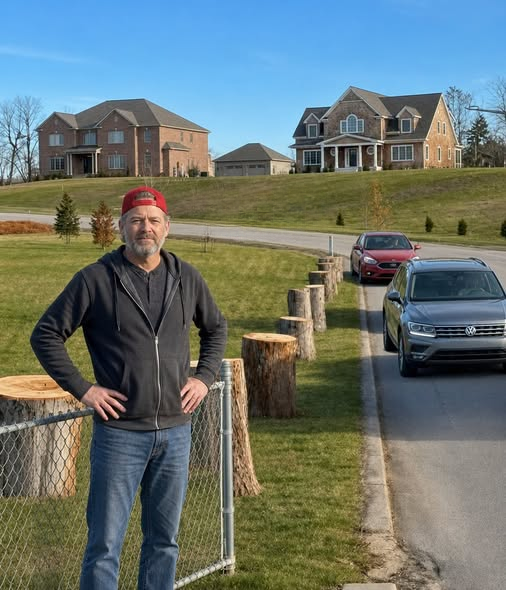
The first tree didn’t fall with enough noise to warn me. There was no polite knock on the door, no advance notice, and no digital message signaling that something irreplaceable was about to be taken away. Only later, when I returned home from an errand, did the sudden, jarring absence hit me. Where a lush, decades-old canopy had once filtered the afternoon sunlight and provided a natural sanctuary for local birds, there was now only an empty, glaring gap of sky and a scattering of pale sawdust whitening the grass.
It takes decades for a tree to grow tall, strong, and deeply rooted into the earth. It takes a chainsaw mere minutes to erase it.
When a neighbor or a hired crew cuts down trees on or near your property line without permission, the immediate reaction is rarely just anger—it is a profound sense of violation. Trees are not mere landscaping accessories; they are living anchors of our homes, offering privacy, shade, ecological value, and emotional comfort. Discovering them wrongfully destroyed launches a complex journey through property law, neighborly conflict, and personal reflection.
The Value of Trees: More Than Just Wood and Leaves
To understand why unauthorized tree removal hurts so deeply, one must first recognize what trees actually contribute to a property. Long before any legal dispute arises, trees perform invaluable work quietly in the background:
-
Privacy and Buffer Zones: Mature trees act as natural living fences, shielding backyards from prying eyes, busy street traffic, and unsightly views. Losing them instantly exposes your private life to the surrounding neighborhood.
-
Environmental and Climate Benefits: Trees moderate local temperatures by providing shade, reduce stormwater runoff through their extensive root systems, and clean the air by absorbing carbon dioxide.
-
Financial Property Value: Real estate experts consistently note that mature, healthy trees can increase a property’s market value by anywhere from 5% to 20%. They make a home look established, cared for, and aesthetically complete.
-
Ecological Habitats: Birds, squirrels, pollinators, and beneficial insects rely on trees for food, shelter, and nesting grounds. When a tree falls, an entire micro-ecosystem is disrupted.
Unraveling the Conflict: Why Do Neighbor Disputes Happen?
Property line disputes are among the oldest and most bitter neighborhood conflicts. When it comes to trees, misunderstandings generally stem from a few common causes:
1. Blurred Boundaries and Misguided Assumptions
Many property owners simply do not know where their exact land boundaries lie. Fences are often built years prior in the wrong spot, and older survey markers can become obscured or lost over time. A neighbor might hire a tree service, point vaguely toward a tree, and assume—often incorrectly—that because branches overhang their side, the entire trunk belongs to them.
2. Desire for Sunlight and Views
As neighborhoods age, trees grow larger. A tree planted decades ago might eventually block a neighbor’s solar panels, garden sunlight, or scenic view. Instead of initiating an open, polite conversation to discuss trimming or pruning, some property owners take matters into their own hands, ignoring the legal boundaries altogether.
3. Fear of Property Damage
Concerns over falling branches, cracking sidewalks, or clogged gutters can create anxiety. While a property owner does have the legal right to trim branches that cross over onto their property line, that right almost never extends to trespassing or destroying a tree whose trunk sits on someone else’s land.
The Legal Reality: Understanding Property Lines and Timber Trespass
When unauthorized tree removal occurs, it moves past a simple matter of bad etiquette and enters the realm of property law. Depending on local municipal codes and state laws, cutting down someone else’s tree can carry severe legal and financial consequences.
Determining True Ownership
The golden rule of property tree law is straightforward: ownership follows the trunk. If the entire trunk of the tree sits on your side of the property line, the tree belongs entirely to you. Even if massive limbs stretch out over your neighbor’s yard, they do not own the tree.
If a tree sits directly on the boundary line (known as a boundary tree), it typically belongs jointly to both property owners, meaning neither party can legally cut it down or severely damage it without mutual consent.
Legal Recourse and Damages
In many jurisdictions, cutting down someone else’s trees is classified as “timber trespass” or vandalism. The legal remedies can be substantial:
-
Treble Damages: In numerous states, laws allow homeowners to sue for triple the actual appraised value of the destroyed trees.
-
Professional Appraisal Costs: Certified arborists can calculate the replacement value of a mature tree—factoring in its species, size, health, and age—which can easily run into thousands or tens of thousands of dollars per tree.
-
Restoration Expenses: Courts can order the offending party to pay for mature tree replacement, landscaping repair, and site cleanup.
The Turning Point: Access and Retaliation
When I hung up the phone with Brad from Summit Tree & Land Management, the silence of the valley felt deafening. The HOA president—likely sitting in a climate-controlled room overlooking the valley—had decided that their view was worth more than my property rights. They assumed there would be no friction. They assumed I was just a solitary property owner who would grumble, call a lawyer, and eventually accept a quiet insurance payout while their multi-million dollar homes enjoyed the enhanced horizon.
What they failed to realize was basic geography.
Cedar Ridge Estates was built on a steep, isolated geological shelf. When developers planned the gated community years ago, they negotiated access rights, but the terrain dictated infrastructure. The only paved, accessible ingress and egress road connecting their community to the county highway did not run over public land.
It crossed the lower southwest corner of my family’s parcel. An easement had been granted decades prior for residential access, but an easement grants the right of passage—it does not transfer ownership, nor does it strip a property owner of their fundamental rights to maintain and secure their own land.
Executing the Shutdown
The sun was beginning to dip below the ridge, casting long shadows across the freshly cut stumps. Mara walked back over, her boots crunching on the stray bits of bark.
“What are you going to do?” she asked, her voice tight. “Sue them? That’ll take years.”
“I’m not going to wait years,” I said quietly.
I walked back to my truck, pulled a heavy steel chain and a padlock out from under the rear seat, and drove down to the lower boundary where Pine Hollow Road met the private access spur leading up to Cedar Ridge.
There was a heavy steel utility gate installed years ago by my father to keep out illegal dumpers. For years, it had remained unlocked and propped open against the wooden post, serving as a polite gesture of neighborly trust.
Trust was officially revoked.
I pulled the heavy gate across the asphalt. I wrapped the thick steel chain twice around the reinforced steel post and locked it securely with a weatherproof padlock. The heavy metal clank echoed in the quiet evening air—a definitive, final sound.
Then, to ensure there was no confusion, I backed my truck directly across the access lane, turned on my hazard lights, and placed a bright orange construction sign on the asphalt: PRIVATE PROPERTY — ROAD CLOSED DUE TO ONGOING LITIGATION AND TRESPASSING.
The Fallout: When Privilege Meets Reality
It didn’t take long for the phones in Cedar Ridge to start ringing.
Within forty-five minutes, the first luxury SUV rolled down the winding private road, only to grind to a halt twenty feet from my closed gate. The driver leaned on the horn—a long, entitled blast meant to summon someone to open the gate for royalty.
I sat on my front porch with a cup of coffee, watching through binoculars as a frustrated driver threw open their car door, marched up to the gate, and rattled the padlock in disbelief.
By nightfall, the HOA president himself was pounding on my front door.
When I opened it, his face was flushed with anger. He didn’t introduce himself. He didn’t apologize for the six sycamore trees. He simply pointed a trembling finger toward the road.
“You have no right to close that road!” he barked. “There are hundreds of residents up there! Emergency services! People trying to get home from work!”
I leaned against the doorframe, my voice calm and measured.
“Your contractors just cut down six protected trees on my property without my permission,” I replied evenly. “Under state property law, unauthorized destruction of land grants me the immediate right to secure my perimeter until law enforcement and surveyors assess the damages. Furthermore, this is my private road. The easement allows transit, but it does not protect against structural interference or security lockdowns when active property violations are being investigated.”
“Do you know who we are?” he sputtered, falling back on the oldest, most pathetic line in the book. “We’ll sue you into oblivion! We’ll take your entire property!”
I smiled slightly, stepping back into the warmth of my hallway.
“Go ahead,” I said. “Call your lawyers. Tell them you stole my trees, and now you can’t drive your BMWs off the mountain. Let me know how that conversation goes.”
I closed the door in his face.
Conclusion: Rebuilding and Moving Forward
The battle over the road and the trees lasted for weeks. It involved county commissioners, emergency service rerouting plans, independent arborists, and a battalion of high-priced HOA attorneys who quickly realized their clients had committed a textbook case of timber trespass.
In the end, the HOA was forced into a massive settlement: they paid full financial restitution for the mature sycamores—calculated in the tens of thousands of dollars—funded professional landscape replanting with mature evergreens to instantly restore our privacy, and signed a binding legal agreement respecting every inch of our property boundaries.
The road reopened, but the dynamic on the ridge changed forever. The residents of Cedar Ridge learned a hard, expensive lesson about boundaries, respect, and the foolishness of destroying someone else’s home for the sake of a better view.
No landscape is worth losing your peace over, but sometimes, protecting your sanctuary requires drawing a hard line in the dirt—or in my case, locking a gate at the bottom of a private road.