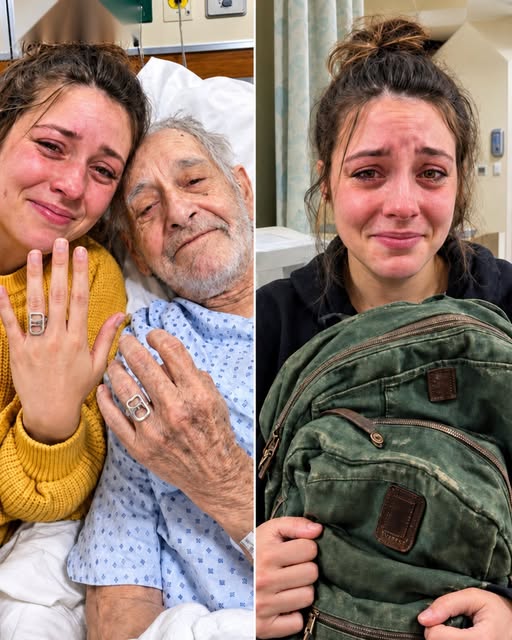
The Stranger I Married in a Hospital — And the Secret He Left Behind
I never imagined that a quiet afternoon in a hospital waiting room would change the direction of my entire life.
At twenty-nine, I was still trying to understand how to move forward after losing my mother. Grief had changed almost everything about me. It made ordinary days feel strangely empty, and it left me searching for something meaningful to fill the spaces that had once belonged to family, conversation, and routine.
That was how I started volunteering at the hospital.
At first, I thought I was doing it for the patients.
Eventually, I realized they were helping me just as much.
I spent much of my time visiting people who had few or no visitors. Some had family members who lived far away. Others had relatives who had become distant over the years. A few simply had nobody left.
I learned that loneliness inside a hospital could be just as difficult as the illness itself.
Then I met Thomas.
He was seventy-two and living with advanced heart failure. His condition had left him extremely weak, and even walking a short distance required more effort than it should have.
But there was something unusual about him.
Despite everything he was facing, Thomas rarely complained.
Whenever I entered his room, he tried to smile.
Sometimes we talked about ordinary things.
The weather.
Books.
Old movies.
Food he missed eating.
Places he had visited when he was younger.
Other times, we simply sat together without saying much at all.
Those quiet moments became important to both of us.
I didn’t think of Thomas as a stranger anymore.
He had become someone I looked forward to seeing.
One afternoon, while sunlight filtered through the hospital window, Thomas reached toward me and gently took my hand.
His fingers were thin and surprisingly cold.
“Sarah,” he said quietly.
“Yes?”
“Would you marry me?”
For several seconds, I honestly thought I had misunderstood him.
I stared at him.
“Thomas, you’re joking.”
He shook his head.
“No.”
I laughed nervously because I didn’t know what else to do.
“You barely know me.”
“I know enough.”
I looked at him carefully.
“You’re seriously ill.”
“I know.”
“And we’ve only known each other for a short time.”
“I know that too.”
There was no excitement in his expression like someone proposing a traditional marriage.
Instead, there was a calmness that made the question feel much more serious.
Thomas explained that he had spent much of his life avoiding relationships because of circumstances he didn’t want to discuss. Now that he believed his time was becoming limited, he didn’t want his final days to be spent completely alone.
He wasn’t asking me for a grand romance.
He was asking for companionship.
For someone to sit beside him.
For someone to hold his hand.
For someone to know his name when his life was nearing its end.
I told him I needed time to think.
That evening, I went home and couldn’t stop thinking about his request.
It sounded strange.
It was strange.
I knew that.
But there was also something deeply human about it.
Thomas wasn’t asking me to pretend that we had spent twenty years together.
He wasn’t asking me to forget that we had only recently met.
He simply didn’t want his final chapter to be defined by loneliness.
And perhaps because I understood loneliness so well myself, his request affected me more deeply than I expected.
Two days later, I returned to the hospital.
Thomas was awake.
When he saw me, he smiled.
“I thought you might not come back.”
“I almost didn’t.”
He raised an eyebrow.
“And?”
I sat beside his bed.
“If we do this, we’re doing it because we care about each other. Not because we’re pretending this is some ordinary marriage.”
He nodded.
“I understand.”
A hospital chaplain agreed to perform a small ceremony.
There were no flowers.
No elaborate decorations.
No expensive clothing.
No guests.
I wore a simple yellow sweater.
Thomas wore a clean shirt that the nurses had helped him prepare.
We didn’t even have wedding rings.
So, with a little humor, Thomas used a soda-can pull tab as a makeshift ring.
I laughed when he slipped it onto my finger.
“You’re really giving your wife this?”
He smiled.
“It’s all I have.”
“Then I’ll keep it.”
And I did.
The ceremony lasted only a few minutes.
But strangely, it felt meaningful.
For the next seven days, I spent nearly every possible hour beside Thomas.
I brought him books.
I told him stories about my mother.
He told me stories about his childhood.
We talked about mistakes we had made.
People we had lost.
Things we wished we had done differently.
Sometimes Thomas became too tir