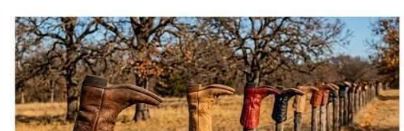
The first time I saw a single boot sitting on top of a fence post, I thought someone had simply lost it.
It was an old cowboy boot.
Brown leather.
Cracked around the ankle.
The toe was faded almost white from years of dust and sun.
It stood alone beside a long country road, balanced carefully on a weathered wooden fence post.
There was no sign.
No explanation.
Just one boot looking out across a field.
I remember wondering why anyone would leave something like that outside.
Then the person riding with me said something I’ll never forget.
“That’s not trash.”
“What is it?”
“A story.”
At first, I didn’t understand.
But the farther we drove through the countryside, the more boots I noticed.
Some were black.
Some were brown.
Some were painted bright colors.
One fence had three boots lined up along the posts.
Another had an old pair of work boots hanging from a gate.
I began noticing something I had never paid attention to before.
In rural communities, objects often carry meanings that aren’t written down.
A piece of clothing can become a memory.
A weathered sign can become a landmark.
An old chair on a porch can remind someone of a person who sat there every morning.
And sometimes, a boot becomes a symbol.
For many people, a boot on a fence post represents work.
Not glamorous work.
Not the kind of work people photograph for magazines.
The kind that starts before sunrise.
The kind that leaves mud on your jeans and cracks on your hands.
Farmers.
Ranchers.
Mechanics.
Construction workers.
People who spend their days outside regardless of whether the weather is pleasant.
Their boots carry them through all of it.
Dust.
Rain.
Snow.
Heat.
Cold.
Years of walking across fields, barns, gravel roads, muddy yards, and concrete floors.
Eventually, those boots become too worn to use.
The natural choice would be to throw them away.
But some people don’t.
Instead, they place them somewhere visible.
A fence post becomes a final resting place.
The boot remains there long after the person who wore it has retired.
In that sense, the boot becomes a small monument.
It says:
This person worked here.
This person walked this land.
This person was part of this place.
Sometimes the meaning is even more personal.
A boot may be placed on a fence post to remember someone who has died.
A farmer.
A rancher.
A family member.
A friend.
Someone whose absence changed the landscape of everyday life.
There might be no formal memorial.
No large stone.
No plaque.
Just an old boot.
People who pass by may never know whose boot it was.
But the family does.
They know the person who wore it.
They remember how that person walked.
They remember the sound of those boots coming through the back door.
They remember seeing them beside the bed after a long day.
And now, whenever they drive past the fence, they see that boot and remember.
Sometimes a boot can even honor an animal.
In ranching communities, horses are not simply animals people own.
They can become working partners.
A horse may carry someone through years of work.
It may be part of a family’s daily routine for decades.
When that horse dies, people sometimes find their own quiet ways to remember it.
An old boot, saddle, bridle, or other piece of equipment can become part of that memorial.
But not every boot on a fence post is sad.
Some are there simply because somebody thought it would be funny.
Rural humor has a way of turning ordinary objects into decorations.
A bright red cowboy boot might sit on a post just to make passing drivers smile.
Someone might paint an old boot blue.
Another person might turn one into a flower planter.
You may even find a pair of boots filled with flowers during spring.
There doesn’t always have to be a deep explanation.
Sometimes people put something unusual on a fence because they like it.
And that’s perfectly good enough.
Then there is another reason people may recognize a boot on a fence post.
It can become a landmark.
Imagine driving down a rural road where there are miles of fields, scattered houses, and very few street signs.
Someone tells you:
“Keep going until you see the old boot.”
You might laugh.
But when you finally see it, you know exactly where you are.
For people who live in the area, the boot becomes part of the local geography.
“Turn left after the boot.”
“Her house is just past the fence with the red boot.”
“Keep driving until you see the old pair by the barn.”
An object that means nothing to a stranger can become incredibly useful to someone who knows the area.
There are also boots that simply become part of a property’s personality.
Maybe the homeowner wore them while working the land.
Maybe they were too worn to use but too meaningful to throw away.
Maybe the family has had them for generations.
Putting them on a fence post gives them a second life.
And occasionally, a boot can serve as a subtle piece of communication.
In some rural traditions, objects placed near a home, gate, or fence can signal that someone is around or that the property is active.
It may not be a formal code.
It may simply be something neighbors understand.
A boot on a fence can quietly say:
Someone lives here.
Work is happening here.
This place has a history.
That may be why these objects can feel strangely comforting.
They aren’t polished.
They aren’t expensive.
They aren’t designed to impress anyone.
They are ordinary things that have been given meaning.
The boot itself isn’t important because it is a boot.
It is important because someone wore it.
Someone walked in it.
Someone worked in it.
Someone came home wearing it.
And eventually, someone decided that it deserved to stay.
The next time you pass an old boot sitting on a fence post, don’t automatically assume someone forgot it.
Look at the condition of the leather.
Look at where it has been placed.
Look around the property.
There might be a story nearby.
Maybe it belonged to someone who worked that land for fifty years.
Maybe it marks the memory of someone who is gone.
Maybe a child placed it there as a joke.
Maybe someone simply thought it looked good.
Or maybe it has become a landmark that generations of neighbors recognize without ever thinking twice.
That’s what makes the boot so interesting.
There isn’t one universal meaning.
Its meaning comes from the person who placed it there and the community that understands it.
To one person, it is an old boot.
To another, it is a memorial.
To someone else, it is a joke.
To a local farmer, it might be a landmark.
And to a family, it might be the last visible reminder of someone they loved.
So the next time you see a lone boot balanced on a fence post, slow down for a moment.
You may be looking at more than worn-out leather.
You may be looking at a piece of someone’s life.
A small monument to hard work.
A reminder of someone missed.
A piece of local tradition.
Or simply a little bit of rural humor.
Either way, that boot has already done something remarkable.
It made you stop.
It made you wonder.
And somewhere along that fence line, it may still be telling a story.