Prologue: The Rhythm of the Humming Motor
Some moments in life are remembered because they are perfect. Others stay with us because they reveal something deeper about love, strength, and the people who quietly stand beside us when we need them most. For me, that revelation began with the soft, mechanical hum of a vintage sewing machine echoic against the quiet walls of our living room late at night.
It was a sound I never expected to hear coming from my father.
To anyone who knew him, my father was a man of quiet demeanor and calloused hands. He spent his days working with timber, metal, and heavy tools—fixing things that were broken, building sturdy structures, and solving physical problems with pragmatic patience. Soft fabrics, delicate lace, and fashion were completely foreign to his world. Yet, as the weeks leading up to my senior prom ticked away, he sat under the warm glow of a desk lamp, carefully feeding yards of ivory silk beneath a tiny, tapping needle.
He was translating a mother’s legacy into a daughter’s future, one careful stitch at a time.
Chapter 1: The Weight of High School Expectations
Senior year of high school arrives with a sudden, overwhelming velocity. Between college applications, final examinations, and the looming reality of stepping into adulthood, there is an unspoken pressure to make every milestone memorable. At the center of this whirlwind sits prom night—an event painted by popular culture and teenage expectations as the grand finale of youth.
In the hallways of my school, conversation revolved entirely around one subject for months: the dresses.
Every afternoon, groups of girls gathered around glowing phone screens, displaying elaborate gowns from designer boutiques. They spoke in excited chatter about satin, tulle, sequined bodices, and lavish trips to downtown bridal shops. For many of my classmates, finding a dress was a joyous rite of passage accompanied by mothers, aunts, and grandmothers who offered tears of joy and open checkbooks.
For me, those hallway conversations brought a quiet ache.
My mother had passed away several years earlier. Her absence was a constant, subtle presence in our home, a silent shadow that lengthened during moments that typically called for a mother’s touch. While my father did everything in his power to fill both roles—cooking dinners, attending school meetings, and offering steady encouragement—there were soft spaces in a teenage girl’s life where the void remained pronounced.
As my friends made appointments at high-end dress shops, I quietly worried about the cost. My father worked tirelessly to keep our household running smoothly, but boutique prom dresses carried price tags that felt entirely unjustifiable for a single evening. I had resolved to find something modest at a thrift store or a local department store sales rack, telling myself that the dress did not truly matter.
I thought I was hiding my anxiety well. But fathers notice more than they let on.
Chapter 2: The Treasure in the Attic
It was a chilly Tuesday evening in late February when my father called me up to the hallway outside the attic stairs. The air upstairs always carried the faint, comforting scent of cedar, old paper, and dried lavender.
Standing beneath the pull-down ladder, he held a heavy, brass-latched trunk that usually sat tucked away in the deepest corner of the eaves. I recognized that trunk immediately. It was where my father kept the few preserved items that had belonged to my mother before her illness—her hand-painted journal, a wooden music box, and her wedding gown.
“I’ve been thinking,” my father said, setting the trunk gently onto the floor. His voice carried that familiar, grounded calmness. “You shouldn’t have to settle for just any dress for your prom. And you shouldn’t have to spend a fortune on something off a rack that millions of other people can buy.”
He unlatched the brass locks with a soft click and lifted the lid. Inside, wrapped meticulously in acid-free tissue paper, lay my mother’s wedding dress.
When he lifted it out, the fabric caught the warm light of the hallway lamp. It was a gown from the early 1990s—fashioned from thick, rich ivory silk, featuring intricate hand-sewn lace along the neckline and small pearl beads scattered across the bodice. It was elegant, timeless, and filled with memories of a day when my parents were young and full of dreams.
“Your mother loved this dress,” he said softly, running his fingers gently over the lace. “She always hoped that someday you might wear it. But styles change, and I know a wedding dress isn’t quite right for a high school dance. So I thought… what if we changed it?”
I looked at him, bewildered. “Changed it? How?”
“We remodel it,” he said simply. “We keep the soul of it, but turn it into something modern. Something that belongs to you.”
“Dad,” I hesitated, touched but deeply skeptical. “Who is going to do that? Alterations like that cost more than a new dress.”
My father looked down at his rough, hands, then back at me with a soft, determined smile. “I am.”
Chapter 3: Learning an Unfamiliar Art
The idea seemed impossible at first. My father knew how to measure lumber, build bookshelves, and fix plumbing leaks. He had never held a pair of fabric shears in his life, nor did he know the difference between an A-line silhouette and a dart seam.
Yet, determination is a powerful force.
The very next day, my father retrieved my grandmother’s old electric sewing machine from storage. It was a heavy, cast-iron Singer model from the 1970s, housed in a polished dark wood cabinet. He cleared off the dining room table, placed the machine in the center, and set to work studying an art form he knew nothing about.
What followed over the next six weeks was a masterclass in patience, love, and quiet dedication.
Every night after coming home from a long day at work, my father sat down at the dining table. He didn’t just jump into cutting the silk; he approached sewing with the precision of an engineer.
-
Research and Blueprinting: He bought books on basic dressmaking and spent hours watching instructional videos online. He drew sketches on graph paper, taking meticulous measurements and calculating how much fabric could be harvested from the full skirt of the wedding gown.
-
Practice and Testing: Before laying a single blade against my mother’s gown, he bought inexpensive muslin fabric from a local craft store. He practiced stitching straight lines, creating subtle pleats, and installing hidden zippers. The dining room floor became covered in scrap fabric and thread trails.
-
Careful Preservation: Every element of the original dress was treated with immense respect. He carefully removed the heavy vintage sleeves and high collar using a small seam ripper, saving every piece of hand-sewn lace so it could be reused.
I would sit across from him at the table doing my homework while the quiet clack-clack-clack of the machine filled the room. Occasionally, he would stop, put on his reading glasses, inspect a seam with intense scrutiny, and pull out a line of stitches if it wasn’t perfectly straight.
“If you’re going to build something,” he would remind me, “you build it right. It doesn’t matter if it’s a bridge or a dress. The foundation has to be honest.”
Chapter 4: The Construction and the Friction
Creating something meaningful is rarely a smooth journey. There were evenings filled with frustration, self-doubt, and tension.
Transforming a 1990s wedding gown into a modern prom dress was far more complicated than simply shortening the hem. The original dress was heavy, structured with internal boning, and designed for a completely different silhouette. To make it fit a teenager decades later, my father had to redesign the entire bodice while preserving the integrity of the fragile silk.
One evening in mid-April, disaster struck. While attempting to adjust the side seam along the ribcage, the old silk fabric began to fray near a critical joint.
I walked into the kitchen to find my father sitting with his head in his hands, the dismantled dress spread across his lap. The sewing machine was silent. For the first time since the project began, he looked thoroughly defeated.
“I made a mistake,” he whispered, looking up at me. “The fabric is old. It didn’t take the tension, and I pulled it too tight. I don’t know if I can fix this without ruining the whole front panel.”
Panic flared in my chest—not because of the dress, but because I saw how much pain it brought him to feel like he had let me down.
“Dad, it’s okay,” I said, sitting beside him on the wooden bench. “It’s just fabric. If it doesn’t work out, we can buy something simple. You’ve already done so much.”
He looked at the dress, then at a framed photograph of my mother that sat on the side cabinet. He took a slow, deep breath, reached for his seam ripper, and shook his head gently.
“No,” he said quietly but firmly. “We don’t give up on things that matter. We just adapt.”
He spent three hours that night re-engineering the side panels. Instead of trying to patch the frayed silk directly, he designed delicate lace inserts using the preserved trim from the original sleeves. What started as a technical mistake turned into the most striking feature of the dress—a subtle, sheer lace paneling on either side that gave the vintage gown a fresh, contemporary elegance.
It was a lesson I would never forget: perfection isn’t the absence of mistakes; it’s the beauty created by fixing them with care.
Chapter 5: The Fitting Sessions
As spring arrived and the trees outside began to bloom, the dress slowly took its final shape.
Our living room had turned into a makeshift tailor’s studio. A full-length mirror stood in the corner, flanked by warm lamps. Every few days, my father would call me over for a fitting.
These fittings were moments of quiet reverence. He would kneel on the floor with a box of yellow-headed pins between his lips, carefully measuring the hemline so it hovered precisely a quarter-inch above the floor. He paid attention to every detail:
-
How the fabric draped when I walked.
-
Whether the straps sat comfortably without slipping.
-
How the bodice moved when I took a deep breath.
During these moments, I began to see my father in a new light. I had always viewed him as a provider—someone who fixed broken lawnmowers, paid the bills, and made sure dinner was on the table. But watching him pin delicate lace with his large, rugged hands revealed a profound tenderness that I hadn’t fully appreciated before.
He was pouring all the love he felt for my mother, and all the love he had for me, into every single millimeter of thread.
On the final fitting, two weeks before prom, he zipped up the back and stepped back to look.
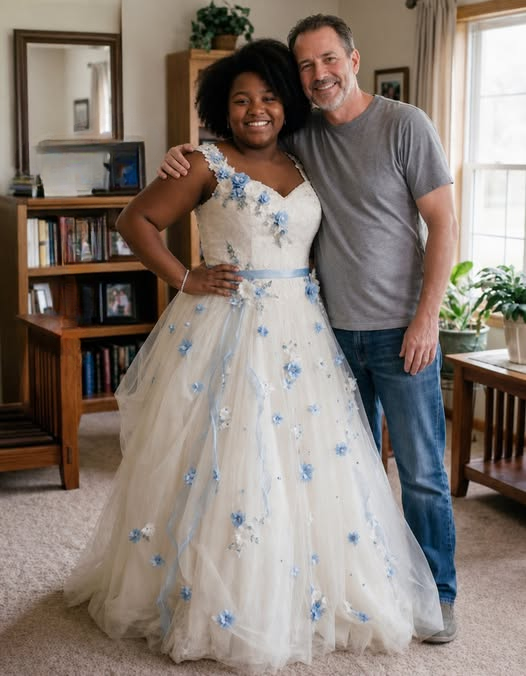
The transformation was breathtaking. The heavy, outdated wedding gown had become a sleek, floor-length A-line gown of rich, luminous ivory silk. The modern sweetheart neckline was framed by the original hand-sewn lace, and the subtle lace side panels added an effortless elegance that looked entirely bespoke. It didn’t look like an altered wedding dress, nor did it look like something mass-produced from a store.
It looked like a piece of art.
My father stood in the center of the room, holding his tape measure over his shoulder. He looked at me in the mirror, and for a long moment, neither of us said a word. Then, his eyes welled up with quiet tears—the first time I had seen him cry since my mother’s funeral.
“You look just like her,” he whispered softly. “She would be so proud.”
Chapter 6: The Night of the Event
When prom night finally arrived, the house was filled with an energy that felt almost electric.
Outside, the late afternoon sun cast a warm golden light across the front lawn. My friends arrived in a flutter of excitement, their bright satin dresses rusting as they walked up the driveway. Their parents followed behind with cameras, eager to capture the traditional pre-dance photographs.
When I walked down the stairs wearing the finished dress, a quiet hush fell over the room.
My friends, who had spent months talking about boutique designers and expensive gowns, gathered around me in awe. They ran their fingers gently over the silk, admiring the unique lace detail and the flawless fit.
“Where did you buy this?” one of my closest friends asked, her eyes wide. “I’ve never seen a dress like this in any shop.”
I looked across the room at my father, who was standing near the doorway in his best dark suit, camera in hand, trying his best to look nonchalant.
“It’s custom,” I said proudly, my voice steady and full of joy. “My dad made it from my mother’s wedding gown.”
The reaction was immediate—gasps of disbelief followed by admiration. My friends’ parents looked at my father with deep respect, understanding the immense labor of love that stood before them.
My father blushed slightly, waving off the praise with a modest nod. “Just followed the blueprint,” he said softly, though the pride in his eyes was undeniable.
Before we left for the venue, my father took me out to the front porch for a quiet moment away from the crowd. He pulled a small, velvet box from his jacket pocket and handed it to me. Inside was a simple pearl bracelet made from the leftover beads he had carefully removed from the dress’s original sleeves.
He fastened it around my wrist with a gentle touch.
“Tonight is a celebration of how far you’ve come,” he said, looking at me with unwavering warmth. “Have fun, dance, and remember that you are always carried by the love of the people who brought you here.”
Chapter 7: Stepping onto the Floor
The venue for prom was a grand ballroom decorated with twinkling fairy lights, floral arrangements, and booming music. The room was a sea of colors—vibrant pinks, deep blues, shimmering golds, and synthetic fabrics reflecting the flashing stage lights.
As I walked into the hall, I felt an extraordinary sense of calm and confidence.
While many of my peers were constantly adjusting uncomfortable straps, pulling at stiff bodices, or worrying about whether someone else had purchased the exact same dress, I felt completely at ease. My dress didn’t just fit my body perfectly; it fitted my soul. Every movement felt natural, grounded, and elegant.
Throughout the evening, classmates and teachers came up to compliment the gown. Each time someone praised its beauty, I felt a deep surge of pride in telling them the story behind it. It wasn’t just a garment; it was a conversation, a memory, and a testament to family resilience.
When the fast music paused and a soft, melodic song began to play, I stood near the balcony overlooking the dance floor. I touched the small lace panel at my waist and looked out at the lights.
For the first time since my mother passed away, I didn’t feel her absence as a painful void. Instead, I felt her presence as a warm, comforting blanket. She was there in the silk, in the lace, and in the devotion of the man who had sat up night after night learning how to sew just to make his daughter smile.
Chapter 8: The True Meaning of Craftsmanship
Looking back on that night years later, the details of the music, the decorations, and the dance floor have naturally faded with time. But the memory of the dress—and the process of its creation—remains as sharp and clear as ever.
We live in a world that often prioritizes convenience, speed, and disposable luxury. It is easy to buy something off a shelf, use it once, and forget about it. But true value isn’t measured by price tags or brand labels. True value is measured by the thought, effort, and heart invested in something.
My father did not just remake a dress; he gave me several invaluable gifts that shaped how I view the world:
-
The Beauty of Devotion: He showed me that real love is an action word. It is found in late nights, quiet labor, and the willingness to step completely outside one’s comfort zone for the sake of another person’s happiness.
-
Resilience Through Grief: He taught me that loss does not have to be the end of a story. We can take the pieces of what was broken or left behind and rebuild them into something breathtaking and new.
-
Patience and Integrity: Through his careful measurements and refusal to cut corners, he demonstrated that anything worth doing is worth doing with care, honesty, and attention to detail.
Epilogue: A Legacy Preserved
Today, that dress hangs safely in a custom garment bag in my own closet.
The silk remains as soft and luminous as it was on that spring evening. Occasionally, on quiet rainy afternoons, I will open the wardrobe, unzipper the bag, and run my fingers over the lace side panels and the hand-stitched seams.
I can still smell the faint, comforting scent of cedar and lavender. I can still hear the rhythmic, steady hum of my grandmother’s old sewing machine echoing through the quiet house. And I am reminded once again of the power of love to heal, construct, and transform.
Prom night is often spoken of as a transition—a bridge between youth and adulthood. For me, that bridge was paved with silk threads and anchored by a father’s unconditional love.
It was never just about a dress. It was about knowing that no matter where life’s journey might lead, I step forward supported by a foundation built on sacrifice, memory, and an unbreakable bond that no passage of time can ever unravel.