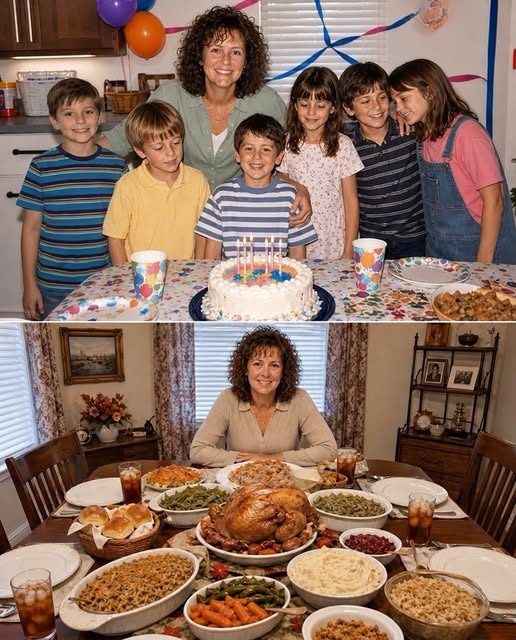
For her 60th birthday, Linda did not want an expensive gift.
She did not ask her children to buy her jewelry, arrange a large party, or reserve a table at an expensive restaurant.
There was only one thing she wanted.
She wanted all six of her children to sit around the same table again.
It had been years since that had happened.
When the children were young, having everyone together had been ordinary. Their home had been filled with conversations, laughter, arguments, school bags, dirty laundry, and the constant movement that comes with raising a large family.
Now the house was quiet.
Her children had grown up and built lives of their own.
Linda understood that.
Still, she hoped that one evening might bring everyone together again.
She did not know that her birthday dinner would become one of the most emotional evenings of her life.
A House That Was Once Full of Noise
Linda and her husband had once imagined what their future family would look like.
Her husband loved the idea of having a busy home.
He would joke that one day there would be so many children around the dinner table that nobody would be able to hear themselves think.
Eventually, that dream became reality.
They had six children in ten years.
Their names were Mark, Jason, Caleb, Grant, Sarah, and Eliza.
Their childhood home was rarely quiet.
Someone was almost always looking for a missing shoe.
Someone needed help with homework.
Someone was arguing about whose turn it was to use the television.
There were birthday parties, school performances, sports practices, family trips, and countless ordinary evenings around the dinner table.
Linda often felt exhausted.
But she also felt fortunate.
She knew those years would not last forever.
When Everything Changed
The family’s life changed when Linda’s husband decided he wanted something different.
He had met another woman online.
She lived in another country.
At first, Linda did not understand how serious the relationship was.
Then, within a relatively short period, her husband announced that he wanted to leave.
He said he needed to find himself.
The decision devastated Linda.
It also left her with six children who still depended on her.
There was no time to spend months processing what had happened.
Bills still had to be paid.
Children still had to attend school.
Meals still had to be prepared.
Homework still had to be checked.
Life continued whether Linda was emotionally ready for it or not.
So she carried on.
Raising Six Children Alone
The years that followed were difficult.
Linda worked hard to provide for her family.
She learned how to make limited resources stretch as far as possible.
She became an expert at finding inexpensive solutions to expensive problems.
When a child became sick, she stayed beside the bed.
When there was a school meeting, she attended.
When someone needed money for a school activity, she found a way to provide it.
When one of the children experienced a breakup or friendship problem, Linda listened.
When a teenager made a mistake, she tried to correct the behavior without making the child feel unloved.
She was not perfect.
No parent is.
There were days when she was tired and impatient.
There were moments when she wished someone else could take over for a while.
But she kept going.
Her children were growing.
That was enough reason.
Watching Them Become Adults
Eventually, the children became teenagers.
Then they became young adults.
The house began changing.
The bedrooms became quieter.
The arguments became less frequent.
The laundry piles became smaller.
One by one, the children began leaving home.
Mark started a career.
Jason moved to another city.
Caleb became busy with work.
Grant, who had always been the most unpredictable, spent long periods away.
Sarah built a life of her own.
Eliza eventually moved out as well.
Linda was proud of all of them.
She had spent years preparing them for independence.
But she discovered something that many parents eventually learn.
It is one thing to teach your children to leave home.
It is another thing to become comfortable with the empty space they leave behind.
The Calls Became Less Frequent
At first, the children called regularly.
Then the calls became less predictable.
A weekly conversation became every few weeks.
A long conversation became a short exchange.
Visits became increasingly difficult to arrange.
Linda tried not to complain.
She knew they had jobs, relationships, homes, and responsibilities.
She remembered being young herself.
She understood what it was like to feel as though there were never enough hours in a day.
So she told herself that the distance was simply part of adulthood.
Still, she missed them.
She missed having everyone under one roof.
She missed the noise.
She missed hearing six different voices at once.
Her 60th Birthday
As her 60th birthday approached, Linda decided not to make a complicated request.
She wanted dinner.
That was all.
She invited all six children.
She told them there was no need for expensive gifts.
She did not want anyone to spend money on a large celebration.
She simply wanted everyone to come home.
“Just one evening,” she told them.
“All of us together.”
The children agreed.
Linda felt genuinely excited.
She began planning the meal several days in advance.
She thought about what everyone liked to eat.
She remembered childhood favorites.
She planned dishes that would remind them of home.
She wanted the evening to feel familiar.
Preparing the House
On the morning of her birthday, Linda cleaned the house.
She arranged the dining room.
She brought out plates that were normally reserved for special occasions.
She polished the glasses.
She folded the napkins carefully.
She placed six chairs around the table.
Then she added her own chair at the head.
Seven places in total.
Looking at the table made her smile.
For a moment, she could almost imagine her children as they had been years earlier.
Mark complaining about something.
Jason making everyone laugh.
Caleb trying to finish his meal quickly.
Grant asking for another serving.
Sarah and Eliza talking across the table.
It was only a memory.
But Linda hoped that for one evening, they could recreate it.
Waiting
At four o’clock, Linda began checking the time.
Nobody had arrived yet.
That was normal.
Dinner was still hours away.
At five, she looked through the window.
Still nothing.
She sent a message to the family group.
She told everyone that dinner was ready whenever they arrived and reminded them to travel safely.
She expected a series of replies.
Instead, the group remained quiet.
A few minutes later, she noticed that Sarah had started typing.
Three dots appeared.
Then disappeared.
No message came.
Linda laughed nervously.
Perhaps Sarah was driving.
Perhaps she had accidentally opened the conversation.
Perhaps someone had forgotten to respond.
Linda decided not to worry.
Six O’Clock
By six, Linda began wondering whether everyone had been delayed.
She called Mark.
No answer.
She called Jason.
Again, no answer.
Caleb’s phone went to voicemail.
She tried Eliza.
Nothing.
Grant did not answer either.
Linda looked at the prepared food.
Everything was ready.
The table was set.
The house was clean.
The candles were lit.
But there were no footsteps outside.
Seven O’Clock
At seven, Linda stopped pretending she wasn’t worried.
She called the children again.
Still nothing.
She considered whether there had been a misunderstanding.
Perhaps the date had been entered incorrectly in someone’s calendar.
Perhaps one person had misunderstood the time and the others had followed.
She wanted there to be a simple explanation.
Anything would have been better than believing that six people had independently decided not to come.
Eight O’Clock
By eight, the food had begun to cool.
Linda turned down the oven.
She sat at the table.
The six empty chairs seemed to make the room larger.
She looked at the place settings.
Each one represented a person she had spent years raising.
She remembered holding them when they were babies.
She remembered helping them learn to walk.
She remembered their first days of school.
She remembered graduation ceremonies.
She remembered their first jobs.
She remembered every stage of their lives.
Now she was sitting alone.
The Question She Could Not Ignore
Linda tried to tell herself that she was overreacting.
Adults get busy.
Plans change.
People make mistakes.
But the longer the evening continued, the harder it became to believe that this was simply a scheduling problem.
She began asking herself questions.
Had she done something wrong?
Had she become too demanding?
Had she called too often?
Had she expected too much?
Or had her children simply moved so far into their own lives that their mother’s birthday no longer seemed important?
She did not know.
And not knowing was painful.
Nine O’Clock
By nine, Linda had stopped expecting anyone to arrive.
She blew out most of the candles.
She began putting some of the food away.
She kept a few dishes on the table because she could not bring herself to dismantle everything.
Then she sat down again.
The house was almost completely silent.
Linda picked up one of the folded napkins.
She remembered ironing them that morning.
The small detail suddenly made her emotional.
She had spent so much time preparing for a family evening that never happened.
She began to cry.
Not because she wanted an elaborate birthday.
Not because she expected expensive gifts.
She simply wanted to feel remembered.
A Knock at the Door
Then she heard a knock.
Three firm knocks.
Linda froze.
For a moment, she thought one of the children had finally arrived.
She hurried toward the door.
But when she opened it, a police officer was standing outside.
The officer looked serious.
Linda immediately became concerned.
“Are you Linda?” he asked.
She confirmed that she was.
The officer then explained that he had something to give her.
He handed her a folded piece of paper.
There was writing on the front.
Linda recognized the handwriting immediately.
It belonged to Grant.
Her youngest son had always been difficult to predict.
He could be spontaneous and impulsive, but Linda had always believed that he cared deeply about his family.
Her hands began to shake.
The Note
Linda opened the paper.
There were only a few words.
The message asked her not to make unnecessary phone calls and to listen carefully to the officer.
It also asked her to go with him.
Linda looked at the officer.
“What happened?”
He told her that there was a situation involving her family and that she needed to remain calm.
Suddenly, the disappointment of the evening became something else.
She was no longer wondering why her children had failed to attend dinner.
She was wondering whether they were safe.
A Different Kind of Fear
Linda’s mind immediately went through every possibility.
Had there been an accident?
Was someone injured?
Was one of her children in trouble?
Had something happened on the road?
She wanted answers.
The officer explained that he could not discuss every detail immediately.
He needed Linda to accompany him.
She looked back at the dining room.
Six empty chairs.
A table prepared for a celebration.
Food that had gone untouched.
The scene suddenly seemed completely different.
Perhaps the empty chairs had nothing to do with forgetting her birthday.
Perhaps there was another reason.
The Journey
Linda followed the officer.
During the drive, she asked several questions.
The officer reassured her that she was not being taken anywhere against her will and that the situation involved information that needed to be explained in person.
Linda was still frightened.
But she began remembering Grant’s note.
“Listen to him.”
Why had Grant written that?
Why had he been unable to call?
Why had all six children disappeared at exactly the same time?
The questions continued to multiply.
The Unexpected Explanation
Eventually, Linda learned that her children had been communicating with one another for weeks.
They had known that she was planning a birthday dinner.
They had also known that their mother had been feeling increasingly isolated.
The lack of contact had not necessarily meant that they had forgotten her.
Instead, they had been working together on something they believed would be meaningful.
Grant had been coordinating part of the plan.
The police officer’s involvement was connected to the unusual circumstances surrounding the surprise.
Linda was stunned.
She had spent hours believing that her children no longer cared.
The reality was more complicated.
A Family Misunderstanding
The children had underestimated how their silence would affect their mother.
They had believed they were creating anticipation.
Instead, they had created anxiety.
What seemed like a clever surprise from their perspective had been emotionally painful for Linda.
The experience reminded everyone that intentions and results are not always the same.
A surprise may be exciting when someone knows that something positive is coming.
Without that knowledge, silence can easily be interpreted as rejection.
Linda explained this honestly when she finally saw her children.
She told them that she understood what they had intended.
But she also wanted them to understand what those four hours had felt like.
Seeing Her Children Again
When Linda finally saw all six children together, she could hardly speak.
They had arranged for everyone to be together.
For the first time in years, all six children were standing in the same place.
The sight brought back memories of their childhood.
The noise.
The arguments.
The laughter.
The constant activity.
Linda hugged each of them.
She was relieved.
She was emotional.
And she was still somewhat frustrated.
She told them that their surprise had gone too far.
The children apologized.
They had not understood how quickly worry could replace excitement.
The Conversation That Followed
The family eventually sat together and talked.
Not about presents.
Not about money.
Not about the dinner.
They talked about the years that had passed.
Linda told them that she missed them.
She admitted that she sometimes felt forgotten.
Her children listened.
Some of them explained that they had been overwhelmed by their own responsibilities.
Others admitted that they had assumed their mother was doing fine because she rarely asked for help.
That assumption had created distance.
Linda realized that she had also contributed to the misunderstanding.
She often hid her loneliness because she did not want to make her children feel guilty.
As a result, they had no idea how strongly she wanted more regular contact.
What the Family Learned
The birthday became a lesson in communication.
Linda learned that her children could not always know what she needed unless she told them.
Her children learned that being busy did not mean they should allow communication to disappear completely.
Everyone agreed that they needed a better balance.
They did not promise to return to the way things had been when the children were young.
That would not be realistic.
Instead, they decided to create new traditions.
A regular family video call.
A shared calendar for important family events.
Occasional visits.
And, most importantly, honest conversations.
A New Family Tradition
The family eventually developed a new birthday tradition.
Every year, they would make an effort to gather together.
It did not always happen on the exact date.
Sometimes work schedules made it impossible.
Sometimes travel was difficult.
But everyone made the effort.
Linda no longer expected the house to be filled with six children every weekend.
She understood that adulthood had changed the family.
What mattered was that they were making a conscious effort to remain connected.
Linda’s Perspective Changed
The experience also changed Linda’s understanding of motherhood.
For decades, she had believed that raising children meant giving them everything she could.
She still believed that.
But she also recognized that her children were now adults.
They had responsibilities that mattered.
They had families and careers.
They had problems she did not always know about.
She could not expect them to live as though they were still teenagers.
At the same time, she did not have to pretend that she never needed companionship.
Both truths could exist at the same time.
The Empty Chairs
Months later, Linda kept the same dining table.
She did not replace it.
She did not remove the extra chairs.
But their meaning had changed.
The six empty chairs from her birthday had once represented disappointment.
Now they represented possibility.
They reminded her that family relationships can change without disappearing.
They reminded her that communication is important.
And they reminded her that assumptions can create unnecessary pain.
The Importance of Speaking Honestly
Linda’s story demonstrates why family members should communicate openly about expectations.
Parents sometimes expect their adult children to understand their feelings without explaining them.
Adult children sometimes assume that their parents are fine because they appear independent.
Both assumptions can lead to misunderstandings.
A simple conversation can sometimes prevent years of hurt.
Instead of waiting for someone to notice that you are lonely, it can be healthier to say so.
Instead of assuming that a parent does not need help, adult children can ask.
Instead of expecting everyone to know what is wanted, families can discuss it.
A Birthday She Would Never Forget
Linda had originally wanted her 60th birthday to be memorable because all six children would be together.
Instead, it became memorable for an entirely different reason.
She experienced disappointment.
Then worry.
Then relief.
And finally, gratitude.
The evening did not unfold according to her expectations.
But it gave her family an opportunity to confront something they had all been avoiding.
They needed to make more effort to stay connected.
And they needed to communicate honestly about what family meant to them as adults.
Final Thoughts
Families rarely remain exactly the same throughout life.
Children grow up.
Parents age.
People move.
Careers become demanding.
Relationships change.
New responsibilities appear.
It is natural for the structure of a family to evolve.
But changing circumstances do not mean that connection has to disappear.
Linda’s experience showed that even a family that feels distant can find its way back toward one another.
The answer is not always a grand gesture.
Sometimes it is a phone call.
Sometimes it is a visit.
Sometimes it is an honest conversation.
And sometimes it is simply telling someone, “I miss you.”
For Linda, her 60th birthday began with an empty dining room and six vacant chairs.
She thought those chairs represented everything she had lost.
By the end of the evening, she understood something different.
The chairs represented people who had grown up and moved into lives of their own—but who could still return home.
Her children were no longer the noisy youngsters who once filled every corner of the house.
They were adults.
They had their own responsibilities and challenges.
But they were still her children.
And she was still their mother.
The family could not turn back the clock.
They could not recreate every year of childhood.
But they could choose what happened next.
And sometimes, that choice is what matters most.