My wife, Clara, had gone on plenty of weekend retreats over the fifteen years we had been married.
She loved taking occasional short trips to recharge—sometimes a yoga workshop, a silent meditation retreat in the mountains, or a three-day digital detox near the coast. She always returned home refreshed, laughing about the awkward icebreakers and bearing small souvenirs or local pastries for us to enjoy together.
This time, however, she came back completely different.
At first, I couldn’t articulate what felt so strange. The moment she walked through our front door on Sunday evening, she set her duffel bag down and stepped forward to hug me.
The physical embrace felt strangely stiff, almost unnatural, as though she were executing a gesture she had rehearsed rather than reacting on instinct.
Ten minutes later, while standing in the kitchen, she paused, opened two incorrect cabinets, and asked me where we kept the blue ceramic coffee mugs—mugs she had personally picked out at a pottery barn five years ago and used every single morning.
Later that evening, when we went upstairs to sleep, she walked instinctively to the right side of the bed, despite having slept on the left side for our entire marriage.
Even our golden retriever, Buster, who usually greeted Clara with chaotic tail wags, stood motionless in the hallway, tilting his head and sniffing the air around her with wary eyes before slowly backing away.
I tried to rationalize everything. I convinced myself that she was simply exhausted from her long drive or suffering from a lingering migraine.
Until the following morning.
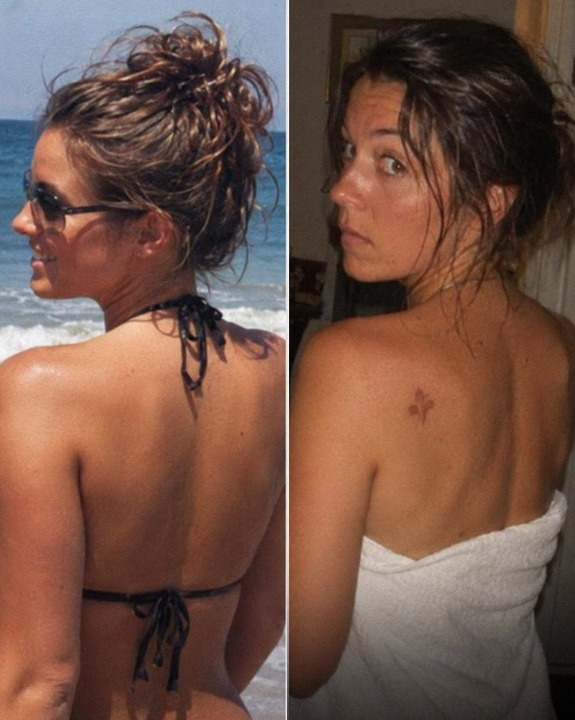
Clara stepped out of the master bathroom wrapped in a white bath towel, her damp hair pinned up. As she turned her back to grab her robe from the chair, my eyes landed on her back.
Just below her left shoulder blade was a dark, distinct birthmark, roughly two inches wide, shaped almost perfectly like a lily petal.
I froze, staring at her back in total disbelief. I had spent fifteen years beside this woman. I knew every small freckle, every faint scar, and every detail of her skin.
That mark had never been there.
Clara noticed my rigid stance in the mirror. “What’s wrong, Mark?”
I stepped closer and pointed. “The birthmark on your back.”
She frowned, turning her head over her shoulder to look into the mirror. “What birthmark?”
I handed her a handheld vanity mirror so she could see her back clearly.
The exact moment her eyes registered the lily-shaped mark, the color drained completely from her face. She reached up with trembling fingers, touching the skin carefully, almost fearfully, as if testing whether it was real.
“I’ve… I’ve never had that,” she whispered, her voice barely audible.
She let out a short, nervous laugh, trying to brush it off. “Maybe it’s just a strange reaction to an oil from the spa, or maybe it’s always been there and we just never paid attention to it.”
“No,” I said firmly. “It hasn’t.”
That evening, while Clara was reading downstairs, I sat at my desk and pulled up our private digital photo archives. I spent hours scanning through fifteen years of vacation memories—beach trips, tropical honeymoons, backyard summer barbecues, and swimming pool photos.
Her back was clearly visible in dozens of high-resolution images. Her skin was completely clear below her left shoulder blade. No birthmark. Not even a faint shadow.
When I brought my laptop downstairs and showed her the clear photographic evidence, Clara didn’t argue or offer excuses. She simply stared at the screen, fell completely silent, and looked down at her hands.
Over the next three days, the strange little anomalies kept piling up like a mountain of undeniable clues.
She suddenly developed an intense aversion to spicy foods—dishes she had loved for years. She drew a blank when I brought up funny stories from our college days, listening like a polite stranger hearing them for the first time. Most unsettlingly, when she signed a get-well card for my mother, she signed it using “Claire”—a childhood nickname her late grandmother had used, but which she had explicitly asked everyone to stop using twenty years ago.
On Thursday afternoon, I walked past the master bathroom and saw the door cracked open. Clara was standing in front of the full-length mirror, her shirt pulled forward, silently tracing the outline of the lily-shaped birthmark with her thumb, her expression filled with profound confusion and sorrow.
She didn’t notice me watching her.
An hour later, Clara announced she was heading out to the local market to buy groceries. The moment I heard her car pull out of the driveway, I walked straight to her home office desk and opened her personal laptop.
The screen prompted for a password. Usually, her password was our anniversary date, but typing it yielded an immediate “Incorrect Password” error.
After three failed attempts, I remembered a strange phrase she had muttered under her breath on the night she returned from the retreat—a reference to her old childhood address. I typed it in.
The screen unlocked instantly.
There were no files scattered on the desktop—only a single, unlabelled folder sitting in the center of the screen, represented by a tiny icon shaped like a lily.
My heart hammered against my ribs as I clicked the folder open.
Inside were medical files, scanned birth certificates, and a series of private correspondence logs from an international ancestry database.
As I opened the primary text document, my hands went completely numb.
The woman who had walked into my house four days ago wasn’t an imposter or an alien—she was Clara’s identical twin sister, Elena.
According to the legal documents inside the folder, Clara and Elena had been separated at birth through a fraudulent, non-consensual private adoption agency in the late 1980s. Clara had grown up with her loving adoptive parents, completely unaware of her biological background, while Elena had been raised across the country by a different family.
Two months ago, Elena had tracked Clara down through a commercial DNA matching service. The “weekend retreat” Clara had booked wasn’t a wellness seminar at all—it was a secret, private meeting at a quiet mountain cabin to meet the identical sister she never knew existed.
The folder contained emotional photos of the two sisters standing side-by-side during the first two days of the retreat—two women with identical faces, identical smiles, and identical eyes, separated only by the lily-shaped birthmark on Elena’s back.
I sat staring at the screen, tears pricking my eyes as the psychological weight of the mystery vanished, replaced by profound empathy for two sisters robbed of a life together.
But the most shocking part came an hour later when the front door opened.
I walked down the stairs holding the laptop. Standing in the foyer were two women, both wearing winter coats, holding hands and wiping tears from their eyes.
Clara stepped forward, looking at me with immense vulnerability.
“Mark,” Clara said softly, her voice trembling. “I’m so sorry I kept this from you. On Sunday night, Elena was so overwhelmed and terrified by everything we discovered that she froze when you welcomed her into the house. She was supposed to just stay in the guest room for one night, but we were both in shock. We didn’t know how to explain thirty years of hidden family secrets to you.”
Elena stepped up beside her sister, giving me a nervous, polite smile—the same woman who had been trying so hard to navigate my home for four days.
“I’m sorry for confusing you, Mark,” Elena whispered gently. “And for using your coffee mugs.”
I looked at Clara, then at Elena, and felt the heavy tension melt away from my chest. I set the laptop on the hallway table, walked over, and pulled both sisters into a warm, welcoming hug.
Uncovering the truth revealed a deeply buried family tragedy, but facing it together brought our family closer than ever before—proving that true love always finds a way through the darkest mysteries.