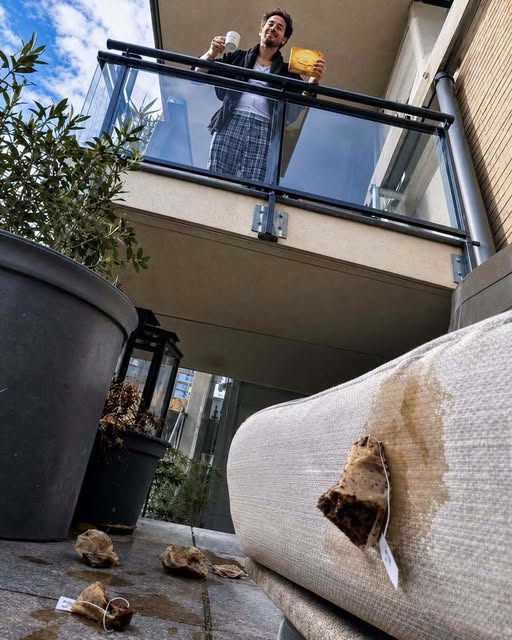
My Upstairs Neighbor Kept Throwing Tea Bags Onto My Balcony—So I Finally Found a Peaceful Way to Stop It
My upstairs neighbor threw his used tea bags onto my balcony twice a day.
Almost every day.
At first, I thought it was an accident.
Then I realized it was a routine.
Around seven in the morning, sometime after he finished his first cup of tea, something small and dark would appear over the railing.
And again around nine at night.
A used tea bag.
Sometimes it landed near my flowerpots.
Sometimes beside the balcony chair.
Sometimes on the concrete floor.
Once, it landed directly on a towel I had placed outside to dry.
The first few times, I simply picked them up and threw them away.
I didn’t want a disagreement with a neighbor over something so minor.
I had lived in the building for eleven years.
In all that time, I’d learned that apartment living required a certain amount of patience.
You heard footsteps above you.
You occasionally heard furniture being moved.
Someone’s television might be louder than usual.
People had different schedules.
Different habits.
Different ideas about what counted as a nuisance.
I wasn’t interested in becoming the person who complained about every little thing.
So I ignored the tea bags.
At least at first.
The First Problem
The first time I noticed a tea bag on my balcony, it was lying beside one of my plant pots.
I assumed someone had dropped it.
I picked it up.
The next morning, there was another one.
I looked up toward the balconies above me.
Nobody was outside.
I shrugged and threw it away.
A few days later, another appeared.
Then another.
Eventually, I realized they were all coming from the same apartment.
The fourth floor.
Apartment 4B.
My upstairs neighbor.
I didn’t know him particularly well.
We exchanged polite greetings in the hallway.
I’d accepted a few packages for him during the winter when he wasn’t home.
Once, when he was away for several days, I had helped move a delivery away from the entrance so it wouldn’t get damaged.
We weren’t friends.
But we’d always been friendly enough.
That’s why I didn’t immediately assume he was doing it intentionally.
People make mistakes.
Maybe he was cleaning the balcony.
Maybe the wind was carrying them.
Maybe he didn’t realize where they landed.
I decided to wait.
Then one Saturday morning, I found a tea bag sitting directly on a white bath towel I had left outside to dry.
The tea had soaked into the fabric.
There was a brown circular stain in the middle.
I stared at it for a few seconds.
That was the moment I decided to say something.
My First Conversation With Him
I went upstairs and knocked on his door.
When he opened it, I held up the stained towel.
“Can I ask you something?”
He looked at the towel.
Then he looked at me.
“Oh.”
“Did this come from your balcony?”
He paused.
“Probably.”
“It’s the third or fourth one I’ve found downstairs.”
He looked embarrassed.
“I’m sorry.”
His reaction surprised me.
I had expected an argument.
Instead, he seemed genuinely apologetic.
“I drink tea out there in the morning,” he explained. “Sometimes I just flick the bag over the railing without thinking.”
I stared at him.
“You throw them over the balcony?”
He gave a small shrug.
“Yeah. I didn’t realize they were landing on yours.”
“They are.”
He looked down.
“I’m sorry. I won’t do it again.”
That seemed reasonable.
I thanked him and went downstairs.
For the rest of the day, I thought the issue was finished.
It wasn’t.
The Very Next Morning
At approximately 7:04 the next morning, I heard something land on my balcony.
I looked outside.
Another tea bag.
I stared at it.
I checked the balcony above.
Nobody was visible.
Maybe he’d forgotten.
Maybe it was leftover from the previous day.
I decided not to react.
The next morning, another one appeared.
Then another.
I began finding them so regularly that I could almost predict when they would arrive.
Seven in the morning.
Nine at night.
Like a strange little schedule.
Still, I said nothing.
I told myself it wasn’t worth another conversation.
Then three weeks passed.
One evening, I had placed a cushion cover outside to air out.
The next morning, I found a used tea bag sitting directly on it.
The moisture had soaked through the fabric.
The stain didn’t come out.
That was when my patience finally ran out.
Not because of the cost.
The cushion cover wasn’t expensive.
It was the attitude.
I’d already spoken to him.
He had acknowledged the problem.
He had promised to stop.
And yet nothing changed.
The Second Conversation
I went upstairs again.
He opened the door.
“Hi,” I said.
He immediately recognized the expression on my face.
“What happened?”
“Your tea bags are still landing on my balcony.”
He sighed.
“Seriously?”
“Yes.”
“It’s only a tea bag.”
I held up the stained cushion cover.
“This one landed here.”
He looked at it.
“It leaves stains.”
“I understand, but it’s just tea.”
“I know what it is.”
He leaned against the door frame.
“You live downstairs,” he said. “That’s how apartment buildings work.”
Then he laughed.
I wasn’t amused.
“I’ve already asked you twice.”
“I’m not throwing anything at you.”
“You’re throwing it over the railing.”
He shrugged.
“It’s a tea bag.”
Then he added:
“You should be thankful it’s tea and not something worse.”
I stood there for a moment.
I realized the conversation wasn’t going anywhere.
“Please just stop,” I said.
He smiled.
“Fine.”
Then he closed the door.
I walked downstairs.
I was angry.
Very angry.
But I also knew exactly what would happen if I went back upstairs and started shouting.
We’d have an argument.
He’d tell other residents that I had overreacted.
I would become the story instead of the problem.
So I decided not to give him that opportunity.
One Final Chance
I told myself that if nothing happened the next morning, I would simply let it go.
I wouldn’t complain again.
I wouldn’t confront him.
I’d just clean up the tea bags and move on.
At 7:04 the next morning, another one landed beside my plant pots.
I stood there in my robe, holding a cup of coffee.
I looked at the tea bag.
Then I looked at the balcony above.
And something changed.
I wasn’t going to retaliate.
I wasn’t going to throw anything back.
I wasn’t going to damage his property.
I wasn’t going to create a bigger problem.
Instead, I was going to document what was happening and use the building’s normal process.
I went inside.
I opened my phone.
And I started keeping a record.
The Balcony Journal
For the next several days, I wrote down every incident.
Date.
Time.
Location.
What had landed on the balcony.
Whether anything had been damaged.
I also took photographs.
Not dramatic photographs.
Just simple pictures showing the tea bags where they had landed.
I kept the stained towel.
I kept the damaged cushion cover.
I didn’t exaggerate anything.
I didn’t write insults.
I didn’t post anything online.
I simply documented the facts.
At first, it felt almost silly.
It was only tea.
But after a week, I had a surprisingly clear record.
Seven morning incidents.
Five evening incidents.
Three stained items.
Several tea bags beside the plants.
And the most important detail:
I had already asked him twice to stop.
I Checked the Building Rules
Our apartment building had a property management office on the first floor.
I had never needed to contact them about a neighbor before.
I read the building’s rules first.
There was a section about throwing objects from balconies.
Another section addressed keeping balconies clean.
There were also rules concerning objects that could fall onto lower balconies or common areas.
I realized I didn’t need to turn this into a personal battle.
There was already a process.
So I sent the property manager a short email.
I didn’t call my neighbor names.
I didn’t accuse him of being malicious.
I simply explained what had happened.
I included several photographs.
I also explained that I had already spoken with him directly twice.
Then I waited.
The Property Manager Responded
The property manager replied the following afternoon.
She thanked me for documenting the issue.
She said she would speak with the resident privately.
She also reminded me that if anything fell onto my balcony again, I should photograph it and record the date.
That was it.
No confrontation.
No shouting.
No threats.
No dramatic meeting.
Just a formal record.
For the first time since the tea bags began appearing, I felt like the situation was actually moving toward a solution.
Then Something Unexpected Happened
That evening, I heard a knock on my door.
I opened it.
My upstairs neighbor was standing there.
He looked uncomfortable.
“Can I talk to you?”
“Sure.”
He took a breath.
“The building manager contacted me.”
I nodded.
He looked toward the floor.
“I didn’t realize how often it was happening.”
I almost laughed.
“You said it was only a tea bag.”
“I know.”
He paused.
“I was being dismissive.”
That was probably the most honest thing he’d said to me since the whole situation began.
He explained that he’d developed the habit of throwing used tea bags from the balcony years earlier when he lived in a different building.
Apparently, he had never considered where they went after leaving his hand.
“That doesn’t make it okay,” he said. “I should have stopped when you asked.”
I agreed.
But I didn’t want an argument.
“I just don’t want things landing on my balcony.”
“I understand.”
He apologized.
Then he said something I hadn’t expected.
“I actually feel pretty embarrassed about it.”
I told him there was no reason to make it bigger than it needed to be.
“Just use the trash can.”
He laughed.
“Fair enough.”
The Next Morning
At 7:00 the following morning, I sat outside with my coffee.
For the first time in weeks, I wasn’t watching the balcony above me.
I wasn’t waiting for a tea bag.
I wasn’t wondering whether I would have to clean something.
I was simply enjoying my morning.
Seven minutes passed.
Nothing happened.
Ten minutes.
Still nothing.
At 7:30, my balcony remained clean.
That night, nothing landed there either.
The following morning was the same.
And the morning after that.
The tea bags were gone.
An Unexpected Apology
A few days later, I saw my neighbor in the lobby.
He held up a paper bag.
“Guess what?”
I looked inside.
Tea.
He laughed.
“I bought a trash bin specifically for my balcony.”
I smiled.
“That should solve the problem.”
“I hope so.”
Then he added:
“And I owe you a new cushion cover.”
I told him that wasn’t necessary.
But he insisted.
Eventually, I accepted.
Not because the cushion cover was expensive.
Because it represented something else.
He had finally acknowledged that his actions had affected someone else.
What I Learned
The entire situation taught me something I probably should have understood years ago.
Being patient doesn’t mean allowing a problem to continue forever.
And setting a boundary doesn’t require becoming aggressive.
There is a middle ground.
You can say:
“Please stop.”
You can explain why.
You can give someone an opportunity to correct their behavi