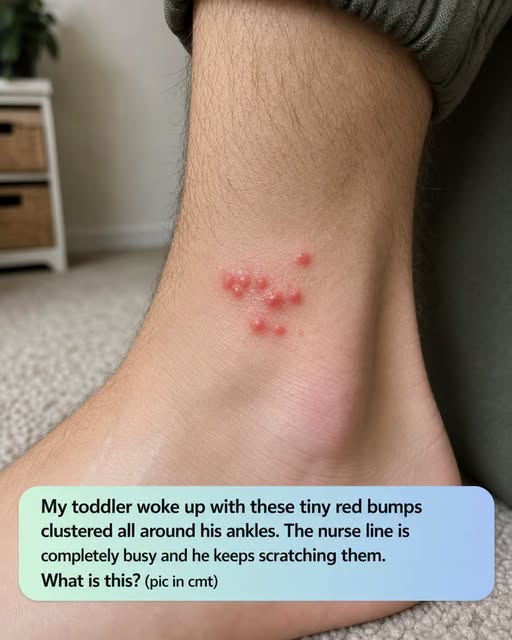
Parents know that children can develop unexpected skin changes from time to time.
Sometimes a small patch of redness is nothing more than irritation caused by clothing, sweat, grass, or another everyday exposure. In other situations, itchy bumps can be associated with insect bites, an allergic reaction, or a skin condition that deserves professional attention.
That is why discovering several small red bumps around a toddler’s ankles can understandably make a parent concerned—especially when the child keeps scratching them.
The difficult part is that skin problems can look surprisingly similar.
A photograph or short description usually isn’t enough to determine exactly what caused a rash. Several different conditions can produce small red, itchy bumps, and the correct approach depends on the child’s symptoms, recent activities, environment, and overall health.
Rather than trying to identify the problem from appearance alone, parents can look for useful clues and pay attention to warning signs that indicate when professional medical advice is needed.
Why Are the Bumps Around the Ankles?
The location of a rash can sometimes provide a clue, although it does not establish a diagnosis.
The ankles are frequently exposed to the environment.
A toddler may come into contact with grass, soil, plants, insects, footwear, socks, laundry products, or other materials during the day.
Because young children spend so much time playing on floors and outdoors, their lower legs can encounter many potential sources of irritation.
The bumps may therefore be connected to something the child encountered recently.
However, the same general area can also be affected by conditions unrelated to an outside exposure.
That’s why it is important to consider the child’s complete symptoms rather than focusing only on where the bumps appeared.
Insect Bites Are One Possibility
Small itchy bumps appearing in a cluster can sometimes occur after insect exposure.
Children may not notice when an insect lands on them, particularly while playing outdoors or sleeping.
Depending on the type of insect and the individual’s reaction, bites can appear as small red or swollen spots.
The reaction can also vary considerably from one child to another.
One child may develop barely noticeable marks, while another may experience considerably more itching or swelling.
If a parent suspects an insect exposure, it can be useful to think about where the child has recently been playing or sleeping.
Was the child outdoors?
Did the family visit a park?
Did the child play around grass or vegetation?
Were there any changes in bedding or sleeping arrangements?
These details can help a healthcare professional understand the situation.
Irritation From Socks or Shoes
Another possibility is simple irritation.
Toddlers can sweat considerably during active play, and tight or rough clothing may rub against the skin.
Socks, shoes, elastic bands, detergents, fabric softeners, or other materials can sometimes contribute to irritation.
If the bumps appear exactly where a sock or shoe makes contact, that may be a useful observation.
Parents can check whether the skin improves after removing a possible source of irritation.
However, persistent or worsening symptoms should still be discussed with a healthcare professional rather than assuming the cause.
Allergic Reactions Can Look Different From One Child to Another
Skin reactions can also occur after contact with certain substances.
A child might encounter something new through clothing, soap, lotion, plants, food, or another environmental exposure.
An allergic or sensitivity-related reaction can produce redness, itching, swelling, or other skin changes.
But not every itchy rash is an allergy.
This is an important distinction because parents may understandably try to identify the trigger immediately.
If the cause isn’t obvious, keeping track of recent exposures can be helpful when speaking with a pediatrician or other healthcare professional.
Scratching Can Make Things Worse
When a toddler has an itchy rash, scratching can become difficult to control.
Unfortunately, repeated scratching can irritate the skin further.
It may also cause small breaks in the skin, increasing the possibility of irritation or infection.
Parents can try to keep the child’s fingernails short and clean.
Gentle measures that help keep the child comfortable may also be useful, but medications or specialized treatments should be used according to appropriate medical guidance for the child’s age.
Avoid experimenting with strong creams or household remedies simply because someone recommended them online.
Young children’s skin can be particularly sensitive.
Look at the Whole Picture
When evaluating an unfamiliar rash, don’t focus only on the bumps.
Consider how the child is behaving.
Is the toddler otherwise playing normally?
Are they eating and drinking normally?
Do they have a fever?
Are they unusually tired or difficult to comfort?
Is the rash staying in one location, or is it spreading?
Are the bumps becoming larger?
Is there swelling?
Are there blisters, drainage, or areas of broken skin?
These observations can be more useful to a healthcare professional than simply saying that the child has “red bumps.”
When to Seek Urgent Medical Attention
Some symptoms require prompt medical evaluation.
Parents should seek urgent medical assistance if a child develops significant difficulty breathing, swelling of the face, lips, tongue, or throat, becomes faint or unusually difficult to wake, or appears seriously unwell.
A rapidly developing widespread reaction can also require immediate assessment.
In these circumstances, don’t wait for an online discussion or a routine appointment.
Contact emergency medical services or seek urgent care according to local medical guidance.
What About Fever?
A rash accompanied by fever deserves additional attention.
Many childhood illnesses can involve both skin changes and fever, and the combination can have different causes.
The child’s age, temperature, behavior, and other symptoms all matter.
A toddler who has a rash and appears significantly unwell should be evaluated by a healthcare professional.
Parents should not rely solely on the appearance of the rash to determine whether the situation is serious.
Signs of Possible Skin Infection
Scratching can occasionally damage the skin.
If an area becomes increasingly painful, warm, swollen, or red, or if there is drainage or another notable change, it may require professional assessment.
A healthcare professional can determine whether the skin appears irritated, infected, or affected by another condition.
Avoid squeezing, picking, or attempting to open bumps.
Those actions can further irritate the skin.
Take a Photograph for Comparison
If a rash changes over time, photographs can be useful.
Take a clear picture in good lighting and, if possible, keep a record of when it was taken.
A second photograph later can help show whether the rash is spreading or changing.
If you speak with a healthcare professional, these images may also provide useful information.
Avoid sharing identifiable photographs of a child publicly when it isn’t necessary.
Privacy is important, particularly when discussing children’s health.
Think About Recent Changes
Parents can also make a simple list of anything that changed recently.
For example:
- A new soap or shampoo.
- A different laundry detergent.
- New clothing or shoes.
- A new blanket or bedding.
- Outdoor activities.
- Time spent around animals.
- Travel.
- A different sleeping environment.
- New lotions or skin products.
- Recent illnesses.
This doesn’t mean one of these changes is definitely responsible.
It simply gives a healthcare professional more information to work with.
Don’t Rely on a Comment Section for a Diagnosis
When a child develops an unusual rash, it is natural to search online for answers.
However, internet images and social media comments can be misleading.
A rash that looks similar to another person’s rash may have a completely different cause.
A person commenting online cannot examine the child, review their medical history, or assess their other symptoms.
Online information can be useful for general education, but it should not replace professional evaluation when a child is unwell or symptoms are concerning.
What Parents Can Do While Waiting for Advice
If the child is otherwise comfortable and there are no emergency warning signs, parents can focus on basic comfort and observation while waiting to speak with a healthcare professional.
Keep the skin clean.
Try to prevent excessive scratching.
Avoid introducing several new products at once.
Dress the child in comfortable clothing.
Pay attention to whether the rash changes.
And keep track of any additional symptoms.
If the nurse line is busy, parents can consider another appropriate local healthcare resource, such as a pediatric clinic, primary-care service, urgent-care facility, or local medical advice service, depending on the situation and availability.
Why the Exact Cause Matters
Different skin problems can require very different approaches.
A simple irritation may improve after the triggering substance is removed.
An insect-related reaction may need a different approach.
Other conditions may require examination and specific treatment.
This is why automatically labeling every cluster of red bumps as one particular condition can be misleading.
The goal should not be to guess the diagnosis.
The goal should be to recognize the child’s symptoms, identify any warning signs, and obtain appropriate advice.
Parents Should Trust Their Observations
Parents often know when their child is behaving differently.
If something about the situation feels unusual, it is reasonable to ask a healthcare professional for guidance.
You don’t need to know exactly what the rash is before seeking help.
Simply explaining what you observed can be enough to start the conversation.
Mention when the bumps first appeared, where they are located, whether they are itchy, whether they are changing, and whether the child has any other symptoms.
That information can help the clinician decide what should happen next.
Final Thoughts
Finding small red bumps around a toddler’s ankles can be concerning, particularly when the child is uncomfortable and repeatedly scratching.
There are many possible explanations, ranging from everyday irritation and environmental exposure to insect bites and other skin conditions.
However, appearance alone is rarely enough to determine the exact cause.
Parents should pay attention to the child’s overall condition, watch for changes in the rash, avoid unnecessary scratching or harsh products, and seek professional medical advice when symptoms persist, worsen, or are accompanied by other concerning signs.
Most importantly, serious warning symptoms should never be ignored.
If a child develops difficulty breathing, significant facial or throat swelling, severe illness, unusual difficulty waking, or another emergency symptom, immediate medical assistance is appropriate.
For less urgent situations, a pediatrician or other qualified healthcare professional can examine the child and provide advice based on their age, symptoms, medical history, and the appearance of the skin.
The mystery of a few small bumps may seem simple, but children’s skin can react to many different things.
Instead of relying on a dramatic online diagnosis, careful observation and appropriate medical guidance are the safest ways to determine what may be happening.
Sometimes the answer is something relatively minor.
Sometimes it requires treatment.
And sometimes the most important thing a parent can do is simply recognize that the situation deserves a professional opinion.
When it comes to a young child’s health, asking for help is never something to feel embarrassed about.