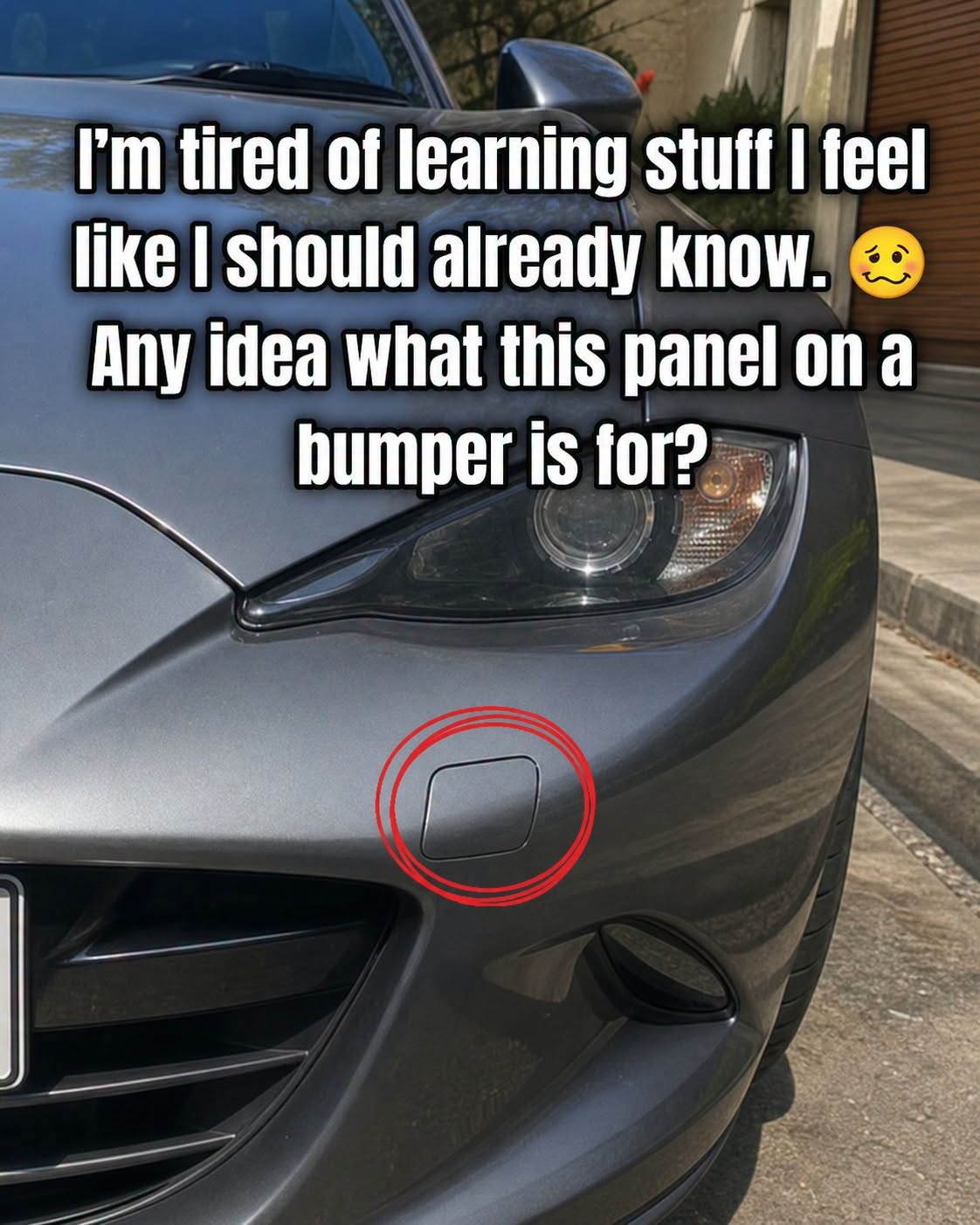
There are certain things we see every day without ever stopping to ask what they actually do.
A button on the dashboard.
A small slot beside a door handle.
A strange symbol on the instrument panel.
Or, in this case, a small removable panel built into a vehicle’s bumper.
I recently noticed one of these panels and realized something slightly embarrassing: I had no idea why it was there.
At first, I assumed it was simply part of the bumper’s design.
But the more I looked at it, the more obvious it became that the panel had been deliberately included for a reason.
So I started wondering:
What is that little panel on the bumper actually used for?
The answer can vary depending on the make, model, year, and equipment of the vehicle. However, on many modern cars, a small removable panel in the bumper provides access to an important feature that drivers may not need very often.
And once you know what you’re looking at, the mystery becomes much easier to understand.
The Small Panel That Many Drivers Ignore
Modern vehicles contain hundreds of components, many of which are hidden from view.
Manufacturers have to balance appearance, safety, convenience, manufacturing requirements, and serviceability.
That means some useful components are placed behind small covers rather than being left exposed.
A bumper is a particularly practical location for this kind of access point.
The bumper needs to look clean and finished, but there are circumstances when a particular opening or mounting point may be required.
Rather than leaving a permanent hole visible, manufacturers can install a small removable cover.
When the cover is in place, it blends into the bumper.
When access is needed, the panel can be removed.
One Common Purpose: Towing Access
One of the most common reasons for a removable bumper cover is access to a towing point.
Many vehicles have a designated location where a tow eye or towing attachment can be installed when the vehicle needs to be moved.
The access point may be hidden behind a small panel so that it doesn’t interfere with the vehicle’s appearance during normal driving.
If the vehicle ever needs to be recovered after a breakdown or transported in a particular situation, the cover can be removed and the appropriate towing equipment installed according to the manufacturer’s instructions.
This is particularly useful because the towing attachment doesn’t necessarily need to remain installed all the time.
Why Hide the Towing Point?
At first, it might seem easier simply to leave the attachment point exposed.
But there are several reasons manufacturers may choose a covered design.
An exposed opening could affect the appearance of the vehicle.
It could also allow dirt, moisture, road debris, or other contaminants to accumulate inside.
A removable cover provides a cleaner appearance while allowing access when necessary.
It’s essentially a compromise between practicality and design.
The result is something that most drivers barely notice until they suddenly need it.
It May Not Be a Towing Cover
Here’s where things get interesting.
Not every bumper panel serves exactly the same purpose.
Vehicles differ considerably in design.
A similar-looking panel on two different cars can have completely different functions.
Depending on the model, a bumper cover may provide access to equipment associated with towing, parking sensors, lighting, wiring, or other components.
That’s why identifying the exact vehicle is important before deciding what a particular panel does.
The safest way to identify it is to consult the owner’s manual or the manufacturer’s documentation for that specific model.
Look at the Shape
There are a few clues that can help you understand a bumper panel.
Start by looking at its shape.
A small rectangular or circular cover that appears to be designed to pop out may be an access cover.
If it is located symmetrically on the front or rear bumper, that can provide another clue.
Some vehicles have covers positioned where a towing attachment can be installed.
However, location alone isn’t enough to confirm its purpose.
Different manufacturers use different layouts.
Don’t Force the Cover Open
This is an important point for anyone who discovers one of these panels.
Don’t automatically pry it open with a screwdriver, knife, or other sharp object.
The panel may be held in place with clips, tabs, or another mechanism designed to be released in a particular way.
Forcing it can damage the cover or the bumper.
If you’re curious about the panel on your own vehicle, check the owner’s manual first.
The manual may explain exactly where the access point is and how the cover should be removed.
Your Owner’s Manual Is Often the Best Answer
Vehicle manuals contain a surprising amount of information that drivers rarely read.
They explain dashboard warning lights, maintenance schedules, emergency procedures, tire information, towing instructions, fluid specifications, and many other features.
A mysterious bumper panel may be described in a section dealing with towing or vehicle recovery.
If you’ve misplaced the physical manual, many manufacturers provide digital versions through their official websites or owner portals.
Searching for the exact model and year can also help locate the correct documentation.
Be careful, however, to use information that matches your exact vehicle.
A procedure for one model may not apply to another.
Why These Features Are Easy to Miss
Cars have become increasingly sophisticated.
Many features are designed to remain invisible during normal use.
That’s good from a design perspective.
Drivers don’t want their vehicles covered in exposed mechanical components.
They want smooth bodywork, clean lines, and convenient operation.
But the downside is that some useful features become hidden in plain sight.
A person can own the same car for years without ever needing to know what a particular access panel does.
Then one day, they notice it and suddenly realize they’ve been looking at it every day without understanding its purpose.
Bumper Panels Can Also Relate to Sensors
Modern vehicles increasingly use sensors and cameras to assist drivers.
Parking assistance systems, collision-warning technology, adaptive cruise systems, and other features can involve components positioned around the exterior of the vehicle.
Some are clearly visible.
Others are integrated into the bodywork.
A removable panel, however, should not automatically be assumed to cover a sensor.
Sensor locations and designs vary widely between manufacturers.
If you’re trying to identify a specific panel, looking at the vehicle’s manual and equipment list is much more reliable than guessing from its appearance.
Don’t Confuse an Access Cover With a Damage Panel
Another possibility is that what appears to be a removable panel is actually part of the bumper assembly designed to accommodate a particular feature.
For example, a bumper may be manufactured with different configurations depending on whether the vehicle has certain optional equipment.
A panel may therefore be present even if the vehicle isn’t equipped with the feature that would normally use the opening.
This is one reason photographs alone don’t always provide enough information.
Why Vehicle Identification Matters
If you want someone to identify a mysterious part of your car, providing more information can make the answer much easier.
Instead of simply asking, “What is this?”
Include:
- The vehicle’s make.
- The model.
- The model year.
- Whether the panel is on the front or rear bumper.
- A clear photograph.
- The approximate size of the panel.
- Any markings around it.
These details can help narrow down the possibilities.
A panel on the rear bumper of one vehicle might serve a completely different purpose from a similarly shaped panel on another.
A Small Feature With a Practical Purpose
One of the interesting things about vehicle design is that many components are created around situations that drivers may encounter only occasionally.
A towing access point is a good example.
Most drivers hope they never need roadside recovery.
But if they do need it, having a properly designed attachment point can make vehicle recovery easier and safer.
The same principle applies to many other features.
Emergency equipment, spare-tire compartments, service access points, and temporary mounting locations may remain unused for years.
Their importance only becomes obvious when the situation calls for them.
What You Should Do If You Need to Use It
If you believe the panel on your vehicle provides access to a towing attachment, don’t rely on guesswork.
Consult the vehicle’s owner’s manual.
Look for instructions relating to towing, recovery, or emergency vehicle movement.
Follow the manufacturer’s specified procedure.
Use only the appropriate equipment designed for the vehicle.
If you’re unsure, contact the manufacturer, a qualified mechanic, or a professional roadside assistance provider.
Incorrectly attaching recovery equipment can cause damage or create a safety hazard.
A small cover may look simple, but the components behind it can have an important purpose.
The Internet Can Help—If You Ask the Right Question
Online communities can be excellent sources of information about unusual vehicle features.
Owners of the same model may have encountered the same question.
But the quality of an answer depends heavily on the information provided.
A clear photo combined with the exact vehicle model is much more useful than a vague description.
It’s also worth comparing multiple answers and checking the information against the manufacturer’s documentation.
That extra step can prevent a simple misunderstanding.
The Bigger Lesson
The mystery of a small bumper panel is a good reminder that vehicles contain many features we don’t consciously notice.
Modern design often hides practical equipment behind clean exterior surfaces.
What looks like a decorative piece may actually provide access to something important.
And something that appears identical across different vehicles may serve completely different purposes.
So there’s no need to feel embarrassed about not knowing.
Most people don’t memorize every feature of their vehicle.
That’s exactly why owner’s manuals, qualified technicians, and reliable vehicle documentation exist.
Final Thoughts
That small panel on the bumper may look insignificant, but it could serve a very practical purpose.
On many vehicles, similar covers are used to provide access to a designated towing or recovery point. On other models, a comparable panel may have a different function.
The exact answer depends on the vehicle.
Before removing the cover, forcing it open, or attaching anything behind it, check the owner’s manual for the correct procedure.
And if you’re trying to identify one for someone else, provide the vehicle’s make, model, year, and a clear photograph.
What seems like an insignificant piece of plastic can actually be part of a carefully designed system intended to help when the vehicle needs servicing, recovery, or special equipment.
So the next time you notice a strange little panel on a car bumper, don’t assume it’s just decoration.
It may be one of those cleverly hidden features that you never need—until the day you really do.