My fourteen-year-old son had brought home a report card we were both proud of.
His grades had improved significantly over the semester, and he had worked especially hard in several subjects that hadn’t come easily to him.
So I decided to take him somewhere special.
For months, he had been talking about a steakhouse across town.
He had seen pictures of it online and had been asking when we could go.
That evening, I told him to get ready.
“Where are we going?”
“Your choice.”
His face immediately lit up.
“Seriously?”
“Seriously.”
He ran upstairs to change.
At that moment, I had no idea that our dinner would turn into a conversation neither of us would forget.
Everything Was Going Well
The restaurant was busy but comfortable.
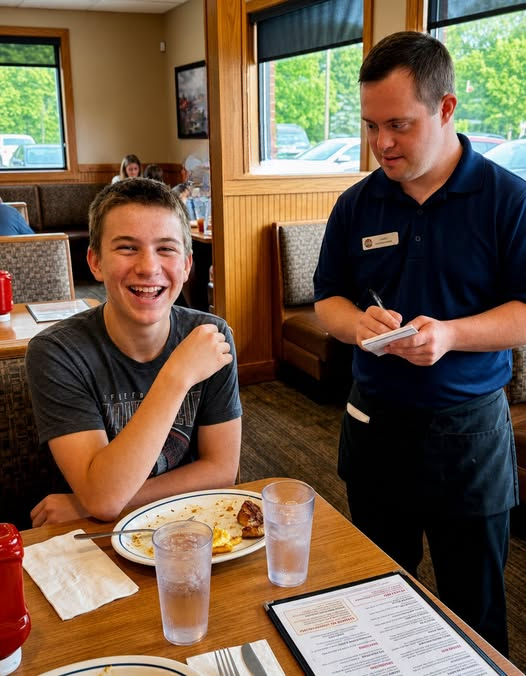
We were seated near the window, and Leo immediately started studying the menu.
“This is exactly what I wanted,” he said.
I smiled.
“You earned it.”
We talked about school.
He told me about a project he had completed.
I asked about his friends.
He complained about having to wake up early.
It was an ordinary conversation between a mother and her teenage son.
Then our waiter approached.
His name was Sam.
He appeared to be a young adult and greeted us politely.
He introduced himself, took out his notepad, and asked what we’d like to drink.
Sam carefully repeated our choices back to us.
He went through each item one at a time to make sure he had everything correct.
I noticed that he was taking his time.
There was nothing unusual about that.
He was simply doing his job carefully.
Then I looked across the table.
Leo was smiling.
At first, I thought he was amused by something on his phone.
Then I realized he was watching Sam.
The Moment I Became Concerned
Sam began explaining the evening’s specials.
He spoke carefully and paused occasionally while finding the words he wanted.
Leo started imitating him.
It was subtle at first.
Then it became obvious.
He copied Sam’s mannerisms and quietly laughed.
I immediately gave Leo a serious look.
“Stop.”
He shrugged.
Sam didn’t seem to notice.
He continued explaining the menu.
Leo looked at me and smiled as though he couldn’t understand why I was upset.
I felt embarrassed.
Not because our waiter was different.
Because my son was choosing to make fun of someone who was simply doing his job.
I Didn’t Make a Scene
I could have raised my voice.
I could have embarrassed Leo in front of the restaurant.
But I decided not to.
Instead, I looked at him and said quietly:
“We’re going to talk about this later.”
He rolled his eyes.
Sam finished taking our order and thanked us.
Then he walked toward the kitchen.
I watched him leave.
There was nothing remarkable about the interaction from his perspective.
He had simply done his job.
But for me, something had changed.
I had always believed that my son was becoming a kind and thoughtful young man.
That evening, I realized that good character isn’t measured only by how someone treats people they know.
It’s also measured by how they behave around people they believe have less social power than they do.
An Important Conversation
When Sam returned, I apologized for Leo’s behavior.
“I’m sorry about that.”
Sam looked slightly confused.
“It’s okay.”
I smiled.
“Thank you.”
Before leaving, I added a generous tip.
I wanted Sam to know that his work was appreciated.
Then I asked for the check.
Leo didn’t say much.
He seemed irritated.
We walked through the parking lot in silence.
Once we were in the car, he finally spoke.
“Mom, seriously?”
I kept driving.
“I was just joking.”
I didn’t answer.
“It wasn’t even that serious.”
Still, I said nothing.
He sighed.
“Why are you acting like I did something terrible?”
I glanced at him in the rearview mirror.
“Because you did something unkind.”
He looked away.
“I didn’t hurt anybody.”
“That’s not the only way people can be hurt.”
He didn’t respond.
The rest of the drive was quiet.
The Box in My Closet
When we arrived home, Leo headed toward the stairs.
“Where are you going?”
“To my room.”
“Not yet.”
He stopped.
“Why?”
“Sit at the kitchen table.”
He looked annoyed.
I went upstairs to my bedroom.
At the back of my closet was a wooden box I hadn’t opened in years.
It was old.
The corners were worn.
There were small scratches across the lid.
I carried it downstairs and placed it on the table.
Leo stared at it.
“What is that?”
“Something I should have shown you a long time ago.”
I opened the lid.
Inside were photographs, letters, and a few small keepsakes.
Leo looked confused.
Then he picked up one of the photographs.
It showed me standing beside a young man.
He was smiling broadly.
Leo studied the picture.
“Who is that?”
I sat across from him.
“Your uncle Daniel.”
The Story Leo Didn’t Know
Leo had heard Daniel’s name before.
But he had never known much about him.
Daniel was my older brother.
He had been born with an intellectual disability and needed additional support throughout his life.
Growing up, our family learned that Daniel experienced the world differently from most people.
Some tasks took him longer.
Some conversations were difficult.
But he had his own strengths.
He loved music.
He remembered people’s birthdays.
He could spend hours fixing small things around the house.
And he had an extraordinary ability to make people feel welcome.
When I was a child, Daniel was the person who could make me laugh after a terrible day.
He was patient with me.
He listened to me.
He never cared whether I was popular.
He never cared about grades.
He simply cared that I was okay.
The Photograph
Leo turned the photograph over.
There was a date written on the back.
“How old were you here?”
“About your age.”
He looked at me.
“And Uncle Daniel?”
“Sixteen.”
Leo looked back at the photograph.
“He looks happy.”
“He was.”
I smiled.
“He was also one of the kindest people I ever knew.”
What Happened Later
I explained that Daniel eventually found work in a local community center.
He helped organize supplies.
He welcomed visitors.
He assisted with simple tasks.
He loved having a routine.
Most importantly, he loved being treated like an adult.
Some people underestimated him.
Others spoke to him as though he were much younger than he actually was.
Daniel didn’t always know how to respond.
But I noticed how those experiences affected him.
They made him quieter.
They made him hesitant.
And sometimes they made him wonder whether people were laughing at him rather than with him.
The Lesson I Wanted Leo to Understand
I looked at my son.
“Do you know what bothered me tonight?”
He didn’t answer.
“It wasn’t that you made a joke.”
He looked at me.
“It was that you chose someone who was simply doing his job and turned one of his differences into entertainment.”
Leo stared at the table.
“I didn’t think about it like that.”
“That’s exactly the problem.”
I paused.
“Before you make someone the subject of a joke, think about whether they would find it funny too.”
He nodded slowly.
The Question
Leo picked up another photograph.
“Did people make fun of Uncle Daniel?”
“Sometimes.”
“What did you do?”
“I tried to stand up for him.”
“Did he know?”
“Sometimes.”
He looked at me.
“Was he embarrassed?”
“Sometimes.”
The room became quiet.
Then Leo asked:
“Did you ever make fun of him?”
I took a breath.
“I made mistakes when I was younger.”
He waited.
“I was a teenager once too. I didn’t always understand how my words affected other people.”
Leo looked surprised.
“So you’re saying you’ve done something like I did?”
“I’ve said things I regretted.”
I smiled.
“The important part is learning from those moments.”
The Second Photograph
I handed him another photograph.
This one showed Daniel working at the community center.
He was standing behind a table covered with books.
A handwritten sign read:
WELCOME
Leo studied the image.
“He looks like he likes his job.”
“He loved it.”
“What happened?”
“Nothing dramatic.”
I closed the box slightly.
“He simply grew older, found work he enjoyed, and built a life that mattered to him.”
That was important.
I didn’t want Leo to think Daniel’s life existed only as a lesson about disability.
Daniel had been a complete person.
He had preferences.
Dreams.
Frustrations.
Humor.
Friends.
Responsibilities.
He deserved the same respect as everyone else.
What Makes Someone Valuable?
I asked Leo a question.
“What makes a person valuable?”
He shrugged.
“Being good?”
“Good at what?”
He thought.
“I don’t know.”
“That’s the point.”
A person’s worth isn’t determined by how quickly they speak.
It isn’t determined by whether they have a disability.
It isn’t determined by their job.
It isn’t determined by their grades.
And it certainly isn’t determined by whether other people think they’re impressive.
Everyone deserves basic dignity.
Everyone deserves the chance to work, participate, contribute, and be treated with respect.
Leo Finally Understood
He looked down.
“I’m sorry.”
“To me?”
He shook his head.
“To Sam.”
I nodded.
“That’s who you owe an apology to.”
“Do you think he’ll remember?”
“Maybe.”
Leo looked worried.
“What if he doesn’t forgive me?”
“Then you accept that.”
He was quiet.
“An apology isn’t a way to make yourself feel better.”
I continued.
“It’s a way of taking responsibility.”
He nodded.
The Next Day
The next afternoon, Leo surprised me.
He asked whether we could return to the restaurant.
I asked why.
“I want to apologize.”
I wasn’t sure whether Sam would be working.
But Leo wanted to try.
So we went.
When we entered, the hostess recognized us.
Sam was working that afternoon.
Leo walked over.
“Hi.”
Sam smiled.
“Hello.”
Leo took a breath.
“I was here yesterday.”
Sam nodded.
“I remember.”
Leo looked nervous.
“I acted disrespectfully toward you.”
Sam didn’t say anything.
“I thought I was being funny, but I wasn’t.”
He paused.
“I’m sorry.”
Sam smiled.
“Thank you.”
It was a simple exchange.
No dramatic speech.
No applause.
No grand gesture.
Just an apology.
A Small Change
We left the restaurant a few minutes later.
In the car, Leo was quiet.
Finally, he said:
“That wasn’t as hard as I thought.”
I smiled.
“What did you expect?”
“I don’t know.”
He looked out the window.
“I guess I thought he’d be angry.”
“He had every right to be.”
“But he wasn’t.”
“People respond differently.”
Leo nodded.
Then he said something I didn’t expect.
“I think I understand now.”
What He Learned
Over the next few months, I noticed small changes in Leo.
He became more careful with jokes.
He paid more attention to how people responded to him.
He didn’t suddenly become perfect.
He was still fourteen.
He still made mistakes.
He still said things without thinking.
But when someone pointed out that something he had said was hurtful, he became more willing to listen.
That was progress.
The Box Stayed on the Table
For several weeks, I kept the wooden box on a shelf in the living room.
One evening, Leo asked whether he could look through it again.
“Of course.”
He opened the lid.
He studied the photographs.
Then he found one of Daniel laughing with a group of friends.
“Uncle Daniel looks happy here.”
“He was.”
“What happened to him?”
“He lived a long and meaningful life.”
Leo smiled.
“I wish I’d known him.”
“So do I.”
A Family Story Worth Remembering
Daniel’s story wasn’t meant to make Leo feel ashamed.
It was meant to help him understand something that textbooks and lectures can’t always teach.
People are more than the characteristics you notice first.
Someone may communicate differently.
Someone may move differently.
Someone may learn differently.
Someone may need additional support.
None of those things makes them less deserving of respect.
And sometimes, the person you underestimate may be the person who teaches you the most.
The Real Lesson
I had originally taken Leo out to celebrate his academic achievement.
But that evening taught us something more important than any grade.
Achievement is valuable.
Hard work matters.
Success is worth celebrating.
But character matters too.
A person can earn excellent grades and still have more to learn about empathy.
A person can be talented and still make mistakes.
Growing up isn’t about becoming perfect.
It’s about becoming willing to recognize when you’ve done something wrong and choosing to do better next time.
Looking Back
Years later, I still remember that dinner.
Not because something extraordinary happened.
Nothing dramatic occurred.
A waiter served our food.
A teenager made an inappropriate joke.
A mother realized her son needed a lesson about empathy.
And a young man eventually understood why his behavior had been wrong.
That’s all.
But sometimes ordinary moments become important because they give us an opportunity to teach something that lasts.
What I Wanted My Son to Remember
Before Leo went to bed that night, I told him one final thing.
“You don’t have to understand everything about another person.”
He looked at me.
“But you should always treat them with dignity.”
He nodded.
“And if you don’t know how someone wants to be treated?”
“Ask?”
I smiled.
“Exactly.”
He thought for a moment.
“Mom?”
“Yes?”
“Can we go back to that restaurant sometime?”
“Why?”
He smiled.
“The steak was actually really good.”
I laughed.
“Fine.”
He stood up.
“But next time, you’re paying for dessert.”
He smiled.
“Deal.”
And just like that, the difficult conversation was over.
But I knew the lesson would stay with him.
Final Thoughts
Children and teenagers are still learning how to navigate the world.
They will make mistakes.
They will sometimes say things they shouldn’t.
They may not immediately understand why a joke that seems harmless to them can be hurtful to someone else.
Our job as parents isn’t simply to punish those mistakes.
It’s to help them understand the consequences, take responsibility, and become better people.
That evening, Leo learned that respect isn’t something we give only to people who are similar to us.
It’s something everyone deserves.
The old wooden box eventually went back into my closet.
But I left one photograph on Leo’s desk.
It was the picture of Daniel standing behind the welcome table at the community center.
On the back, there was a handwritten sentence:
“Everyone deserves to feel welcome.”
Leo kept that photograph.
And whenever I saw it, I knew he hadn’t just heard the lesson.
He had begun to understand it.