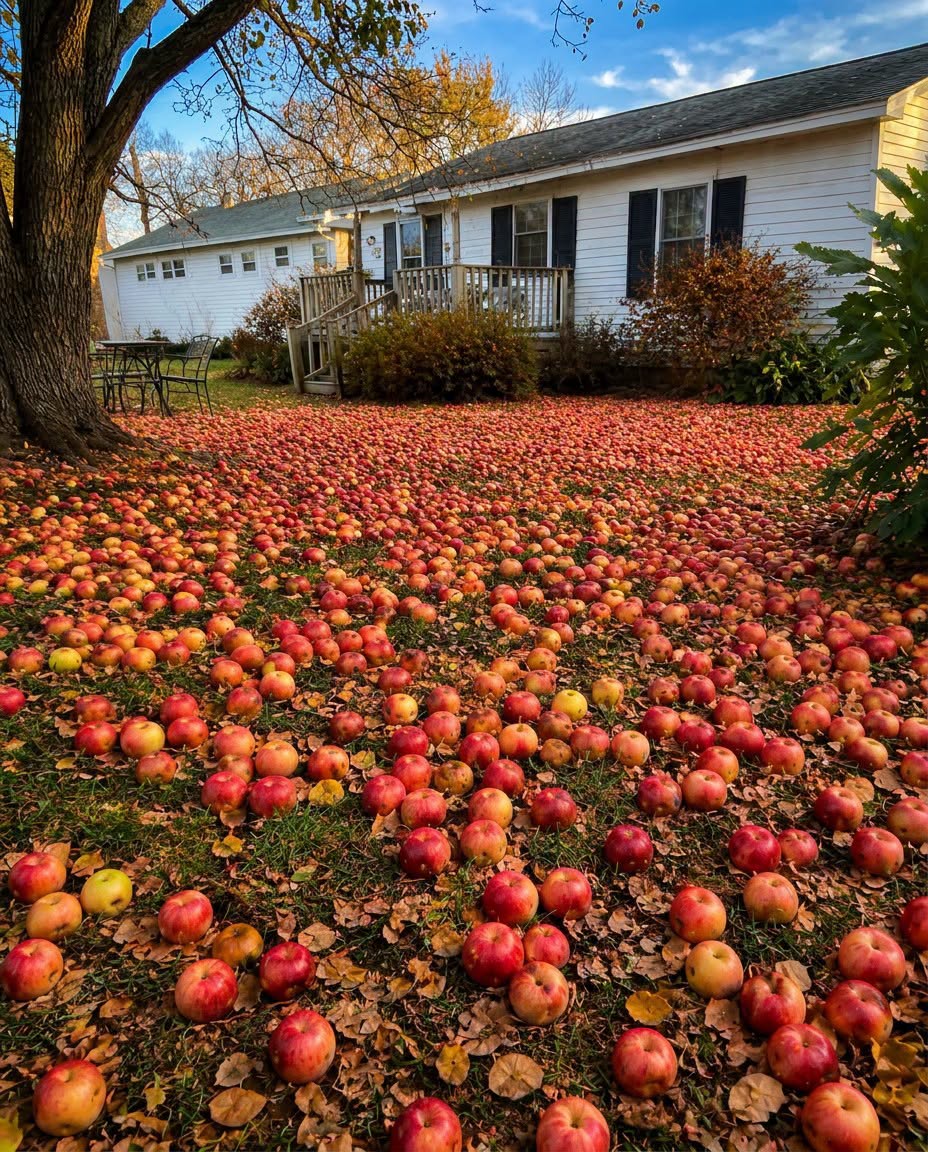
My Neighbor Wanted My Apple Tree Gone — Then I Discovered Who Had Damaged It
Twelve years ago, my husband planted an apple tree in our backyard.
At the time, neither of us could have known how important that simple act would eventually become to me.
He planted it only a few months before he passed away.
The tree was still small when he put it into the ground. Its trunk was thin enough to wrap one hand around, and its branches barely reached above the fence.
He spent an entire afternoon preparing the soil, checking the roots, adding compost, and carefully positioning the young tree.
I remember teasing him because he treated the planting like he was working on an important construction project.
He laughed and told me, “You’ll see. One day we’ll have more apples than we know what to do with.”
He was right.
Over the years, the little tree grew into one of the largest trees on our property.
Every autumn, its branches became heavy with apples. Some years there were so many that I couldn’t possibly use them all.
I made pies.
I prepared applesauce.
I gave bags of apples to coworkers.
Neighbors would stop by and ask if they could pick a few.
Parents walking with their children sometimes accepted apples when I offered them.
I never minded sharing.
In fact, I enjoyed it.
The tree had become part of the neighborhood.
But for me, the apples were never the most important part.
The tree itself was a reminder of my husband.
Whenever I worked around it, I remembered the afternoon he planted it.
Whenever new leaves appeared in spring, I thought about how excited he had been to see the first signs of growth.
And whenever the branches became heavy with fruit in autumn, I remembered his prediction that someday we would have more apples than we could use.
Taking care of that tree made me feel connected to him.
So when a new neighbor moved into the house next door, I never imagined that the tree would become the center of a dispute.
The New Neighbor
The new homeowner arrived in the neighborhood last spring.
At first, I tried to be welcoming.
I introduced myself, explained where the trash collection schedule was posted, and told him to let me know if he ever needed information about the neighborhood.
He was polite enough during that first conversation.
Nothing about him seemed unusual.
That changed a few weeks later.
One afternoon, he knocked on my door.
When I opened it, he immediately started talking about the apple tree.
“I need you to remove that tree,” he said.
I thought I had misunderstood him.
“The apple tree?”
“Yes.”
I looked past him toward the backyard.
“I’m not sure what you mean.”
He explained that he didn’t like the way the tree looked and believed it made the neighborhood appear less tidy.
I almost laughed because I assumed he was making a joke.
Instead, I asked him what specifically bothered him.
He pointed toward the fence.
Branches from the tree extended toward the property line, although the trunk and main structure were entirely on my property.
“Leaves fall into my yard,” he said.
“That’s normal for trees,” I replied.
He then mentioned apples.
Apparently, an occasional apple rolled beneath the fence.
I offered a simple solution.
“I can trim the branches that extend toward your side, and I’ll make sure to collect any apples that fall near the fence.”
He shook his head.
“I don’t want it trimmed.”
I waited.
“I want the tree gone.”
His tone made it clear that this wasn’t a casual suggestion.
I Tried to Find a Reasonable Solution
I explained that the tree had been there for more than a decade.
I also told him that it was planted entirely on my property and that I had no intention of removing it.
I wasn’t trying to be difficult.
I simply couldn’t understand why I should remove a healthy tree because someone who had recently moved into the neighborhood didn’t like it.
He became increasingly frustrated.
He said the tree was unattractive.
He complained about fallen leaves.
He complained about apples.
He complained about branches.
Eventually, he said that he had purchased his home expecting the neighboring property to look a certain way.
I told him respectfully that buying a house didn’t give him control over what existed on someone else’s property.
The conversation ended without an agreement.
I assumed that would be the end of it.
It wasn’t.
The Complaints Continued
Over the following weeks, he found new reasons to bring up the tree.
If a few leaves crossed the fence, he complained.
If an apple rolled into his yard, he complained.
If I trimmed the tree, he watched from his window.
Sometimes he would make comments while I worked outside.
I tried not to respond.
I didn’t want a disagreement with a neighbor to become a permanent source of stress.
So I continued maintaining the tree.
I trimmed it when necessary.
I collected fallen fruit.
I kept the area around the fence clean.
Eventually, the neighbor contacted the homeowners’ association.
He claimed that the tree violated neighborhood appearance standards.
That was when I decided to stop relying on conversations and check the rules carefully.
I reviewed the community guidelines.
Nothing prohibited my tree.
I also checked the property boundaries.
The tree was clearly located on my side.
An inspector eventually came to examine the situation.
After reviewing the property lines and community regulations, the inspector confirmed that the tree was not violating the association’s rules.
There was no requirement for me to remove it.
The neighbor didn’t say much after that.
But his attitude changed.
He became quieter.
Instead of arguing, he watched.
And somehow, that made me more uncomfortable than the arguments had.
The Morning Everything Changed
One autumn morning, I woke earlier than usual.
The house was quiet.
I made coffee and walked toward the bedroom window.
When I looked outside, I stopped.
For several seconds, I couldn’t understand what I was seeing.
Apples covered the lawn.
There were hundreds of them.
They were scattered across the grass, walkway, flower beds, and around the base of the tree.
Some had been crushed.
Others were still perfectly intact.
Several branches were broken.
The tree itself looked different.
Bare areas were visible where clusters of fruit had been hanging only the previous evening.
I knew immediately that this wasn’t normal weather.
A storm might knock down apples.
Strong wind might break a branch.
But this looked completely different.
Someone had removed a large amount of fruit from the tree.
Then they had left it scattered across my yard.
I stood there staring through the window.
My first emotion wasn’t anger.
It was sadness.
That tree had survived twelve years.
It had survived storms, heat, freezing temperatures, insects, and seasons when it produced very little.
My husband had planted it.
And now someone had deliberately damaged it.
I got dressed and went downstairs.
Before I stepped outside, I noticed my neighbor walking toward his driveway with a cup of coffee.
He looked over the fence.
Then he looked at me.
There was a small smile on his face.
“Looks like you had quite a storm last night,” he said.
I stared at him for a moment.
Then I answered calmly.
“Apparently.”
He waited, seemingly expecting me to become angry.
I didn’t.
Instead, I went back inside.
There was something he didn’t know.
Several weeks earlier, I had installed a security camera on my property.
The Camera
The camera wasn’t installed because I was planning some kind of confrontation.
I installed it because I had begun feeling uncomfortable about the repeated incidents around my property.
It covered my driveway, part of the backyard, and the area around the apple tree.
I had forgotten about it until that morning.
I opened the recording.
There it was.
The activity had happened during the middle of the night.
A person entered the yard.
The footage wasn’t perfect, but it was clear enough to show someone approaching the tree and removing apples.
The person repeatedly pulled fruit from the branches.
At one point, a branch bent sharply and broke.
The person then moved around the tree, gathering more apples and dropping them across the lawn.
I watched the recording twice.
Then a third time.
The person was wearing dark clothing and a hood.
I couldn’t immediately identify the face.
But the footage showed something else.
The person had entered my property.
That was important.
I saved the video.
I also took photographs of the damaged branches and the scattered fruit.
Then I made a list of everything that had happened during the previous months.
The complaints.
The HOA report.
The arguments.
The comments about the tree.
The repeated attention toward my property.
I didn’t want to accuse anyone without evidence.
I wanted the facts.
I Decided Not to Confront Him
My first instinct was to wa