I’m a sixty-year-old widow, and for the past seven years, I’ve lived alone in the same quiet suburban house my husband and I bought when our children were still young.
My life is simple now.
I garden.
I read.
I occasionally babysit my grandchildren.
And because I’m the only person living in the house, my monthly expenses are usually easy to predict.
That included my electricity bill.
So when I opened last month’s statement and saw that the amount had nearly doubled, I assumed there had been some kind of mistake.
I checked the dates.
Correct.
I compared the meter reading with the previous month.
Also correct.
I walked through the house looking for anything that might explain the sudden increase.
The air conditioner was working normally.
The refrigerator wasn’t malfunctioning.
I hadn’t bought any new appliances.
I hadn’t suddenly started leaving every light in the house on.
Nothing made sense.
I called the power company.
The representative was polite but told me their system showed unusually high overnight electricity use.
“Overnight?” I repeated.
“Yes, ma’am.”
That made even less sense.
I was usually asleep by ten thirty.
The representative suggested that I check whether any outdoor equipment or appliances were drawing power.
I thanked her and promised I would.
For the next several days, I kept thinking about it.
Then one night, I couldn’t sleep.
It was after midnight when I heard a faint clicking sound outside my bedroom window.
At first, I assumed it was an animal.
Then I heard another sound.
Something being dragged across the driveway.
I got out of bed and looked through the curtains.
What I saw made me stare in disbelief.
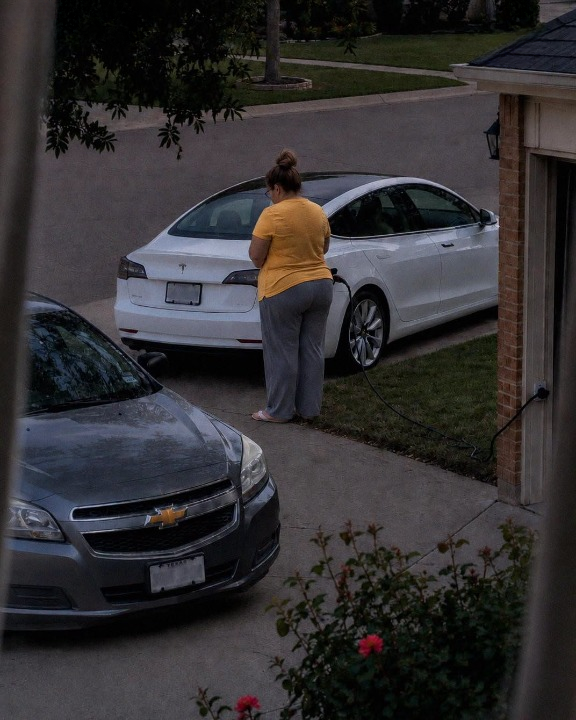
My next-door neighbor, Monica, was standing beside her electric car.
Her car was parked unusually close to the edge of my driveway.
A long charging cable ran from the vehicle, across the grass, and directly to the outdoor electrical outlet beside my garage.
My outlet.
For several seconds, I honestly thought I had misunderstood what I was looking at.
Then I put on my slippers and walked outside.
“Monica?”
She turned around.
She didn’t look embarrassed.
She didn’t look surprised.
She simply looked annoyed that I had caught her.
“What are you doing?”
She glanced at the cable.
“Charging my car.”
I stared at her.
“From my house.”
She shrugged.
“Yes.”
I actually laughed because the situation was so ridiculous.
“You’re using my electricity.”
“Oh, come on.”
“No, seriously. How long have you been doing this?”
She crossed her arms.
“A little while.”
“A little while?”
She sighed as though I were inconveniencing her.
“My charger at home has been acting up.”
“Then get it repaired.”
“I will.”
“Until then, you can’t plug your car into my house.”
Monica rolled her eyes.
“You live alone, Diane.”
I stared at her.
“What does that have to do with anything?”
“You barely use electricity compared with a family.”
That sentence stunned me.
Monica had three children.
She lived in a newer house than mine.
Her front yard was professionally landscaped.
She drove a nearly new electric car.
This wasn’t a situation where someone was struggling and desperately needed help.
She simply believed that because I lived alone, my property was somehow available for her convenience.
“My electricity bill nearly doubled,” I said.
She laughed.
“From this? I doubt it.”
“The power company said my overnight usage increased.”
“So?”
“So you’ve been making me pay to charge your car.”
She waved her hand.
“It’s probably not even that much.”
“It doesn’t matter whether it’s five dollars or fifty. You didn’t ask.”
“Oh, please. You’re acting like I emptied your bank account.”
I could feel myself getting angry.
But this wasn’t even the first time Monica had crossed a boundary.
A year earlier, I noticed my lawn mower missing.
I eventually found it in her garage.
When I asked about it, she said she’d “borrowed” it.
Without asking.
Another time, a little ceramic garden gnome disappeared from beside my roses.
Two weeks later, I spotted it underneath a tree in Monica’s yard.
When I confronted her, she laughed and said, “It looked better over there.”
I should have realized then that Monica didn’t really understand the word “mine.”
Still, I had always tried to keep the peace.
Neighbors can make life pleasant or miserable, and I preferred pleasant.
But standing outside after midnight while Monica casually used my electricity changed something.
I pointed toward the cable.
“Unplug it.”
She sighed.
“Diane.”
“Now.”
She unplugged the car.
Then she muttered, “You’re unbelievably stingy.”
I looked at her.
“I’m stingy because I don’t want to pay your bills?”
“You’re retired. What do you even spend money on?”
I couldn’t believe she had actually said it.
“That is none of your business.”
She picked up the cable.
“I have three kids. I’m constantly driving somewhere.”
“And that gives you permission to take electricity from me?”
“You’re making this way bigger than it is.”
She walked away.
As she went, she called over her shoulder, “Honestly, I think you just like having something to complain about.”
I stood there for several seconds.
Then I smiled.
Not because anything was funny.
Because I had finally understood something.
Arguing with Monica wasn’t going to work.
She didn’t think she had done anything wrong.
Calling the police crossed my mind, but I really didn’t want the situation to become a neighborhood war if there was another solution.
So the next morning, I made a few phone calls.
First, I called an electrician.
I explained what had happened.
He came over that afternoon and installed a locking weatherproof cover over the outdoor outlet.
He also added a small energy-monitoring device so I could see exactly how much power that specific outlet had used recently.
Then I printed my last two electric bills.
The difference was obvious.
Finally, I called our neighborhood association.
Not to make a formal complaint.
Not yet.
I simply asked what the rules were regarding unauthorized use of another homeowner’s utilities.
The woman I spoke to was very interested.
Apparently, Monica had already received complaints from two other neighbors about borrowing things without permission.
That was when I came up with my idea.
I wasn’t going to damage her car.
I wasn’t going to create a dangerous trap.
I wasn’t even going to argue with her.
I was simply going to make her explain herself publicly.
The neighborhood association was holding its monthly community meeting the following evening in the small clubhouse at the end of our street.
Monica attended almost every meeting because she loved volunteering for committees.
So I attended too.
But before that meeting happened, Monica apparently didn’t realize I had locked the outlet.
That evening, shortly after eleven, I heard movement outside again.
I looked through the window.
There she was.
Monica.
Car parked beside my driveway.
Charging cable in hand.
She walked toward the outlet.
Then stopped.
She stared at the new lock.
I watched her pull on the cover.
Nothing.
She tried again.
Then she spotted the small notice the electrician had placed beside it:
PRIVATE ELECTRICAL OUTLET — AUTHORIZED USE ONLY.
Monica marched toward my front door.
She rang the bell repeatedly.
I answered through my doorbell speaker.
“What is it?”
“You locked the outlet!”
“Yes.”
“I need to charge my car!”
“Then use your own charger.”
“You know mine isn’t working.”
“Then use a public charging station.”
“Do you know how inconvenient that is?”
I almost laughed.
“More inconvenient than paying for someone else’s electricity?”
She looked directly into the camera.
“You are unbelievable.”
“No, Monica. What’s unbelievable is coming back after I specifically told you not to.”
Her voice rose.
“What am I supposed to do tonight?”
“That sounds like something you should have considered before assuming my house was your personal charging station.”
Several porch lights came on nearby.
Neighbors were beginning to notice the argument.
Monica saw them too.
Instead of lowering her voice, she became louder.
“She locked me out of the outlet!”
A man across the street stepped onto his porch.
“Your outlet?”
Monica stopped.
He frowned.
“Or Diane’s?”
Another neighbor came outside.
Then another.
Within a few minutes, several people were watching.
Monica suddenly realized how strange her complaint sounded.
“She wasn’t even using it,” she said.
I opened my front door.
“That doesn’t make it yours.”
One neighbor laughed.
Monica’s face turned red.
“This is ridiculous.”
I stayed calm.
“No. This is simple. You were charging your vehicle from my house without permission, and you continued after I told you to stop.”
She pointed at me.
“You’re making me look like some kind of thief.”
“I didn’t call you anything.”
That silenced her.
The next evening, I attended the neighborhood meeting.
Monica was there.
She avoided looking at me.
During the section for homeowner concerns, I raised my hand.
“I’d like to ask a question about unauthorized utility use.”
Monica immediately looked up.
I didn’t mention her name.
I didn’t need to.
I explained that someone had repeatedly used an outdoor outlet on my property without permission.
Then I showed the electricity records.
The association president explained that no resident was allowed to use another homeowner’s utilities, equipment, or property without clear consent.
Then something unexpected happened.
The man who lived two houses down raised his hand.
“Since we’re talking about boundaries, can we discuss people taking garden equipment without asking?”
Monica sank lower in her chair.
Another woman spoke.
“And moving decorations from other yards?”
I almost felt sorry for her.
Almost.
It turned out I wasn’t the only person who had been trying to “keep the peace.”
Monica had borrowed extension cords, gardening tools, patio chairs, and even a pressure washer from different neighbors without asking properly.
Most people had avoided confronting her because each incident seemed too small to start an argument over.
Together, however, they showed a pattern.
The association president spoke firmly.
“We shouldn’t need a neighborhood rule reminding adults that another person’s property requires permission.”
Nobody said anything.
Then Monica stood.
“I get it.”
Her face was bright red.
“I made some assumptions.”
The president nodded.
“Then perhaps this is a good time to correct them.”
The following morning, I found an envelope in my mailbox.
Inside was a handwritten note from Monica.
Diane,
I’m sorry.
I honestly told myself the electricity wasn’t costing you enough to matter. That wasn’t my decision to make.
I’m also sorry for coming back after you told me to stop.
Please let me know what I owe you.
— Monica
I stared at the note.
It wasn’t the warmest apology I’d ever received.
But it was an apology.
I calculated a reasonable estimate based on the extra usage and gave her the amount.
She paid it.
She also had her own home charger repaired two days later.
For the next month, we barely spoke.
Then one afternoon, Monica knocked on my door.
This time, she was holding my old garden gnome.
“I think this belongs here.”
I looked at it.
“You think?”
She smiled awkwardly.
“Definitely.”
I took it.
“Thank you.”
She started to leave.
Then she turned.
“For what it’s worth, I really am sorry.”
I nodded.
“I appreciate that.”
We’re not close friends now.
I doubt we ever will be.
But we wave.
She asks before borrowing anything.
More importantly, she accepts no as an answer.
And my electricity bill returned to normal.
Some friends later told me I should have called the authorities immediately.
Maybe I would have been justified.
But I’m glad I handled it differently.
Monica didn’t need revenge.
She needed a boundary she couldn’t ignore.
Locking the outlet stopped the behavior.
The neighborhood meeting made her understand why it was wrong.
And the whole experience reminded me of something I should have learned years earlier.
Keeping the peace doesn’t mean allowing people to take advantage of you.
Sometimes being a good neighbor means sharing.
Sometimes it means helping.
And sometimes it simply means being willing to say:
“No. That belongs to me.”