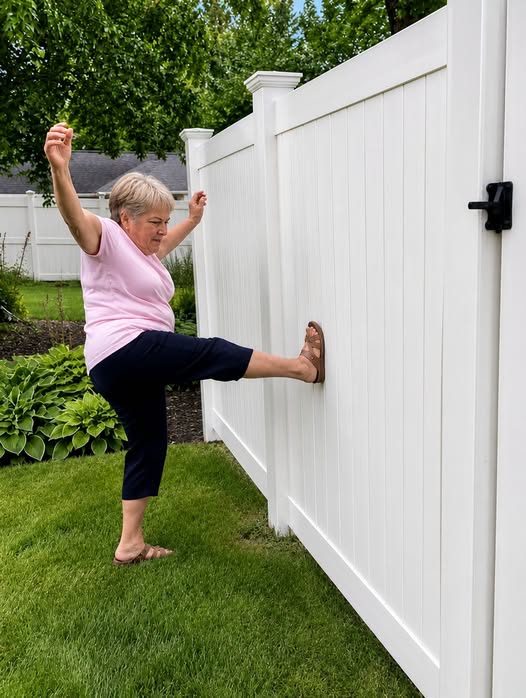
My Neighbor Reported My Fence for Being Two Inches Too High—Then the Inspection Took an Unexpected Turn
For nearly five years, I had lived in the same house without having a serious problem with any of my neighbors.
Our street wasn’t perfect, but it was peaceful.
People waved when they passed each other.
Neighbors occasionally borrowed tools.
Children played outside in the afternoons.
During the warmer months, people sat on their porches and talked until sunset.
It was the kind of neighborhood where everyone generally kept to themselves while still looking out for one another.
Then a new neighbor moved in.
Her name was Linda.
At first, I welcomed her like I had welcomed everyone else.
I helped carry a couple of boxes from her car to the front door, pointed out where the recycling containers were kept, and mentioned the nearby grocery store.
She seemed friendly enough.
But within a few days, I began noticing something unusual.
Linda had an opinion about almost everything.
And, somehow, most of those opinions involved things I was doing wrong.
The First Complaint
The first issue was my trash cans.
They were stored beside my garage, partially visible from the street.
One afternoon, Linda walked over while I was bringing them back from the curb.
“I think those should be somewhere less visible,” she said.
I looked at the cans.
Then I looked at her.
“They’ve always been there.”
She shrugged.
“They make the front of the house look cluttered.”
I smiled politely.
“I’ll keep that in mind.”
I didn’t move them.
A few days later, she complained about my wind chimes.
According to her, they made too much noise whenever the breeze picked up.
I explained that I had owned them for years and that they weren’t particularly loud.
She didn’t seem satisfied.
Then came the issue with my front garden.
Apparently, the plants were growing too close to the walkway.
I trimmed them anyway, mostly because I didn’t want them becoming a nuisance.
I assumed these small disagreements would eventually disappear.
They didn’t.
The Fence
One Saturday morning, I was outside cleaning the patio when Linda walked over.
She stood near the property line and stared at my backyard fence.
After a few seconds, she said:
“Is that fence supposed to be that tall?”
I looked at it.
“Yes.”
She tilted her head.
“I don’t think it’s within the allowed height.”
“It was already here when I bought the house.”
She crossed her arms.
“That doesn’t necessarily mean it’s legal.”
I could tell where the conversation was going.
“I’ve never had an issue with it,” I said.
“That doesn’t mean there isn’t one.”
I tried to keep the conversation friendly.
“If you think there’s a problem, you can check with the city.”
She gave me a strange look.
Then she said:
“Maybe I will.”
She walked away.
I shrugged and went back to cleaning.
At the time, I didn’t think much of it.
That was a mistake.
The Orange Notice
A week later, I came home from work and noticed something bright orange attached near my mailbox.
I stopped walking.
It was an official notice from the city.
Someone had filed a complaint concerning the height of my backyard fence.
According to the complaint, the fence allegedly exceeded the permitted height by approximately two inches.
I read the notice twice.
Two inches.
That’s what had apparently become important enough for someone to involve the city.
I already knew who had filed the complaint.
I didn’t need a signature.
As I looked across the street, I saw Linda standing in her driveway.
She was holding a coffee cup.
When she noticed me looking at the notice, she smiled.
Then she called across the street.
“Rules are rules.”
I didn’t answer.
She continued.
“Maybe next time you’ll think twice before ignoring them.”
I folded the notice and walked inside.
I wasn’t angry.
At least, I tried not to be.
I simply wanted to know whether the fence actually violated any regulations.
If it did, I’d fix it.
If it didn’t, I’d move on.
Either way, the inspection would settle the matter.
Waiting for Thursday
The inspection was scheduled for Thursday morning.
For several days, I thought about it more than I wanted to.
Not because I was worried about the fence.
I was worried about what this meant for the relationship with my new neighbor.
I had no interest in living next door to someone who treated every small disagreement like a formal dispute.
But I wasn’t going to start a neighborhood argument over two inches.
On Wednesday evening, I checked the fence again.
It looked exactly as it had looked for years.
I measured a section myself.
Then another.
The numbers weren’t particularly helpful because I wasn’t sure which regulations applied to that specific portion of the property.
So I decided to let the inspector determine it.
That was what inspections were for.
Linda Takes the Morning Off
Thursday arrived.
Around nine in the morning, I heard a vehicle stop outside.
I looked through the window.
A city inspection vehicle had arrived.
The inspector stepped out carrying a measuring device and a notebook.
Before he even reached my gate, Linda appeared outside.
She had apparently taken the morning off work.
She stood in her driveway with her arms crossed and watched him approach.
She looked delighted.
I stepped outside.
“Good morning.”
The inspector introduced himself and explained that he was there to inspect the fence following a complaint.
I nodded.
“No problem.”
Linda immediately approached.
“I’m the person who reported it.”
The inspector acknowledged her but didn’t engage in the confrontation she seemed to expect.
He simply asked to see the property line and the fence.
I showed him around.
Linda followed.
The Measurements
The inspector began measuring.
He checked several sections rather than relying on a single point.
He looked at where the fence met the ground.
He checked the height along different portions.
He examined the gate.
He made notes.
Linda watched every movement.
After several minutes, she finally asked:
“Well?”
The inspector didn’t answer.
He continued working.
A few minutes later, she asked again.
“Is it over the limit?”
He remained focused on the measurements.
I said nothing.
Eventually, he took another measurement.
Then he stepped back.
He looked at his notes.
He checked one of the measurements again.
Finally, he closed his notebook.
Linda straightened.
She looked almost certain that she had won.
The inspector turned toward me.
“Everything appears to be compliant.”
Linda’s expression changed instantly.
“I’m sorry?”
He repeated himself.
“I don’t see a fence-height violation here.”
She stared at him.
“But it’s too high.”
He shook his head.
“Based on the applicable measurement and the location of the fence, it isn’t.”
Linda looked at me.
Then back at the inspector.
“But I measured it.”
The inspector calmly explained that residential fence regulations could depend on several factors, including where the fence was located and how height was measured.
A measurement taken from one point wasn’t necessarily enough to establish a violation.
Linda seemed unable to process what she was hearing.
“But I specifically reported that it was two inches over.”
The inspector nodded.
“I understand.”
Then he looked at his notes again.
“There is no violation based on what I’ve inspected.”
The Smile Disappears
The satisfaction Linda had been displaying all morning disappeared.
She stood quietly.
I expected her to argue.
Instead, she simply looked embarrassed.
The inspector began putting his equipment away.
Then he paused.
He looked toward Linda’s property.
“Since I’m already here, would you mind if I take a quick look at the rear property line?”
Linda’s face changed.
“Why?”
He pointed toward the area behind her house.
“There’s something I need to verify.”
She hesitated.
I didn’t know what he had noticed.
Neither did she.
The inspector walked toward the side of her property.
Linda followed.
I stayed several steps behind.
The atmosphere had changed completely.
A few minutes earlier, Linda had been standing outside waiting for my fence to be declared a violation.
Now she was following an inspector toward her own backyard.
The Forgotten Structure
At the back corner of Linda’s property was an old wooden structure.
I had noticed it before but had never paid much attention to it.
It looked like a small storage shed.
There was also a covered extension attached to one side.
From the street, it was mostly hidden behind landscaping.
The inspector stopped.
He examined the structure carefully.
Then he opened his notebook.
Linda became visibly uncomfortable.
“What is it?” she asked.
The inspector pointed toward the structure.
“Was this added after you purchased the property?”
Linda hesitated.
“I don’t know.”
He looked at her.
“You don’t know?”
She shook her head.
“My husband handled that stuff.”
The inspector asked whether there were permits associated with the structure.
Linda became silent.
The inspector explained that he couldn’t make a final determination on the spot without checking the city’s records, but the structure appeared to require verification.
That was when Linda’s attitude completely changed.
She was no longer angry.
She looked worried.
The Question
The inspector pointed toward the covered portion of the structure.
“Do you know when this was built?”
Linda didn’t answer.
He asked again.
“Approximately?”
She looked at the ground.
“I think… a few years ago.”
“Was it there when you purchased the house?”
“No.”
The inspector made another note.
Then he asked the question that changed everything.
“Do you have documentation showing it was approved?”
Linda’s eyes filled with tears.
She shook her head.
“No.”
I stood there quietly.
Suddenly, I understood why she had looked so nervous.
She hadn’t expected the inspection to turn toward her property.
She had been focused entirely on my fence.
But by bringing the city’s attention to the boundary between our properties, she had unintentionally created an opportunity for an inspector to notice something that might not have been properly documented.
What the Inspector Actually Found
The inspector didn’t accuse Linda of wrongdoing.
He didn’t threaten her.
He didn’t make dramatic claims.
Instead, he explained that the structure would need to be checked against the city’s records.
If it had been properly permitted, there might be nothing to worry about.
If it hadn’t, there could be additional steps required.
That distinction was important.
An inspection wasn’t a courtroom.
The inspector wasn’t there to punish anyone.
His job was to determine whether the property complied with applicable requirements.
Linda seemed to understand that.
She wiped her eyes.
“I didn’t know.”
The inspector nodded.
“That happens. We’ll need to verify the records before determining what, if anything, needs to be done.”
I expected to feel satisfied.
Instead, I mostly felt uncomfortable.
Watching Linda become upset wasn’t the victory I had imagined.
There hadn’t been a victory.
There had simply been an inspection.
The Driveway Conversation
After the inspector left, Linda remained standing near the property line.
For several seconds, neither of us spoke.
Finally, she said:
“I didn’t think they’d look at my property.”
I didn’t know what to say.
“You were the one who called them.”
She looked down.
“I know.”
She took a breath.
“I thought your fence was violating the rules.”
“I understand.”
She looked toward my fence.
“I really thought it was too high.”
“I wasn’t trying to ignore any rules.”
“I know that now.”
There was a long silence.
Then she said something I hadn’t expected.
“I’m sorry.”
It wasn’t dramatic.
There was no speech.
No argument.
Just a quiet apology.
I accepted it.
“It’s okay.”
She shook her head.
“No. It wasn’t.”
I didn’t disagree.
What Happened Next
The city later reviewed the records concerning the structure behind Linda’s house.
As the inspector had explained, the initial observation did not automatically mean that the structure was illegal.
There was a process for determining what documentation existed and whether anything needed to be corrected.
Linda eventually learned that part of the structure had been modified by a previous owner, and some records needed clarification.
She had options for resolving the situation.
It wasn’t the disaster she had feared.
But it did require paperwork and a little work.
Ironically, the thing she had been most worried about turned out to be far less serious than she had imagined.
And the fence she had complained about turned out to be completely compliant.
The Strange Lesson
The entire experience taught me something I hadn’t expected.
Rules aren’t supposed to be weapons.
They’re supposed to provide clarity.
If a fence is too tall, measure it.
If a structure requires a permit, check the records.
If something needs to be corrected, correct it.
That’s what regulations are for.
The problem begins when people use rules primarily as a way to control or embarrass other people.
Linda had become so focused on proving that my fence was wrong that she hadn’t considered the possibility that she could be mistaken.
And I had been tempted to respond emotionally.
I could have confronted her.
I could have argued.
I could have complained about her property.
Instead, I decided to let the inspection answer the question.
That turned out to be the better choice.
Our Relationship Changed
Things were awkward between us for a while.
I wouldn’t pretend otherwise.
Every time I saw Linda, there was a moment of hesitation.
But eventually, the tension began to fade.
One afternoon, she came over and apologized again.
This time, she explained that she had recently gone through several difficult changes in her life and had become overly focused on making everything around her feel controlled.
She said she had been stressed about the move.
She had wanted the new house to feel perfect.
And when something didn’t match her expectations, she treated it as a problem that needed to be fixed.
That didn’t excuse how she had behaved.
But it helped me understand it.
I told her that I could have handled some things differently too.
We shook hands.
It wasn’t an instant friendship.
But it was a beginning.
The Fence Stayed
The most amusing part was that my fence never changed.
The same fence that had supposedly been two inches too high remained exactly where it had been.
The same panels.
The same posts.
The same gate.
Nothing about it had changed.
What changed was our understanding of it.
Sometimes a disagreement feels enormous because we don’t yet have the facts.
Once the facts become clear, the conflict suddenly looks much smaller.
A Reminder About Neighborhood Disputes
Living close to other people inevitably creates disagreements.
Someone’s tree may drop leaves into another person’s yard.
A dog may bark.
A driveway may be shared.
A fence may sit close to a property line.
A renovation may create concerns.
Not every disagreement requires an official complaint.
And not every complaint means someone has done something wrong.
Before escalating a neighborhood issue, it can be useful to ask a few simple questions:
Is there actually a problem?
Do I know the relevant rule?
Have I spoken respectfully with the person involved?
Could there be an innocent explanation?
Is an official complaint necessary?
Those questions don’t eliminate every conflict.
But they can prevent small misunderstandings from becoming major disputes.
Sometimes the Best Response Is Patience
I could have spent the days before the inspection worrying about Linda.
Instead, I reminded myself that the facts would eventually become clear.
If the fence was too high, I’d deal with it.
If it wasn’t, I’d move on.
That mindset made the entire situation easier.
I didn’t need to prove anything to my neighbor.
I didn’t need to win.
I simply needed to know the truth.
The inspector provided that answer.
And in doing so, he also reminded both of us that regulations are best handled through facts rather than assumptions.
What I Took Away From the Experience
The biggest lesson wasn’t that Linda had been wrong.
It wasn’t even that my fence had been compliant.
The bigger lesson was about how quickly ordinary disagreements can become personal.
A complaint about two inches of fence height had created days of tension.
Two neighbors who had barely met were suddenly suspicious of each other.
One person believed the other was ignoring the rules.
The other felt unfairly targeted.
And none of that was necessary.
The actual issue was settled in a few minutes.
That made me wonder how many neighborhood arguments could be avoided if people simply slowed down before assuming the worst.
The Next Saturday
About a week later, I was outside working in the yard when Linda walked over.
She was holding two cups of coffee.
She handed one to me.
“I come bearing peace offerings,” she said.
I laughed.
“Should I be worried?”
She smiled.
“No more complaints.”
We stood near the fence for a few minutes.
She asked about my garden.
I asked how the paperwork regarding her backyard structure was going.
She said she was working through it.
Then she looked at the fence.
“You know, I actually like it.”
I smiled.
“You’re allowed to.”
She laughed.
For the first time since she moved in, the conversation felt normal.
Not perfect.
Not dramatic.
Just normal.
And sometimes normal is exactly what you want from a neighbor.
The Fence Was Never Really the Problem
Looking back, the fence was almost beside the point.
Two inches had become the center of an argument that was really about something else.
Control.
Stress.
Assumptions.
And the difficulty of adapting to unfamiliar people living nearby.
The inspection didn’t produce the dramatic punishment Linda had expected.
Instead, it produced something much more useful.
Clarity.
My fence was compliant.
Her property needed a separate review.
And both of us walked away with a better understanding of where we stood.
The experience reminded me that sometimes the most satisfying ending isn’t watching someone else face consequences.
It’s discovering the truth, handling the situation calmly, and leaving enough room for people to do better afterward.
The fence remained standing.
The neighborhood remained peaceful.
And eventually, so did our relationship.
Just with a little more understanding on both sides.