For nearly thirty years, I had called the same house home.
At sixty-eight, I had grown deeply attached to the quiet routines that came with it. The house held decades of memories, especially those I had shared with my late husband. After his passing, maintaining the home and caring for the garden gave me something meaningful to focus on each day.
I knew every corner of the property. I knew which flowers needed more sunlight, which plants required extra water, and which areas of the lawn became muddy after heavy rain. The garden wasn’t simply part of my home. It was something I had spent years creating and caring for.
Then a new neighbor moved in.
Her name was Audrey.
She was in her early thirties and, when she first arrived, seemed friendly enough. We exchanged greetings, spoke occasionally over the fence, and I had no reason to think we would have any problems.
For a while, everything was fine.
Then the weekend gatherings began.
At first, I didn’t mind. People have friends, families visit, and occasionally there is going to be some extra noise in a neighborhood. I tried to be understanding.
But Audrey’s gatherings gradually became a regular weekend occurrence.
Music could continue late into the evening. Conversations carried across the yards. Cars came and went, sometimes well after I had gone to bed.
The first few times, I simply tolerated it.
When it became difficult to sleep, I politely mentioned it to Audrey.
She apologized and promised to keep the noise down.
I appreciated that response and assumed the situation would improve.
It didn’t.
The parties continued.
And then another problem began.
Her guests started using my property for parking.
At first, it was only one vehicle.
Audrey’s driveway would fill up, and someone would pull partly onto the edge of my lawn. I noticed it the next morning and decided not to make an issue of it immediately.
But then it happened again.
And again.
Before long, whenever Audrey hosted a gathering, I began wondering whether I would wake up to find another vehicle sitting on my grass.
My driveway was occasionally blocked. Guests would park along the edge of my property, and some vehicles were left there overnight.
The effect on my lawn was becoming increasingly noticeable.
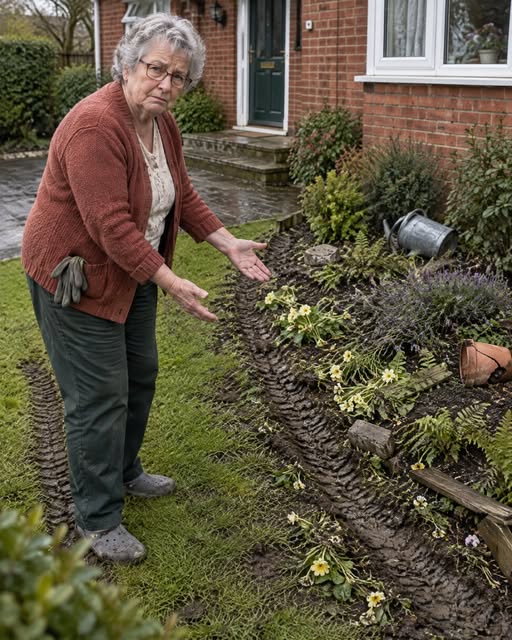
Tire marks appeared in areas I had carefully maintained. A few flower beds were damaged when vehicles drove too close to them. After one particularly busy weekend, several plants near the driveway were crushed.
That was when I decided I needed to speak with Audrey again.
I wasn’t looking for an argument. I simply wanted her guests to respect the property boundary.
One Sunday morning, I walked outside and found muddy tracks across part of my lawn. Several flowers had been flattened, and a vehicle was positioned in a way that blocked a significant portion of my driveway.
I stood there for a moment, trying to remain calm.
Then I walked next door.
Audrey answered the door a few moments later.
“Audrey,” I said politely, “could you please make sure your guests don’t park on my property? It’s starting to damage the lawn and make it difficult for me to use my driveway.”
She looked toward the driveway and then back at me.
“I’m sorry,” she said. “I’ll make sure it doesn’t happen again.”
Her response seemed reasonable, so I accepted it.
I went home hoping that would be the end of the matter.
The following weekend, however, several cars appeared on my lawn again.
Three vehicles were parked along the edge of my property.
I couldn’t believe it.
I waited until the gathering had settled down and then spoke to Audrey again.
“I thought we had discussed this,” I said.
Audrey seemed more annoyed this time.
“They’re only here for a little while,” she replied. “It’s not a big deal.”
“It is a big deal to me,” I said. “I’ve already asked you not to let people park here. They’re damaging the lawn, and sometimes they block my driveway.”
She sighed.
“I’ll talk to them.”
I hoped that would finally resolve things.
Instead, the situation continued.
The following weekend brought more guests and more vehicles.
I began feeling as though my repeated requests simply weren’t being taken seriously.
For years, I had tried to be a considerate neighbor. I didn’t want unnecessary arguments or tension. I believed most disagreements could be resolved through a calm conversation.
But there comes a point when being patient can be mistaken for being willing to accept anything.
One evening, after another gathering had filled the street with cars, I approached Audrey once more.
“I really need you to respect my property,” I told her. “I’ve asked several times now.”
Instead of apologizing, Audrey laughed lightly.
Then she looked at me and said, “What are you going to do, grandma?”
The words caught me completely off guard.
It wasn’t simply the fact that she had ignored my request. It was the way she said it, as though my age made my concerns less important.
I stood there quietly.
For a moment, I didn’t know what to say.
I had never considered my age a reason to be treated differently. I had lived in that house for decades, paid for its upkeep, cared for the property, and done my best to be respectful of the people around me.
Yet Audrey seemed to believe that because I was older, I would simply tolerate whatever happened.
I returned home without saying anything else.
That night, I thought about the situation for a long time.
I thought about my husband and the years we had spent making the house into a home. I thought about the garden I had cared for season after season. I thought about all the times I had chosen patience because I didn’t want a disagreement with a neighbor.
Most importantly, I realized that being polite did not mean I had to ignore repeated problems.
There was a difference between being a good neighbor and allowing someone to disregard reasonable boundaries.
The next morning, I decided I would handle the situation differently.
I wasn’t interested in revenge.
I wasn’t going to create a scene.
I simply intended to make my expectations clear and take reasonable steps to protect my property.
I began documenting the damage to the lawn and the occasions when vehicles had been parked where they shouldn’t have been. I also reviewed the property boundaries and checked the rules that applied to parking and access in my neighborhood.
For the first time, I felt less frustrated and more confident.
I realized I didn’t have to respond emotionally to Audrey’s comment.
I could respond calmly.
And I could let the situation be addressed through clear boundaries rather than arguments.
A few days later, another weekend approached.
I watched as guests began arriving at Audrey’s house.
One car pulled into her driveway.
Then another.
Soon, the available spaces around her property were occupied.
I waited.
I wondered whether another vehicle would end up on my lawn.
Eventually, one of the guests started to pull toward my property.
This time, I stepped outside.
I calmly explained that the area was private property and asked the driver to use another parking space.
The driver apologized and moved the vehicle.
It was a small moment, but it felt different.
For months, I had felt as though I had no control over what happened around my home.
Now I understood that I could set reasonable boundaries without becoming confrontational.
Later that evening, Audrey came outside.
She looked toward my driveway and then at me.
“I guess you’re serious about the parking,” she said.
“I am,” I replied calmly. “I’m happy to be your neighbor, Audrey. I just need my property to be respected.”
There was a pause.
For once, she didn’t laugh.
She looked across the lawn and noticed the damaged flower bed near the driveway.
“I didn’t realize it had gotten that bad,” she said.
“I tried to tell you,” I answered.
She nodded.
The conversation wasn’t dramatic. There was no shouting or angry confrontation.
But something changed after that.
Audrey began asking her guests to park elsewhere. When her driveway filled up, she directed visitors toward legal street parking instead of allowing them to use my lawn.
The late-night gatherings didn’t disappear completely, but the situation became much more manageable.
A few weeks later, Audrey stopped by.
She apologized for the way she had spoken to me that evening.
“I shouldn’t have said that,” she admitted.
I appreciated the apology.
I told her that I didn’t expect us to agree on everything. I simply wanted us to respect each other’s homes and boundaries.
She agreed.
Over time, our relationship became more civil.
We weren’t suddenly close friends, and I didn’t expect that.
Sometimes being good neighbors doesn’t mean spending time together or sharing the same lifestyle.
Sometimes it simply means understanding where one person’s property ends and another person’s begins.
Looking back, I realize the most important lesson wasn’t about parking at all.
It was about boundaries.
For years, I had worried that speaking up would make me seem difficult. I had convinced myself that keeping the peace meant tolerating things that bothered me.
But peace and silence aren’t always the same thing.
Sometimes a calm conversation is necessary precisely because you want to preserve a peaceful relationship.
I also learned that age doesn’t determine whether someone’s concerns deserve to be heard.
Being sixty-eight didn’t make me less capable of standing up for my home.
And I didn’t need to prove anything through anger or confrontation.
I simply needed to speak clearly, remain respectful, and follow through on reasonable boundaries.
My lawn eventually recovered.
I replanted the flowers that had been damaged, repaired the areas where the tires had left marks, and returned to my usual garden routine.
The yard looked like itself again.
And every time I walked through it, I was reminded of something my husband used to say whenever we faced a difficult situation:
“Being kind doesn’t mean you have to give up your boundaries.”
I hadn’t fully understood that when he was alive.
Now I did.
Sometimes the strongest response isn’t an argument.
Sometimes it’s simply deciding that you deserve to be treated with the same consideration you give to everyone else.