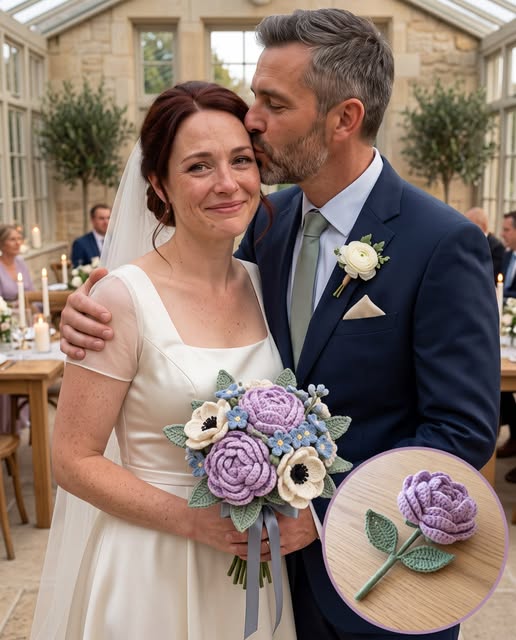
I Used My Daughter’s Crocheted Flowers as My Wedding Bouquet — Then My Fiancé Found a Hidden Note
For almost ten years, I had kept a small collection of crocheted flowers in a box at the back of my closet.
They weren’t expensive.
They weren’t perfectly made.
Some were slightly uneven. A few had loose threads. One had a petal that was noticeably larger than the others.
But to me, they were priceless.
My daughter, Amelia, had made every one of them.
She had been only thirteen when she passed away, but the little flowers she left behind had become some of the most important things I owned.
So when I decided to get married again, I knew exactly what I wanted my bouquet to look like.
I didn’t want roses delivered from a florist.
I didn’t want an elaborate arrangement.
I wanted Amelia’s flowers.
I wanted to carry something she had made with her own hands as I walked toward a new chapter of my life.
I never expected that one of those flowers would contain a secret.
And I certainly never expected my fiancé to be the person who discovered it.
Before Everything Changed
There was a time when I believed my life would follow a simple path.
I was married to my husband, Harold.
We had a beautiful daughter.
We had a home filled with ordinary family noise—the sound of footsteps upstairs, dishes being put away, music playing from someone’s bedroom, and conversations that seemed insignificant at the time but became precious memories later.
Harold was a devoted husband and a loving father.
He was the kind of dad who could turn an ordinary Saturday into an adventure.
He took Amelia to the park.
He helped her with school projects.
He taught her how to ride a bicycle.
He made up silly stories before bedtime.
And Amelia adored him.
Then, one day, everything changed.
Harold was killed in a car accident.
There was no warning.
No opportunity to prepare.
One moment, he was part of our everyday life.
The next, our family had to learn how to exist without him.
I don’t remember much about the days immediately afterward.
I remember people coming to the house.
I remember phone calls.
I remember food being left on the kitchen counter because friends and relatives didn’t know what else to do.
I remember Amelia sitting quietly.
And I remember realizing that I had to somehow become both parents for her.
I had lost my husband.
She had lost her father.
Neither of us knew how to move forward.
Amelia Found Crochet
A few months after Harold’s death, Amelia discovered crochet.
At first, I thought it was simply another hobby.
She watched tutorials.
She borrowed books.
She practiced different stitches.
She made mistakes.
She unraveled things and started again.
Sometimes she became frustrated because something wouldn’t look the way she wanted.
But she kept going.
Eventually, she became surprisingly good at it.
Her bedroom slowly filled with little handmade creations.
There were teddy bears.
Tiny bunnies.
Small animals.
Flowers.
Little decorative figures.
Some were colorful.
Some were simple.
Some looked slightly unusual because she had invented her own designs.
I loved seeing them.
They gave her something to concentrate on.
And perhaps more importantly, they gave her a way to create something beautiful during a period when so much of her world had become painful.
The Little Table Outside Our House
One summer, Amelia decided she wanted to sell some of her creations.
She carried a small table outside and arranged her crocheted animals and flowers on top.
I watched from the doorway.
“Do you really think people will buy those?”
She looked offended.
“Of course.”
I laughed.
“Okay. I believe you.”
She spent the afternoon talking to neighbors.
Some people bought little toys.
Others simply stopped to admire them.
Amelia was thrilled.
At the end of the day, she came running through the front door.
“Mom!”
“What happened?”
“I made money!”
She held up a few bills with enormous pride.
“What are you going to do with it?”
She thought for a second.
“Ice cream.”
I laughed.
“That’s your big plan?”
“Maybe.”
She paused.
“Actually, now I can buy all the sweets in the world.”
I hugged her.
“That’s a lot of sweets.”
She smiled.
“I’ll share.”
Those moments became some of my favorite memories.
Then Amelia Became Sick
Not long afterward, Amelia started feeling unwell.
At first, we thought it was something ordinary.
Fatigue.
Headaches.
Other symptoms that could have had many explanations.
But eventually, we found ourselves in doctors’ offices and hospitals.
Tests followed.
Then more tests.
And eventually came the diagnosis every parent fears.
Amelia had cancer.
She was thirteen.
I remember looking at the doctor and feeling as though the room had suddenly become very small.
I wanted someone to tell me there had been a mistake.
I wanted to wake up.
I wanted to trade places with her.
Instead, I had to sit beside my daughter and listen to doctors explain what would happen next.
Treatment began.
Our lives became appointments, hospital rooms, medications, scans, waiting rooms, and difficult conversations.
But through all of it, Amelia remained Amelia.
She still made jokes.
She still asked about her crochet projects.
She still worried about school.
She still wanted ice cream.
And she still made flowers.
The Flowers
During one particularly difficult period, Amelia made a collection of small crocheted flowers.
They weren’t perfect.
She didn’t have much energy by then, so some of them were simpler than her earlier work.
But she made them anyway.
One afternoon, she handed me a handful.
“For you.”
I smiled.
“Thank you.”
“You have to keep them.”
“I will.”
“Promise?”
“I promise.”
I had no idea then how important that promise would become.
Eventually, despite every effort made by her doctors, family, and everyone who loved her, Amelia died.
She was only thirteen.
There are no words that adequately describe losing a child.
People say time heals.
I don’t know if that’s exactly what happens.
Time teaches you how to carry something that never completely leaves.
I learned how to go to work.
I learned how to answer questions.
I learned how to smile when people asked how I was doing.
But inside, I felt as though a part of me had stopped moving forward.
The Box
After Amelia died, I placed many of her belongings into boxes.
Some were donated.
Some were kept.
Some were too difficult to touch.
The crocheted flowers stayed with me.
I put them in a small box and stored them safely.
For years, I rarely opened it.
Sometimes I couldn’t.
The memories were too strong.
Nearly a decade passed.
I lived.
But for a long time, I wouldn’t have described myself as truly living.
I worked.
I came home.
I paid bills.
I spoke with friends.
I attended family gatherings.
But there was always an empty space inside me.
Then I met Aiden.
Meeting Aiden
It happened in an ordinary coffee shop.
I accidentally spilled my coffee on him.
It was embarrassing.
He looked at his shirt.
I immediately apologized.
He laughed.
“It’s okay.”
“I ruined your shirt.”
“It’s probably the most interesting thing that’s happened to me today.”
I laughed despite myself.
We started talking.
Then we talked again.
Eventually, coffee became dinner.
Dinner became weekends together.
And slowly, something changed.
For the first time in many years, I began looking forward to tomorrow.
Aiden never tried to replace Harold.
He understood that Harold would always be part of my history.
He also understood that Amelia would always be part of me.
That mattered more than I can explain.
He listened when I talked about her.
He never became uncomfortable when I mentioned her name.
He didn’t tell me I needed to “move on.”
Instead, he understood that moving forward didn’t mean leaving her behind.
The Proposal
About a year after we met, Aiden proposed.
It wasn’t extravagant.
There wasn’t a crowd of people watching.
It was quiet and personal.
I said yes.
We began planning our wedding.
I didn’t want a huge event.
I wanted something intimate.
Something meaningful.
Something that felt like us.
One evening, we started talking about flowers.
Aiden asked what kind of bouquet I wanted.
I immediately thought of Amelia.
“I have an idea.”
I went to the closet.
At the back was the box I hadn’t opened in years.
I brought it into the room and carefully lifted the lid.
Inside were Amelia’s crocheted flowers.
Aiden sat beside me.
“What are those?”
“My daughter made them.”
He knew what I meant immediately.
He had heard so many stories about Amelia.
He reached for one.
“This is beautiful.”
I smiled.
“She made it when she was thirteen.”
He looked at the flower carefully.
“Then this should be your bouquet.”
I nodded.
“That’s what I was thinking.”
Building the Bouquet
Over the next few days, I carefully arranged the flowers.
Some were pink.
Some were white.
Some were yellow.
A few were different shades of blue.
They didn’t match perfectly.
That was part of what made them beautiful.
They were handmade.
They were Amelia’s.
I arranged them into a bouquet and tied them together with a simple ribbon.
When I finished, I stood back and looked at it.
For the first time in years, I felt close to my daughter without feeling completely overwhelmed by grief.
I imagined walking down the aisle carrying something she had created.
It felt right.
The Strange Flower
Aiden was in the room with me when I was sorting through the remaining flowers.
He picked one up.
“This one is beautiful.”
I smiled.
“That was one of her favorites.”
He turned it over.
Then he frowned.
“What?”
He examined it more closely.
“There is something strange about this seam.”
I looked at the flower.
“Which seam?”
“Here.”
He pointed to a small section near the base.
The stitches looked different from the rest.
Almost as though someone had opened the flower and then carefully sewn it closed.
I hadn’t noticed it before.
“Maybe she repaired it.”
“Maybe.”
He turned the flower over again.
“Do you want me to check?”
I hesitated.
Then I nodded.
Aiden carefully loosened the stitches.
He didn’t want to damage the flower.
When the seam opened slightly, something appeared inside.
A small folded piece of paper.
We both froze.
“What is that?” I whispered.
“I don’t know.”
He gently pulled it out.
The paper was old.
Yellowed slightly around the edges.
He unfolded it.
Then he stopped.
His expression changed.
“What?”
He didn’t answer.
“Aiden?”
He looked at me.
“I think you need to read this.”
He handed me the paper.
My hands began to shake.
The Note
There were only a few lines written on it.
The handwriting was unmistakable.
It was Amelia’s.
I recognized it immediately.
I sat down.
For several seconds, I couldn’t read the words.
Then I finally did.
The note wasn’t a dramatic confession.
It wasn’t a secret that changed our family history.
It was something much more personal.
Amelia had written that she knew I was hurting.
She knew I was trying to be strong.
And she wanted me to remember that she didn’t want my life to stop because hers had become difficult.
She wrote that she loved me.
She wrote that she wanted me to laugh again.
She wrote that she hoped I would someday meet someone kind.
Someone who would understand that loving her would always be part of loving me.
And then came the sentence that broke my heart.
She wrote:
“Mom, please don’t be afraid to be happy.”
I covered my mouth.
Aiden sat beside me.
Neither of us spoke.
Why Had She Hidden It?
I looked at the flower.
“Why would she put it in here?”
Aiden shook his head.
“Maybe she wanted you to find it someday.”
“But why didn’t she give it to me?”
“I don’t know.”
That was the truth.
We couldn’t know exactly what Amelia had been thinking when she placed the note inside the flower.
Maybe she had wanted to tell me something but couldn’t find the words.
Maybe she had planned to give it to me later.
Maybe she simply wanted to hide a private message somewhere special.
There was no way to ask her.
And that was perhaps the hardest part.
But there was something else.
The note was dated.
It had been written during the final months of her illness.
I had completely missed it.
A Different Way of Understanding Her
For years, I had carried guilt.
I wondered whether I had done enough.
Whether I had been strong enough.
Whether Amelia had been frightened.
Whether she had understood how deeply I loved her.
I had spent years thinking about what I had lost.
But the note made me realize something.
Amelia had been thinking about me too.
Even while she was facing something no child should have to face, she had been worrying about her mother.
She didn’t want me to spend the rest of my life alone.
She didn’t want my memories of her to be only about hospitals and sadness.
She wanted me to remember her laughter.
Her crochet.
Her little table outside our house.
Her dreams of buying all the sweets in the world.
And she wanted me to keep living.
Aiden’s Role
I looked at Aiden.
“How am I supposed to get married after reading this?”
He took my hand.
“Maybe by understanding what she was trying to tell you.”
I started crying.
“I feel like I’m leaving her behind.”
He shook his head.
“You aren’t.”
He pointed toward the bouquet.
“You’re carrying her with you.”
That sentence stayed with me.
He was right.
I wasn’t replacing Amelia.
I wasn’t forgetting Harold.
I wasn’t erasing my past.
I was carrying everything that had shaped me into the person I was.
My first marriage.
My daughter.
My grief.
My memories.
And now, somehow, a new beginning.
The Wedding Day
On the morning of my wedding, I placed Amelia’s flowers carefully on the table.
I touched each one.
The little crocheted petals.
The uneven stitches.
The flower that had contained her note.
I tied the bouquet together.
Then I held it against my chest.
For a moment, I closed my eyes.
I imagined Amelia standing beside me.
Not sick.
Not in a hospital.
Just Amelia.
The girl who loved crochet.
The girl who sold little toys outside our house.
The girl who laughed when she talked about buying all the sweets in the world.
I smiled.
“I kept my promise,” I whispered.
Walking Down the Aisle
When the music began, I took a breath.
I looked down at the bouquet.
For years, I had been afraid that moving forward meant abandoning the people I had lost.
That day, I understood something different.
Moving forward doesn’t erase the past.
It carries it.
Every step toward Aiden was also a step taken with the memories of Harold and Amelia.
The bouquet wasn’t just decoration.
It was a reminder.
A reminder that love can survive difficult changes.
A reminder that grief and happiness can exist at the same time.
And a reminder that a person can miss someone deeply while still allowing themselves to experience something beautiful.
When I reached Aiden, he smiled.
His eyes were filled with tears.
He whispered:
“She’s with you.”
I nodded.
After the Ceremony
We kept the bouquet.
I didn’t throw it.
That tradition never felt right for me.
Instead, we placed it in a special display case after the wedding.
The little flowers remained exactly as Amelia had made them.
The note stayed with us too.
I eventually had it carefully preserved.
It became one of the most precious pieces of paper I owned.
Not because it contained some unbelievable secret.
But because it contained something I had needed to hear for years.
Permission.
Permission to laugh.
Permission to love.
Permission to build another chapter of my life.
Permission to be happy without feeling guilty.
What Amelia Left Behind
Amelia didn’t leave behind a fortune.
She didn’t leave behind a grand inheritance.
She left behind small things.
Crocheted flowers.
Little toys.
Photographs.
Memories.
A handwritten note.
And an enormous amount of love.
Sometimes we imagine that the most valuable things people leave behind are expensive possessions or important documents.
But that’s not always true.
Sometimes it’s a handmade object that took someone an afternoon to create.
Sometimes it’s a sentence written on an old piece of paper.
Sometimes it’s a photograph that nobody thought was important at the time.
Those things can become priceless because of the person connected to them.
The Meaning of the Bouquet
I originally thought I was using Amelia’s flowers because I wanted her with me on my wedding day.
And I still believe that was part of it.
But after finding the note, the bouquet meant something even more.
It became a symbol of two things.
Remembering and continuing.
I could remember Amelia without remaining trapped in the worst moment of my life.
I could love Aiden without loving Amelia any less.
I could build a new home without forgetting the old one.
I could laugh again without feeling that I had betrayed my daughter.
Those lessons didn’t arrive all at once.
Grief isn’t something you solve.
It’s something you learn to carry.
But that little note helped me carry it differently.
A Message I Will Never Forget
The final words Amelia had written were simple.
She wanted me to live.
She wanted me to be happy.
She wanted me to remember her, but not to let sadness become the only thing I had left.
I don’t know whether she understood how much those words would eventually mean to me.
Perhaps she simply wrote them because they were what she felt at the time.
But years later, they found me exactly when I needed them.
I had spent nearly a decade believing that happiness belonged to another version of my life.
Then Aiden came along.
I was afraid to let myself love again.
I was afraid people would think I had forgotten Harold.
I was afraid that being happy meant somehow moving away from Amelia.
But the little note inside that crocheted flower changed the way I understood all of it.
Love doesn’t have to be a limited space.
There is room for memories.
There is room for grief.
There is room for new beginnings.
And there is room for happiness too.
So on my wedding day, I carried Amelia’s flowers.
Not because I wanted to live in the past.
I carried them because she was part of my story.
And when I walked toward the man I had chosen to spend the rest of my life with, I knew that taking that step didn’t mean leaving my daughter behind.
It meant carrying her love with me.
The little crocheted flowers that once sat on a small table outside our house had become my wedding bouquet.
And the hidden note inside one of them became the message I will treasure for the rest of my life.
Sometimes, the most meaningful messages are the ones people leave behind without knowing exactly when they will be discovered.
And sometimes, a tiny handmade flower can hold much more than anyone could ever see from the outside.