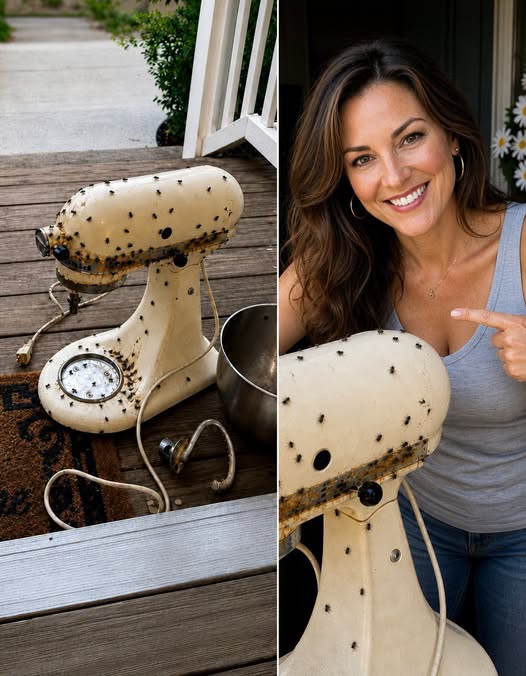
My Neighbor Kept Borrowing My Things—Until She Damaged My Late Mother’s Mixer
For months, I had been telling myself that being a good neighbor meant being generous.
If someone needed a tool, and I had one, why not help?
If someone was preparing a meal and needed an extra kitchen appliance, what harm could there be in lending it for an afternoon?
That was how things began with my neighbor Denise.
At first, I didn’t think much of it.
Then I started noticing a pattern.
Things I lent out rarely came back when she said they would.
Sometimes they returned dirty.
Sometimes pieces were missing.
And sometimes, they came back with a casual explanation that made it sound as though I was unreasonable for expecting them to be returned in the same condition.
I kept overlooking it.
Until she borrowed something that wasn’t merely an appliance.
It was a piece of my mother.
And when Denise returned it damaged, I finally realized that my problem wasn’t the mixer.
My problem was that I had never established a boundary.
It Started With a Ladder
The first time Denise asked to borrow something, I didn’t think twice.
It was spring, and she was doing some work around her house.
She came over one afternoon and asked if she could borrow my ladder.
“Of course,” I said.
She promised she’d bring it back later that day.
It didn’t return that day.
It didn’t return the next morning either.
When I eventually saw Denise outside, I reminded her about it.
“Oh, right!” she said. “I completely forgot.”
She returned it that evening.
There was mud all over the bottom.
I wiped it down and didn’t say anything.
It seemed too minor to make an issue over.
A few weeks later, she asked about my pressure washer.
Again, I agreed.
This time, she kept it for several days.
When it came back, it was covered in dirt, and the hose had been left coiled awkwardly in a way that made me worry it might have been damaged.
I checked it.
It still worked.
So I let it go.
That became my habit.
Something would happen.
I’d notice it.
I’d feel annoyed.
Then I’d tell myself it wasn’t worth creating tension with a neighbor.
I didn’t realize that every time I ignored the problem, I was making it easier for the same thing to happen again.
The Borrowing Didn’t Stop
By summer, Denise had borrowed several things.
A crock pot.
A steamer.
A cooler.
A roasting pan I particularly liked.
None of these items were extraordinarily valuable.
That was part of why I struggled to justify saying no.
But the issue wasn’t their price.
It was the pattern.
When she returned my crock pot, there was dried food stuck around the inside.
The steamer came back without one of its small components.
My cooler had a crack in the handle.
The roasting pan had been returned with grease baked onto the surface.
Whenever I mentioned something, Denise had an answer.
“Oh, I didn’t notice.”
“I thought that piece was already missing.”
“I’ll clean it next time.”
“Sorry, I’ve just been so busy.”
There was always another explanation.
What there wasn’t, however, was any real change.
I began to dread seeing her walking toward my front door.
Whenever she appeared, I knew there was a good chance she wanted something.
Still, I continued saying yes.
Part of me wanted to avoid an awkward relationship.
Part of me thought being neighborly meant helping whenever possible.
And part of me simply didn’t know how to say no without feeling guilty.
Then came the mixer.
The One Thing I Didn’t Want to Lend
My mother had owned a cream-colored stand mixer since 1989.
It wasn’t new.
It wasn’t particularly fashionable.
It wasn’t even the most expensive appliance in my kitchen.
But to me, it was priceless.
My mother had used it for years.
She baked with it on Sundays.
She made cakes for birthdays.
She prepared dough when the family gathered for holidays.
When she became too weak to stand for long periods, the mixer was one of the kitchen tools she had to stop using regularly.
After she was gone, I kept it.
It became part of my routine.
Whenever I used it, I remembered her.
There were other things she had left behind, of course.
Photographs.
Clothing.
Books.
A few pieces of jewelry.
But the mixer was different.
It was something I could still use.
Something that still occupied a place in my everyday life.
That was why, when Denise came to my door one Tuesday morning and asked to borrow it, I immediately said no.
“Denise, I’d rather not lend that one out.”
She looked surprised.
“Why not?”
“It belonged to my mom.”
I expected her to understand.
Instead, she laughed lightly.
“I’ll be careful. I promise. I only need it for one cake.”
I shook my head.
“It’s sentimental.”
She stood there for a moment.
Then she smiled.
“I’ll treat it like it’s made of glass.”
I should have trusted my first instinct.
I should have simply repeated myself.
“No, Denise.”
But she kept standing there.
And I made the mistake of confusing discomfort with kindness.
“Fine,” I said.
She thanked me and carried the mixer away.
I watched her disappear down the sidewalk.
Almost immediately, I regretted it.
I Knew I Had Made a Mistake
My daughter was sitting on the porch steps when Denise left.
She had heard the conversation.
“Why did you give it to her?” she asked.
I sighed.
“I don’t know.”
“You didn’t want to.”
“No.”
“Then why did you say yes?”
I didn’t have a good answer.
Maybe because I didn’t want to seem difficult.
Maybe because I hoped this time would be different.
Maybe because I had spent so much time trying to keep the peace that I had forgotten peace wasn’t supposed to require me to ignore my own boundaries.
My daughter looked at me.
“You should have said no.”
She was right.
But by then, the mixer was already gone.
I told myself it would probably be fine.
After all, Denise had promised to be careful.
Saturday Morning
Four days later, I opened my front door and found the mixer sitting beside the doormat.
Denise hadn’t knocked.
She hadn’t waited.
She hadn’t even sent me a message.
She had simply left it outside.
I stared at it.
For a second, I was more surprised than angry.
Then I noticed the dried cream.
It had hardened in a narrow seam between the upper housing and the body.
I crouched down.
There was residue in places that were difficult to reach.
It clearly hadn’t been cleaned properly.
I lifted the mixer.
It felt the same in my hands.
Heavy.
Familiar.
Except now there was something wrong with it.
I carried it inside.
My daughter followed me.
“Is it okay?”
“I don’t know.”
I plugged it in.
For one brief second, nothing seemed unusual.
Then the motor started.
A rough grinding sound came from inside.
I immediately switched it off.
Neither of us spoke.
My daughter looked at me.
“Mom…”
“I know.”
I unplugged it.
I didn’t want to make the situation worse.
I didn’t know exactly what had happened inside, but it was obvious that something wasn’t right.
And the worst part wasn’t the possibility that the mixer might be damaged.
It was knowing that Denise had apparently realized there was a problem and still returned it without saying anything.
I Went Next Door
I walked across the lawn.
I wasn’t shouting.
I wasn’t planning revenge.
I wasn’t even sure what I wanted to say.
I knocked.
Denise opened the door holding a cup of coffee.
“Oh, yeah,” she said when she saw me.
She didn’t look particularly concerned.
“About the mixer…”
I waited.
She took a sip.
“You should probably just replace it.”
I stared at her.
“What happened?”
“It stopped working while I was making the cream.”
She shrugged.
“I had people waiting for cake, so I had to finish another way.”
I looked at her.
“You knew it stopped working?”
“Of course.”
“And you didn’t tell me?”
She looked confused by the question.
“I left it at your door.”
“That doesn’t answer my question.”
She sighed.
“I figured you’d see that it wasn’t working.”
For a moment, I couldn’t believe what I was hearing.
Then she added something that made the situation even more frustrating.
“Honestly, it’s ancient. You should probably buy a new one anyway.”
I looked back toward my house.
That mixer wasn’t simply an old appliance.
It was one of the few physical objects I had left that connected me to my mother.
Denise couldn’t know what it meant to me in the same way I did.
But she knew it was sentimental.
I had told her.
And she had still treated it like something disposable.
I Finally Said What I Should Have Said Months Earlier
I took a breath.
“Denise, this isn’t about buying a new mixer.”
She looked at me.
“It’s about respecting someone else’s property.”
She didn’t respond.
“I’ve lent you a lot of things over the past several months. They come back late, dirty, damaged, or missing pieces. I’ve ignored it because I didn’t want an argument.”
I paused.
“But I’m not going to ignore it anymore.”
Her expression changed.
“I said I’d be careful.”
“You said that before.”
“I didn’t break it intentionally.”
“I never said you did.”
That stopped her.
I continued.
“Accidents happen. If something breaks while you’re using it, I can understand that. But you knew it had stopped working. You should have told me.”
She looked down at her coffee.
For the first time since I’d known her, she seemed to realize that I wasn’t going to quietly accept another excuse.
The Boundary
I told Denise that from that day forward, I wasn’t going to lend her my personal belongings anymore.
She seemed genuinely surprised.
“You mean nothing?”
“I mean nothing.”
“Not even the pressure washer?”
“No.”
“The cooler?”
“No.”
She frowned.
“That’s a little extreme.”
I shook my head.
“It’s actually very simple. My things are mine. If I’m uncomfortable lending them out, I have the right to say no.”
She didn’t like that answer.
But I wasn’t responsible for making every boundary comfortable for someone else.
I told her I would have the mixer inspected.
If it could be repaired, I would repair it.
If it couldn’t, I would decide what to do after getting an assessment.
I wasn’t demanding money from her on the spot.
I wasn’t threatening her.
I wasn’t trying to embarrass her.
I simply wanted her to understand that my generosity wasn’t an unlimited resource.
Then I walked home.
The Real Lesson Was for Me
That evening, I sat in my kitchen looking at the mixer.
I had been thinking about Denise all day.
But eventually I realized something uncomfortable.
The situation wasn’t entirely about her.
I had allowed it to continue.
Every time something came back dirty, I cleaned it.
Every time something was late, I waited.
Every time a piece went missing, I accepted the explanation.
Every time I felt uncomfortable saying no, I said yes.
I had convinced myself that being kind meant never disappointing another person.
But that’s not kindness.
That’s people-pleasing.
And the difference matters.
Kindness should be freely given.
It shouldn’t be extracted through guilt.
My Daughter Had Been Watching
Later that night, my daughter came into the kitchen.
“Did you talk to Denise?”
“Yes.”
“What did you say?”
“I told her I won’t lend her things anymore.”
She smiled.
“Good.”
I laughed.
“You think I did the right thing?”
“I think you finally said what you wanted to say.”
That stayed with me.
Children notice more than adults realize.
They watch how parents handle difficult conversations.
They learn whether boundaries are something to be ashamed of or something to communicate respectfully.
I didn’t want my daughter to grow up believing she had to sacrifice her comfort, belongings, or dignity to keep everyone else happy.
So perhaps the lesson wasn’t only for Denise.
Maybe it was for me.
What Happened With the Mixer
The next week, I took the mixer to a repair shop.
The technician examined it carefully.
The problem wasn’t as catastrophic as I had feared.
A component inside the mechanism had been damaged, and there was also a buildup of dried material in places that needed to be cleaned.
The technician couldn’t tell me exactly what had caused the failure.
He did, however, tell me that the machine could likely be restored.
I was relieved.
Not because I had saved an expensive appliance.
Because I had saved something connected to my mother.
The repair took some time.
When I finally brought it home, I cleaned the exterior carefully.
I placed it back where it belonged.
For the first time in days, I felt peaceful.
Denise Eventually Came Over
A couple of weeks passed.
Then one afternoon, Denise knocked on my door.
I opened it.
She wasn’t carrying a cup of coffee this time.
She looked uncomfortable.
“I wanted to apologize.”
I waited.
She continued.
“I shouldn’t have left the mixer outside.”
“No,” I said.
“And I should have told you it stopped working.”
“Yes.”
She nodded.
“I also realize I’ve borrowed a lot of things from you.”
I didn’t say anything.
She looked toward the kitchen.
“I didn’t think about how I was treating your stuff.”
That was probably the most honest thing she had said to me since we’d met.
I appreciated the apology.
But an apology doesn’t automatically restore trust.
So I told her that I appreciated her coming over.
I also told her that I still wasn’t comfortable lending her my belongings.
She accepted that.
There was no argument.
No dramatic confrontation.
No need for one.
The boundary was clear.
Things Changed After That
Our relationship with Denise became different.
We weren’t close friends anymore.
But we weren’t enemies either.
We remained neighbors.
We exchanged greetings.
We occasionally talked over the fence.
And when she needed something, she eventually stopped asking me.
At first, I felt guilty about that.
Then I realized I shouldn’t.
There was nothing cruel about refusing to lend someone your property.
In fact, the boundary probably made our relationship healthier.
There was less resentment.
Less awkwardness.
Less keeping track of who had what.
Less wondering whether something would come back.
Sometimes distance isn’t about rejecting someone.
Sometimes it’s simply about creating a healthier relationship.
I Also Learned Something About Possessions
After my mother’s mixer came home, I started looking at my belongings differently.
We often underestimate how much emotional meaning ordinary objects can carry.
A bowl can remind someone of a grandmother.
A jacket can remind someone of a parent.
A handwritten recipe can be more valuable than an expensive gift.
A kitchen appliance can carry memories of family gatherings, birthdays, holidays, and ordinary Sundays.
To another person, the object may look replaceable.
To you, it may represent a piece of someone who is no longer there.
That’s why respect matters.
We don’t always know the history behind someone else’s possessions.
But when someone tells us something is important to them, we should take that seriously.
The Lesson Wasn’t Revenge
When I first walked back from Denise’s house that morning, I had been tempted to think about teaching her a lesson.
I imagined making her understand how frustrating her behavior had been.
But eventually I realized that I didn’t need revenge.
I didn’t need to embarrass her.
I didn’t need to damage something of hers.
I didn’t need to create a neighborhood feud.
The most effective lesson was simply a boundary.
“No.”
Two letters.
One complete sentence.
No elaborate explanation required.
I had spent months trying to avoid saying it.
Once I finally did, the situation became surprisingly simple.
Sometimes Being a Good Neighbor Means Saying No
We often hear that good neighbors help one another.
That’s true.
Communities work better when people are willing to share, cooperate, and lend a hand.
But generosity has limits.
Being a good neighbor doesn’t mean allowing someone to repeatedly disregard your belongings.
It doesn’t mean accepting disrespect because you’re afraid of confrontation.
It doesn’t mean lending something valuable simply because someone asks.
And it certainly doesn’t mean sacrificing something deeply meaningful to you in order to avoid an uncomfortable conversation.
You can be generous and still have boundaries.
You can be kind and still say no.
You can forgive someone and still decide not to trust them with your belongings again.
Those ideas can exist together.
The Mixer Still Sits in My Kitchen
Today, my mother’s mixer still sits on the counter.
It isn’t perfect.
There are scratches on the surface.
The color has faded slightly over the years.
It shows its age.
But when I turn it on and hear the familiar sound of the motor, I think about my mother.
I think about Sunday mornings.
I think about the smell of something baking in the kitchen.
I think about the way she used to prepare food for people she loved.
And now, whenever my daughter helps me bake, she sometimes asks about it.
I tell her about her grandmother.
I tell her how long the mixer has been in our family.
I tell her that some things become valuable not because of what they cost, but because of the memories attached to them.
She understands.
And perhaps that is the best thing that came from the entire experience.
Not the argument.
Not the damaged machine.
Not even the apology.
The real lesson was learning that generosity should never require you to abandon your own boundaries.
I had spent months believing that saying no would make me a bad neighbor.
Instead, saying no finally allowed me to become a more honest one.
I didn’t have to punish Denise.
I didn’t have to humiliate her.
I didn’t have to get even.
I simply had to protect what mattered to me.
And sometimes, that’s the most important lesson of all:
You can be a kind person without saying yes to everything.