There are some objects in a person’s home that are worth far more than their price tag.
They may look ordinary to everyone else.
They may sit quietly on a shelf or countertop for years without attracting much attention.
But to the person who owns them, they can hold an entire lifetime of memories.
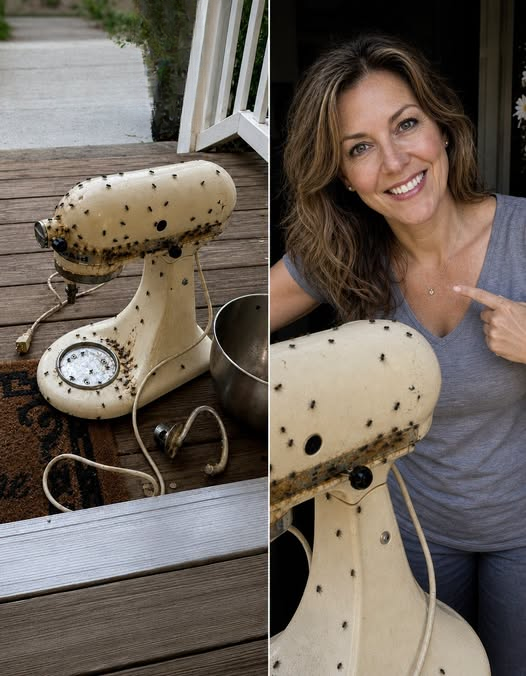
For me, that object was an old cream-colored stand mixer.
My mother bought it in 1989.
At the time, it was simply a useful kitchen appliance. She used it for birthday cakes, holiday cookies, homemade bread, and countless family desserts.
As the years passed, however, the mixer became part of our family’s story.
I remembered hearing its motor running on Sunday mornings.
I remembered sitting at the kitchen table while my mother prepared ingredients.
I remembered the smell of cinnamon and vanilla filling the house.
I remembered watching her scrape batter from the bowl and laughing when I asked if I could have a taste.
After my mother passed away, I kept the mixer.
It wasn’t because I couldn’t afford another one.
It was because I couldn’t replace that particular one.
It was hers.
And for years, I had been careful about who was allowed to use it.
Then my neighbor asked to borrow it.
I should have trusted my first answer.
My Neighbor Had Been Borrowing Things for Months
My neighbor Denise and I had always had a relatively friendly relationship.
We weren’t particularly close, but we had lived near each other long enough to become familiar.
We exchanged greetings.
We occasionally chatted when taking out the trash.
If one of us was away, the other might collect a package from the porch.
Nothing unusual.
Then, gradually, Denise began asking to borrow household items.
The first request came in the spring.
She needed a ladder.
I had one in my garage, so I agreed.
“Could I borrow it for the afternoon?”
“Sure.”
She returned it the following evening.
It was dirty.
Not terribly dirty, but enough that I had to wipe it down before putting it away.
I didn’t think much of it.
A ladder gets dirty.
A few weeks later, she asked about my pressure washer.
Then she needed a cooler.
Then a slow cooker.
Then a steamer.
Then a roasting pan.
I didn’t mind helping at first.
People borrow things.
Neighbors help neighbors.
It seemed harmless.
But a pattern gradually developed.
The items rarely came back exactly when she said they would.
Sometimes they were dirty.
Once, a lid was missing.
Another time, I had to remind her that she still had something of mine.
I always told myself it wasn’t worth making an issue of it.
After all, these were household items.
Nothing was particularly valuable.
Nothing had sentimental meaning.
Until the day Denise asked about my mother’s mixer.
The One Thing I Didn’t Want to Lend
It happened on a Tuesday afternoon.
I was preparing dinner when someone knocked on my door.
It was Denise.
She smiled and explained that she was planning to make a cake for a gathering.
“I was wondering if I could borrow your mixer.”
I knew immediately which mixer she meant.
My mother’s mixer.
I looked toward the kitchen.
It was sitting exactly where I had left it.
I hesitated.
Then I said:
“Honestly, I’d rather not lend that one.”
Denise looked surprised.
“Why?”
“It belonged to my mother.”
I thought that explanation was enough.
It wasn’t a financial issue.
It wasn’t because I thought Denise was incapable of using a kitchen appliance.
It was simply sentimental.
I didn’t want to risk something happening to it.
Denise laughed lightly.
“I’ll be extremely careful.”
“It’s just for one cake.”
I shook my head.
“I’m really attached to it.”
She continued standing there.
My daughter happened to be nearby and later told me that she could see the hesitation on my face.
Eventually, I gave in.
“Fine.”
The moment I said it, I felt a small sense of regret.
But Denise thanked me and promised she would take good care of it.
I watched her carry the mixer away.
I told myself I was worrying over nothing.
I Tried Not to Think About It
For the next couple of days, I didn’t ask about the mixer.
I assumed Denise was using it for the cake and would return it afterward.
Saturday morning arrived.
I opened my front door.
And there it was.
The mixer.
Sitting on my porch.
Not inside a box.
Not covered.
Not accompanied by a note.
It had simply been left beside the doormat.
For a moment, I just stared at it.
Then I picked it up and carried it inside.
That’s when I noticed the condition it was in.
There was dried cream or frosting around part of the machine.
The bowl hadn’t been properly cleaned.
There were traces of mixture around areas that normally stayed clean.
I sighed.
I wasn’t furious.
I was disappointed.
More than anything, I wondered why Denise hadn’t simply knocked on the door.
She could have handed it back to me.
She could have explained what happened.
Instead, she had left it outside and walked away.
Something Sounded Different
I wiped the outside of the mixer and inspected it carefully.
It looked mostly fine.
Then I plugged it in.
The motor started.
But the sound wasn’t right.
It made a rough, unfamiliar noise.
I immediately switched it off.
I tried again.
The same thing happened.
I unplugged it.
My heart sank.
This was the moment when I stopped thinking about the inconvenience of cleaning the mixer.
Something might actually have gone wrong with it.
I stood there for a few seconds with my hand resting on the power switch.
My mother had owned that mixer for decades.
It had survived countless batches of dough and batter.
It had been used more times than I could possibly count.
And now, after I had finally lent it to someone else, it wasn’t working properly.
I Went Next Door
I crossed the lawn and knocked on Denise’s door.
She opened it holding a cup of coffee.
“Oh, hi.”
I tried to keep my voice calm.
“You left the mixer on my porch.”
“Yeah.”
“Is there something wrong with it?”
She paused.
“It stopped working while I was using it.”
I stared at her.
“What happened?”
“I was making the cake and it started making a strange sound.”
“And you didn’t call me?”
She shrugged.
“I figured you would see it.”
I looked at her.
That explanation didn’t make much sense to me.
“You could have told me.”
“I’m sorry.”
She seemed more embarrassed than defensive.
Then she said something that surprised me.
“Honestly, I thought you might just replace it. It’s pretty old.”
That sentence bothered me.
Not because she had suggested replacing an appliance.
But because she didn’t understand what the mixer represented to me.
I explained again.
“It’s not just a mixer.”
“I know.”
“No, I don’t think you do.”
I told her about my mother.
I told her when she had bought it.
I explained that I had kept it because it reminded me of her.
Denise became quiet.
“I didn’t realize.”
“That’s why I didn’t want to lend it.”
She nodded.
“I’m sorry.”
This time, the apology sounded sincere.
I Decided to Find Out What Had Happened
Rather than arguing with Denise, I decided to take the mixer to a repair technician.
I wanted an objective opinion.
Maybe it was broken because of something that happened while Denise was using it.
Maybe it was simply an old machine finally showing its age.
After all, the mixer was more than three decades old.
There were plenty of possible explanations.
I didn’t want to accuse someone of doing something intentionally when I didn’t have proof.
So I put the mixer in my car and drove to a local repair shop.
The technician examined it carefully.
He listened to the motor.
He checked the moving parts.
He looked for signs of wear.
After a while, he gave me his assessment.
The mixer needed servicing.
Some parts were worn.
There was also residue in an area where it shouldn’t have been.
But he couldn’t tell me with certainty exactly when or how the problem had developed.
That answer was actually helpful.
It reminded me not to turn an unfortunate situation into an accusation.
I knew the machine had worked before.
I knew it sounded different afterward.
But I couldn’t honestly say that Denise had intentionally caused the damage.
And I didn’t need to.
The Repair Was Worth It
The technician told me the mixer could be repaired.
It wouldn’t be as simple as cleaning it.
Some components needed attention.
But it was still worth fixing.
I agreed.
While I waited, I started thinking about why I had been so upset.
It wasn’t really about the money.
It wasn’t even entirely about the machine.
It was about trust.
I had clearly told Denise that I didn’t want to lend it.
She had persuaded me.
I had ignored my own instincts.
Then something happened to the mixer.
That was what bothered me most.
I had allowed myself to be talked into something I wasn’t comfortable with.
I Realized I Had a Problem With Saying No
My daughter had noticed this long before I did.
That evening, she asked me:
“Why did you lend it to her if you didn’t want to?”
I didn’t have a good answer.
“She kept asking.”
My daughter smiled.
“Then you should have kept saying no.”
She was right.
It sounds simple.
But sometimes saying no is harder than it should be.
We worry about being rude.
We worry that people will think we’re selfish.
We worry about damaging relationships.
So we agree to things we don’t actually want to do.
I had done exactly that.
I Had Been Quiet About the Other Borrowed Items
Once I started thinking about it, I realized that I had allowed a pattern to develop.
The ladder came back dirty.
The pressure washer was returned late.
The cooler had been left outside for days.
The slow cooker came back without its lid.
The roasting pan needed extensive cleaning.
None of those things alone were a major problem.
But together, they were telling me something.
I had been allowing someone else’s convenience to become my responsibility.
And I had never clearly communicated that I was unhappy about it.
Instead, I kept saying:
“It’s fine.”
“It’s okay.”
“Don’t worry about it.”
Eventually, people believe you.
If you say everything is fine, they assume everything really is fine.
I Had a Conversation With Denise
After the repair shop returned my mixer, I went to speak with Denise again.
This time, I wasn’t angry.
I wasn’t looking for revenge.
I simply wanted to establish a clear boundary.
“I want to talk about borrowing things.”
She nodded.
“I know.”
“I’ve realized that I’m not comfortable lending out my personal belongings anymore.”
She looked embarrassed.
“Because of the mixer?”
“Partly.”
I explained that I had been uncomfortable lending it from the beginning.
“I should have trusted that feeling.”
She apologized again.
Then she admitted something I hadn’t expected.
She said she had become too comfortable asking me for things.
Because I usually said yes, she had stopped thinking about whether she was inconveniencing me.
That conversation actually helped.
I wasn’t interested in humiliating her.
I didn’t want a neighborhood argument.
I just wanted the borrowing to stop.
And it did.
The Mixer Came Back Better Than Expected
A few days later, I brought the mixer home.
The repair had worked.
I placed it on the counter.
For a moment, I didn’t turn it on.
I simply looked at it.
Then I plugged it in.
The motor started.
The familiar sound returned.
Smooth.
Steady.
Almost comforting.
I smiled.
It was still scratched.
The finish was still slightly faded.
It still looked like an appliance that had been used for decades.
But to me, it looked perfect.
I Made a New Rule
From that point forward, I created a simple personal rule.
If something has significant sentimental value, I don’t lend it.
No matter how small the request.
No matter how short the time.
No matter how trustworthy the person seems.
I can still help people.
I can still lend ordinary items.
I can still be a good neighbor.
But I don’t have to lend something that I would be devastated to lose.
That isn’t selfish.
It’s responsible.
Saying No Doesn’t Make You Unkind
The biggest lesson wasn’t about Denise.
It was about me.
I realized that I had spent too much time worrying about whether other people were comfortable with my boundaries.
I should have been asking whether I was comfortable with them.
There is a difference.
Being generous is wonderful.
Helping someone who genuinely needs assistance can create strong relationships.
But generosity should be voluntary.
If you’re saying yes because you’re afraid of saying no, you’re not really making a free choice.
You’re avoiding discomfort.
And eventually, that discomfort often becomes resentment.
I Also Learned Not to Assume the Worst
There was another lesson.
When the mixer stopped working, my first emotional reaction was to assume that Denise had been careless.
I even briefly wondered whether she had ignored my request intentionally.
But I didn’t know that.
The repair technician couldn’t establish exactly what had caused the problem.
The mixer was decades old.
It was entirely possible that normal wear had finally caught up with it.
That realization made me step back.
It is easy to turn frustration into certainty.
We experience something unpleasant and immediately create a story around it.
But sometimes we don’t have enough information to know what happened.
A calmer approach is to separate facts from assumptions.
The facts were simple:
I had lent the mixer.
It was returned dirty.
It was left outside.
It wasn’t working correctly.
Those things were enough to justify a boundary.
I didn’t need to invent a motive.
Denise and I Eventually Moved Past It
For a while, things between us were awkward.
We saw each other outside but didn’t talk much.
Eventually, the tension faded.
One afternoon, Denise stopped me while I was bringing groceries inside.
“I wanted to say thank you for not making a huge issue out of the mixer.”
I looked at her.
“I was upset.”
“I know.”
“But I didn’t want to fight.”
She nodded.
Then she said:
“I understand why you were upset now.”
That was enough for me.
We didn’t become close friends.
We didn’t suddenly start spending weekends together.
But we became better neighbors because we understood each other’s boundaries.
And sometimes that’s more valuable than pretending everything is perfect.
My Daughter Still Reminds Me About It
Every once in a while, my daughter jokes about the mixer.
Whenever someone asks to borrow something, she’ll look at me and say:
“Are you sure?”
Then we laugh.
But the joke contains a useful reminder.
I don’t have to say yes simply because someone asks.
I don’t have to explain myself endlessly.
I don’t have to prove that my reason is important enough.
“No, I’m not comfortable lending that out.”
That’s a complete sentence.
The Mixer Is Still in My Kitchen
Today, my mother’s mixer still sits on my kitchen counter.
I use it regularly.
Sometimes I make one of my mother’s old recipes.
When I do, I remember her.
I remember the kitchen where I grew up.
I remember the sound of her laughing.
I remember how she used to taste the batter and pretend she hadn’t.
And I remember that the things we inherit from people we love aren’t always valuable because of what they cost.
Sometimes an inexpensive object can become priceless because of the memories attached to it.
That’s why I won’t lend the mixer again.
Not because I’m angry at Denise.
Not because I want to punish anyone.
And certainly not because I believe every borrowed item will be damaged.
I simply know now that some things are worth protecting.
The Lesson I Wish I’d Learned Earlier
If someone asks you for something and your first instinct is to say no, don’t automatically override yourself.
Pause.
Ask why you’re uncomfortable.
If the object has sentimental value, that’s enough.
If you simply don’t want to lend it, that’s enough too.
You don’t need a dramatic explanation.
You don’t need a conflict.
You don’t need to wait until something goes wrong before establishing a boundary.
I could have saved myself a lot of worry by trusting my first answer.
When Denise first asked for my mother’s mixer, I said:
“I’d rather not.”
That was the answer.
I should have left it there.
Some Lessons Cost More Than Others
Fortunately, my mother’s mixer could be repaired.
The story could have ended very differently.
Some possessions cannot be replaced.
A handwritten recipe can disappear.
An old photograph can be destroyed.
A family letter can be lost.
An heirloom can be damaged beyond repair.
And once something truly irreplaceable is gone, an apology cannot always bring it back.
That’s why I’ve become more comfortable protecting the things that matter to me.
I still believe in kindness.
I still believe in helping people.
I still believe neighbors should support each other.
But kindness doesn’t mean ignoring your own comfort.
Helping others doesn’t require giving away something precious.
And setting boundaries doesn’t make someone a bad neighbor.
In the End, Nobody Needed a “Lesson”
When I originally found the mixer sitting on my porch, I was angry enough to think about teaching Denise a lesson.
I imagined confronting her.
I imagined telling everyone what had happened.
I imagined making sure she understood how badly she had behaved.
But after I had time to think, I realized something.
She didn’t need a dramatic lesson.
I needed a better boundary.
That was the real solution.
I couldn’t control how carefully another person treated my belongings.
I could control whether I lent them out.
I couldn’t control whether someone understood the sentimental value of something.
I could explain it and decide whether I trusted them with it.
And I couldn’t control every unexpected problem that might happen.
But I could choose what risks I was willing to take.
One Small Appliance Changed the Way I Think
The mixer is still working.
My relationship with Denise is still peaceful.
And I no longer feel guilty about saying no.
That might be the most important part of the entire experience.
The mixer taught me that boundaries aren’t walls.
They’re instructions.
They tell people what you’re comfortable with.
They prevent misunderstandings.
And they can actually make relationships healthier because everyone knows where they stand.
I wish I had understood that years ago.
Instead, I learned it from an old cream-colored mixer that had survived more than three decades of birthdays, holidays, family dinners, and everyday life.
It survived my mother.
It survived decades of use.
It even survived my mistake of lending it out.
And now it remains exactly where it belongs.
In my kitchen.
With me.
And whenever I turn it on and hear that familiar sound, I’m reminded of my mother—and of a simple lesson I won’t forget:
You can be kind without saying yes to everything.
Sometimes the kindest thing you can do for yourself, your belongings, and even your relationships is to set a clear boundary before a small favor becomes a much bigger problem.